
Dold 0053804 IL5881.12 DC24-500V UH DC24V insulation monitor 20-500 kΩ
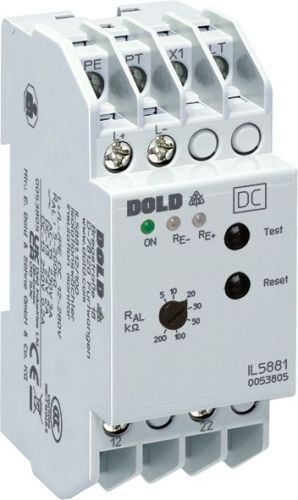
Dold 0053804 IL5881.12 DC24-500V UH DC24V insulation monitor 20-500 kΩ
| Lieske Part No. | 1001710 |
|---|---|
| Mfg Part No | 0053804 |
| EAN-Code | 4030641538040 |
| Manufacturer | Dold |
| Here only | 255,83 EUR
304,44 EUR incl. VAT
|
Further information for Dold 0053804 IL5881.12 DC24-500V UH DC24V insulation monitor 20-500 kΩ
| Technical data | |
| Enclosure design | Distribution board |
| IMD type | DC |
| Nominal voltage IT system | DC 12 - 280 V, DC 24 - 500 V |
| Response value | 5 - 500 kΩ |
| Response value type | Adjustable |
| Width | 35 mm |
| Type | IL 5881 |
| Earth fault indicator | |
| Variant | |
| Alarm value | 20 - 500 kOhm |
| Auxiliary voltage | DC 24 V |
| Contact equipping | 2 changeover contacts |
| Nominal voltage | DC 24 - 500 V |
| Time delay | without |
| Approvals and Markings | UKCA, CCC |
Applications
The insulation monitor is designed for pure DC networks, particularly for IT systems with nominal voltage in the range of DC 24 to 500 V. It is suitable for installations requiring high availability and safety, such as industrial automation, vehicle technology, or railway systems. Selective earth fault detection allows for rapid fault localization, as the LED indicators for L+ and L- separately signal which conductor is affected.
Functions and equipment in detail
The device features two changeover contacts as output contacts, which drop out in the event of a fault (rest current principle). Indication is provided via LEDs: a green LED indicates operational readiness, while red LEDs indicate earth faults on L+ or L-. The pickup value is adjustable via a potentiometer on the front of the device and ranges from 5 to 500 kΩ. The alarm threshold setting can be chosen between 20 and 500 kΩ depending on the application. Integrated reset and test buttons allow manual reset and functional testing of the device. Additionally, external buttons can be connected.
Technology explained simply
The insulation monitor operates on the principle of continuous measurement of insulation resistance. When the resistance falls below the set alarm threshold, the fault is indicated via the LEDs and the output relay switches off. The function can be programmable to memory or hysteresis behavior. With hysteresis behavior, the device automatically resets when the insulation resistance rises above the alarm threshold again. With memory behavior, the fault condition remains stored until manually reset via the reset button. The indication of the type of earth fault (L+ or L-) enables targeted fault correction.
Compatibility and accessories
The device is designed for IT systems with nominal voltage DC 24 to 500 V. The auxiliary voltage is drawn from the monitored network. It is available in the IL 5881 form factor, which has a depth of 61 mm and terminal connections located at the bottom. Mounting is done via DIN rail or screws. The UKCA and CCC certifications confirm compliance with applicable safety standards. The device function meets the requirements of standard IEC/EN 61557-8.
Mounting and installation
Mounting is done in standard installation distributors with 35 mm width. The terminal connections are located at the bottom, facilitating integration into existing control panels. The auxiliary voltage is drawn directly from the monitored IT system, so no additional power supply is required. Terminal markings are clearly defined: A1 and A2 for connection lines L+ and L-, PE for the protective conductor, PT and LT for external test and reset buttons.
Advantages in operation
The insulation monitor provides preventive protection against fires and equipment damage through early detection of insulation faults. The simple adjustment of the pickup value and selective fault indication enable quick diagnosis and maintenance. The integrated test and reset buttons, as well as the option for external control, increase operational flexibility. The construction with rest current principle ensures that the output relay drops out in the event of a fault, enhancing safety. The UKCA and CCC certifications guarantee compliance with relevant safety standards.

This is an offer of:
79279 Vörstetten
https://industry-electronics.com
Tel. 07666/88499-0
Fax. 07666/88499-111
Diesen Artikel finden Sie unter:
industry-electronics.com/artikel/1001710

Lieske Elektronik e.K.
Reutener Str. 1079279 Vörstetten
https://industry-electronics.com
Tel. 07666/88499-0
Fax. 07666/88499-111
Diesen Artikel finden Sie unter:
industry-electronics.com/artikel/1001710