
Dold 0052902 time relay BC7933N.81 AC/DC24V 0.5-10M delayed-off
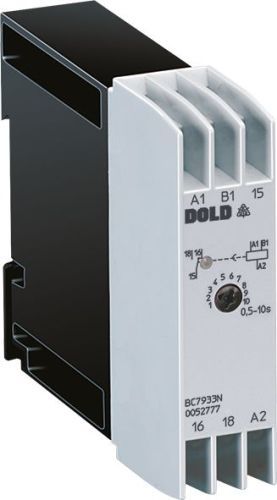
Dold 0052902 time relay BC7933N.81 AC/DC24V 0.5-10M delayed-off
| Lieske Part No. | 1153910 |
|---|---|
| Mfg Part No | 0052902 |
| EAN-Code | 4030641529024 |
| Manufacturer | Dold |
| Here only | 75,54 EUR
89,89 EUR incl. VAT
|
Further information for Dold 0052902 time relay BC7933N.81 AC/DC24V 0.5-10M delayed-off
| Technical data | |
| Enclosure design | Switch cabinet |
| Output contacts | 1 C/O contact |
| Time function(s) | Off-delay, with control signal |
| Width | 22,5 mm |
| Type | BC 7933N |
| Variant | |
| Contact equipping | 1 changeover contact |
| Nominal voltage | AC/DC 24 V |
| Time range | 0,5 - 10 min |
| Variant | Release delay, with control signal |
Applications
This time relay is used in industrial plants where time-controlled sequences are required, for example, to delay the switching off of motors, pumps, or lighting systems. It is particularly suitable for applications where a defined delay is needed between the deactivation of a control signal and the switching off of the load. Its use in enclosures enables safe and structured integration into existing control systems.
Functions and Equipment in Detail
The device features a control input B1, operated at the rated voltage. It is not necessary to use a potential-free control contact, which simplifies connection options. An LED indicator shows the state of the output relay – the yellow LED lights up when the contact is activated (15-18 closed). The contact configuration consists of one changeover contact, rated for an operating voltage of AC 250 V. The contact material is AgNi, ensuring high switching capacity and long service life.
Technology Explained Simply
The drop-out delay means that the output contact does not return to its rest position immediately after the control signal is switched off, but only after a set delay time (here 0.5 to 10 minutes). The time delay is continuously adjustable and can be precisely adapted to the application. The reset time after the delay period is less than 50 ms, enabling rapid repetition of the function. The minimum switching-on time is 15 ms for AC and 5 ms for DC, to ensure proper energizing of the relay.
Compatibility and Accessories
The device is designed for an operating voltage of AC/DC 24 V, with the AC voltage range extending from 110 to 240 V. The terminal clamps allow connection of stranded wires with cross-sections of 1.5 mm² or 2.5 mm², with the use of ferrules and plastic collars according to DIN 46228-1/-2/-3/-4 recommended. The switching capacity according to AC 15 is 3 A at 230 V for the normally closed contact and 1 A for the normally open contact. The electrical service life is 1.5 x 10⁵ switching operations at 1 A and 230 V.
Mounting and Installation
The time relay is mounted in enclosures and requires a continuously applied operating voltage at terminals A1-A2. The terminal designation is standardized: A1/A2 for operating voltage, B1 for control input, 15/16/18 for the changeover contact. When auxiliary voltages are below AC 180 V, the control input must be energized only 150 ms after applying the auxiliary voltage to ensure correct energizing of the relay. Mounting is done in standard enclosure plug-in systems with a width of 22.5 mm.
Operational Advantages
The device features high repeatability of ≤ 0.5 % + 10 ms, which is important for precise control tasks. The mechanical service life is 10⁸ switching operations, ensuring high reliability over a long period. EMC tests according to IEC/EN 61000-4-2 to -4-6 show high immunity to electromagnetic interference. The operating temperature range is from -20 °C to +60 °C, enabling broad application in various environments. Relative humidity up to 95 % at 40 °C is also permitted.
Operating Altitude and Environmental Conditions
The device is designed for an operating altitude of up to 2000 m above sea level. The storage temperature can reach up to +70 °C, while operation is guaranteed between -20 °C and +60 °C. The insulation test voltage is 2.5 kV for 1 minute, and the overvoltage category is III. The creepage and clearance distances correspond to pollution degree 2 with a rated impulse withstand voltage of 4 kV.
Approvals and Standards
The device complies with standards EN 61812-1 for time relays and IEC/EN 60947-5-1 for switching devices. Radio frequency interference suppression is according to Class B limits as per EN 55011. EMC tests include electrostatic discharge, high-frequency radiation, fast transients, and surge voltages, with test voltages ranging from 1 kV to 8 kV. These tests ensure the reliability and immunity of the device in industrial environments.
Connection and Operation
The terminal clamps are clearly labeled: A1/A2 for operating voltage, B1 for control input, 15/16/18 for the changeover contact. The LED indicator shows the state of the output relay. The time delay is adjusted continuously via a rotary knob. The reset time after the delay period is short, enabling rapid repetition of the function. The operating voltage must be continuously applied to power the device.
Functions at a Glance
- Drop-out delay with control signal according to EN 61812-1
- Time range: 0.5 to 10 minutes
- 1 changeover contact, contact material AgNi
- Operating voltage: AC/DC 24 V, AC voltage range 110–240 V
- LED indicator for contact position
- Width: 22.5 mm
- Operating temperature: -20 °C to +60 °C
- EMC tests according to IEC/EN 61000-4-2 to -4-6
- Switching capacity: 3 A / 230 V (normally closed), 1 A / 230 V (normally open)
- Mechanical service life: 10⁸ switching operations
- Repeatability: ≤ 0.5 % + 10 ms
- Reset time: < 50 ms
- Operating altitude: ≤ 2000 m
- Insulation test voltage: 2.5 kV / 1 min
- Overvoltage category: III
- Pollution degree: 2
- Radio frequency interference suppression: Class B according to EN 55011
The device is designed for use in industrial control systems where precise and reliable time delay is required. The combination of robust design, high accuracy, and broad compatibility makes it a reliable component in industrial electrotechnics.

This is an offer of:
79279 Vörstetten
https://industry-electronics.com
Tel. 07666/88499-0
Fax. 07666/88499-111
Diesen Artikel finden Sie unter:
industry-electronics.com/artikel/1153910

Lieske Elektronik e.K.
Reutener Str. 1079279 Vörstetten
https://industry-electronics.com
Tel. 07666/88499-0
Fax. 07666/88499-111
Diesen Artikel finden Sie unter:
industry-electronics.com/artikel/1153910