
Dold 0052648 time relay delayed response AC/DC24V+AC230V
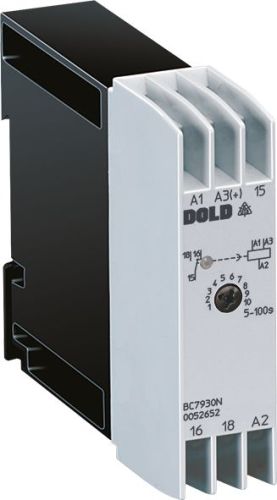
Dold 0052648 time relay delayed response AC/DC24V+AC230V
| Lieske Part No. | 1153860 |
|---|---|
| Mfg Part No | 0052648 |
| EAN-Code | 4030641526481 |
| Manufacturer | Dold |
| Here only | 61,62 EUR
73,33 EUR incl. VAT
|
Further information for Dold 0052648 time relay delayed response AC/DC24V+AC230V
| Technical data | |
| Enclosure design | Switch cabinet |
| Output contacts | 1 C/O contact |
| Time function(s) | On-delay |
| Width | 22,5 mm |
| Type | BC 7930N |
| Variant | |
| Contact equipping | 1 changeover contact |
| Nominal voltage | AC/DC 24 V + AC 230 V |
| Time range | 1,5 - 30 s |
Applications
The relay is used in industrial control systems where time-controlled activation of loads or switching operations is required. Typical applications include delaying motor start-up, ensuring correct start-up sequences in plants, or controlling lighting systems with time-based switching. The delayed-on function ensures that the output contact only switches after the set delay time has elapsed, which is important for coordinating process steps.
Functions and Equipment in Detail
The device features a changeover contact as the output contact, designed for controlling loads up to 3 A at AC 230 V (make contact) and 1 A (break contact). The contact configuration allows control of loads in both directions. An LED indicator signals the state of the output relay – it lights up when contact 15-18 is closed, i.e., when the output is activated. The time delay is continuously adjustable in a 1:20 ratio, enabling precise adaptation to the specific application. The repeatability is ≤ 0.5 % + 10 ms, ensuring high reproducibility of the delay time.
Technology Explained Simply
The relay operates according to standard EN 61812-1 and is designed as a delayed-on device. This means that the output contact only switches after the set time has elapsed, once the operating voltage is applied. The time delay is implemented via an internal timing circuit, controlled by a potentiometer-like adjustment mechanism. The operating voltage can be supplied through two different voltage terminals (A1/A2 and A3/A2), enabling a dual-voltage configuration. The operating voltage ranges are AC 0.8–1.1 U_N and DC 0.9–1.25 U_N, ensuring stable operation even under voltage fluctuations.
Compatibility and Accessories
The relay is designed for mounting on a DIN rail according to IEC/EN 60715, enabling quick and secure installation in enclosures. The terminal clamps are rated for cross-sections of 1 x 4 mm² (solid) or 1 x 2.5 mm² (stranded wire with sleeve) and 2 x 1.5 mm² (stranded wire with sleeve and plastic collar DIN 46228-1/-2/-3/-4) or 2 x 2.5 mm² (stranded wire with sleeve DIN 46228-1/-2/-3). The wire stripping length is 10 mm. The terminals are designed as plus-minus terminal screws M 3.5, with a tightening torque of 0.8 Nm.
Mounting and Installation
Mounting is done via quick fastening on a DIN rail. The terminals are designed for connection with stranded or solid conductors, with the specified cross-sections and stripping length to be observed. The connection terminals are clearly labeled (A1, A2, A3, 15, 16, 18), ensuring unambiguous assignment of the wires. The front color of the device is gray, enabling visual integration into standard control panels.
Advantages in Operation
The relay features a high mechanical life of 10^8 switching operations and an electrical life of 1.5 x 10^5 switching operations at 1 A/AC 230 V. The reset time is ≤ 100 ms, enabling rapid reset after de-energization. The operating temperature ranges from -20 °C to +60 °C, allowing use in various industrial environments. The enclosure protection rating is IP 40, and the terminals are IP 20, providing protection against contact and dust, but not against water spray. The EMC coverage includes immunity to electrostatic discharge (6 kV contact, 8 kV air), high-frequency radiation (20 V/m), and fast transients (4 kV), ensuring reliability in electromagnetically demanding environments.

This is an offer of:
79279 Vörstetten
https://industry-electronics.com
Tel. 07666/88499-0
Fax. 07666/88499-111
Diesen Artikel finden Sie unter:
industry-electronics.com/artikel/1153860

Lieske Elektronik e.K.
Reutener Str. 1079279 Vörstetten
https://industry-electronics.com
Tel. 07666/88499-0
Fax. 07666/88499-111
Diesen Artikel finden Sie unter:
industry-electronics.com/artikel/1153860