
Dold 0052482 direction monitor 230V
Industrial Material > Industrial relays and contactors > Switching units / measuring, control relay
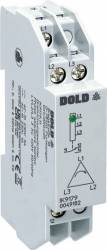
Dold 0052482 direction monitor 230V
| Lieske Part No. | 1313027 |
|---|---|
| Mfg Part No | 0052482 |
| EAN-Code | 4030641524821 |
| Manufacturer | Dold |
| Here only | 92,84 EUR
110,48 EUR incl. VAT
|
Further information for Dold 0052482 direction monitor 230V
| Technical data | |
| 1- / 3-phase | 3 |
| Enclosure design | Distribution board |
| Measuring range max. | 3 AC 400 V |
| Output contacts | 1 C/O contact |
| Standard measuring range | 3 AC 400 V |
| Width | 17,5 mm |
| Type | IK 9179 |
| Variant | |
| Contact equipping | 1 changeover contact |
| Nominal voltage | 3AC 230 V |
| Approvals and Markings | UKCA |
Applications
This phase sequence relay is designed for use in industrial and installation applications, particularly in three-phase networks with a nominal voltage of 3 AC 400 V. It monitors the phase sequence and ensures that the direction of the electric field (clockwise rotating field) is correct. This is essential to prevent damage to motors or other three-phase consumers that may occur due to incorrect rotation. The device is designed for continuous operation and is suitable for applications in manufacturing, power supply, and machine building.
Functions and Equipment in Detail
The device features an LED indicator that visually signals the operating status. The LED lights up when the output relay is activated, i.e., when the correct phase sequence (clockwise rotating field) is detected. The contact configuration includes a changeover contact (11-12-14), which can be used to control auxiliary circuits or warning signals. The switching capacity is 3 A at AC 230 V for the make contact and 1 A at AC 230 V for the break contact, in accordance with IEC/EN 60947-5-1. The electrical service life is typically 300,000 switching operations at 1 A and AC 230 V.
Technology Explained Simply
The phase sequence relay detects the phase sequence in a three-phase system by measuring the voltage at inputs L1, L2, and L3. The nominal frequency is 50/60 Hz, with a frequency range between 45 and 65 Hz. The voltage range coverage is 0.8 to 1.1 times the nominal voltage (3 AC 400 V). The device is designed for operating temperatures from -20 °C to +60 °C and can be used up to an altitude of 2000 m. The housing design is intended for installation distributors according to DIN 43880, with a width of 17.5 mm. The protection rating is IP 40 for the housing and IP 20 for the terminals, providing protection against touch and dust, but not against water.
Compatibility and Accessories
The phase sequence relay IK9179.11 is available in I-form, intended for installation and industrial distributors. Variants RK 9179 and SK 9179 with different depths and connection positions are also available, but are not part of this product. The connection terminals are designed for conductor cross-sections of 2 x 0.6 to 2.5 mm² (solid) or 2 x 0.28 to 1.5 mm² (flexible). The stripping length is 10 mm, and the mounting is done using non-loosening plus-minus terminal screws M3.5 with a tightening torque of 0.8 Nm.
Mounting and Installation
The device is mounted on a DIN rail in accordance with IEC/EN 60715. Installation takes place in enclosures or distributors, with the terminals located at the bottom. Terminal marking follows EN 50005.
Advantages in Operation
The Dold IK9179.11 phase sequence relay provides reliable and maintenance-free monitoring of phase sequence. The LED indicator allows for quick visual inspection of the operating status. The design without auxiliary voltage reduces installation complexity and enhances operational safety. Compliance with the IEC/EN 60255-1 standard ensures electrical safety and reliability of the device. The mechanical service life is at least 30 million switching operations, indicating high durability and low maintenance requirements. The UKCA approval confirms conformity with applicable European safety requirements.

This is an offer of:
79279 Vörstetten
https://industry-electronics.com
Tel. 07666/88499-0
Fax. 07666/88499-111
Diesen Artikel finden Sie unter:
industry-electronics.com/artikel/1313027

Lieske Elektronik e.K.
Reutener Str. 1079279 Vörstetten
https://industry-electronics.com
Tel. 07666/88499-0
Fax. 07666/88499-111
Diesen Artikel finden Sie unter:
industry-electronics.com/artikel/1313027