
Dold 0052159 under-voltage relay AC230V 50/60Hz
Industrial Material > Industrial relays and contactors > Switching units / measuring, control relay
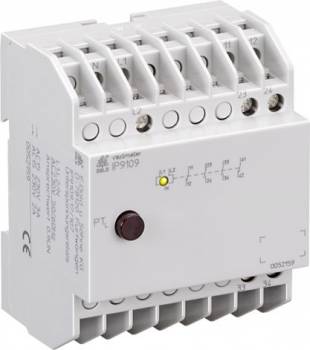
Dold 0052159 under-voltage relay AC230V 50/60Hz
| Lieske Part No. | 1312994 |
|---|---|
| Mfg Part No | 0052159 |
| EAN-Code | 4030641521592 |
| Manufacturer | Dold |
| Here only | 470,41 EUR
559,79 EUR incl. VAT
|
Further information for Dold 0052159 under-voltage relay AC230V 50/60Hz
| Technical data | |
| 1- / 3-phase | 1 |
| Auxiliary voltage | Without |
| Enclosure design | Distribution board |
| Nominal voltage max. | AC 230 V |
| Output contacts | 2 NC contacts, 2 NO contacts |
| Width | 70 mm |
| Type | IP 9109.17/107 |
| Operate delay | |
| Variant | |
| Contact equipping | 2 NO contacts, 2 NC contacts forcibly guided |
| Nominal voltage | AC 230 V |
| Response value | 0,9 Un |
| Time delay | without |
| Variant | For 1-phase mains. Fixed response value. With test button for simulation of undervoltage |
Applications
This relay is designed for monitoring single-phase AC networks, particularly in industrial, commercial and medical installations. It is used to initiate protective measures automatically in the event of undervoltage or power failure, for example, disconnecting loads or triggering alarms. The application is in installation distributors, where the width of 70 mm allows mounting on a standard DIN rail.
Functions and Equipment in Detail
The device features dual-channel voltage measurement, ensuring reliable network monitoring. The contact configuration includes 2 normally closed contacts and 2 normally open contacts, which are mechanically interlocked to ensure high switching reliability. The mechanically interlocked design means that the contacts are mechanically linked, so that one contact cannot switch without the other also switching – this prevents erroneous states. An integrated LED indicator signals the operating status: the yellow LED lights up when the network is fault-free. A test button allows simulation of an undervoltage condition to check the relay’s functionality.
Technology Explained Simply
The relay continuously monitors the supply voltage and reacts as soon as the pickup value of 0.9 Un is undershot. The hysteresis is approximately 2 %, meaning that the return to normal operation only occurs when the voltage exceeds 0.92 Un. The rated voltage is AC 230 V, the rated frequency 50/60 Hz. The device consumes approximately 10 VA and is designed for continuous operation. The operating temperature range is from -20 °C to +60 °C, and the storage temperature range is from -25 °C to +70 °C. The operating altitude is limited to below 2000 m. The switching capacity is 3 A / AC 230 V for normally closed contacts and 2 A / AC 230 V for normally open contacts according to AC 15 (IEC/EN 60947-5-1). The electrical life expectancy is 500,000 switching operations at 1 A and AC 230 V, and the mechanical life expectancy is 30 million switching operations.
Compatibility and Accessories
The relay is designed for single-phase networks and can be connected via terminals La, Lb and N. The terminals are designed for a cross-section of 2 x 2.5 mm² solid or 2 x 1.5 mm² stranded wire with ferrule (DIN 46228-1/-2/-3/-4). The minimum cross-section is 0.6 mm², and the stripping length is 10 mm. The conductor is secured using flat terminals with self-lifting connection washers. Quick mounting is achieved via a DIN rail (IEC/EN 60715). The control of the mechanically interlocked relay can be done via an external contact at Y1-Y2.
Mounting and Installation
Mounting is done on a standard DIN rail in the installation distributor. The connection terminals are clearly marked: La and N serve as auxiliary voltage and measurement input, Lb and N as the second measurement input. The output contacts are configured as 2 normally closed contacts (23-24, 33-34) and 2 normally open contacts (11-12, 41-42). Terminal marking follows EN 50005. The device is designed for operation at altitudes below 2000 m and meets requirements for creepage and clearance distances (rated impulse voltage 4 kV, pollution degree 2 according to IEC 60664-1). The protection rating is IP 40 for the housing and IP 20 for the terminals (IEC/EN 60529). The housing materials consist of thermoplastic with V0 behaviour according to UL Subject 94.
Advantages in Operation
The dual-channel voltage measurement increases the reliability of network monitoring. The mechanically interlocked contacts ensure high switching reliability and prevent erroneous states. The rest current principle ensures that the relay is not activated in the event of a fault, enabling safe disconnection. The integrated LED indicator and test button simplify maintenance and functional checks. Compliance with standards IEC/EN 60255-1 and DIN VDE 0100-710 ensures suitability for critical applications, particularly in medical facilities. The robust construction, with a mechanical life of 30 million switching operations and an electrical life of 500,000 switching operations at 1 A and AC 230 V, ensures long-term operational durability.
Protection Rating and EMC
The housing has a protection rating of IP 40 (IEC/EN 60529), providing dust and touch protection. The terminals have a protection rating of IP 20. The device meets electromagnetic compatibility (EMC) requirements according to IEC/EN 61000-4-2 to -4-6, including static discharge (8 kV), HF radiation (10 V/m), fast transients (4 kV), surge voltage (1 kV between supply lines, 2 kV between line and earth), and conducted HF (10 V). Radio frequency interference suppression complies with Class B limits according to EN 55011. Vibration resistance is 0.35 mm amplitude at a frequency of 10 to 55 Hz (IEC/EN 60068-2-6), and climatic resistance corresponds to 20/060/04 (IEC/EN 60068-1).

This is an offer of:
79279 Vörstetten
https://industry-electronics.com
Tel. 07666/88499-0
Fax. 07666/88499-111
Diesen Artikel finden Sie unter:
industry-electronics.com/artikel/1312994

Lieske Elektronik e.K.
Reutener Str. 1079279 Vörstetten
https://industry-electronics.com
Tel. 07666/88499-0
Fax. 07666/88499-111
Diesen Artikel finden Sie unter:
industry-electronics.com/artikel/1312994