
Dold 0051284 BA9019 3AC50/60Hz 200-480V 3kW soft start device
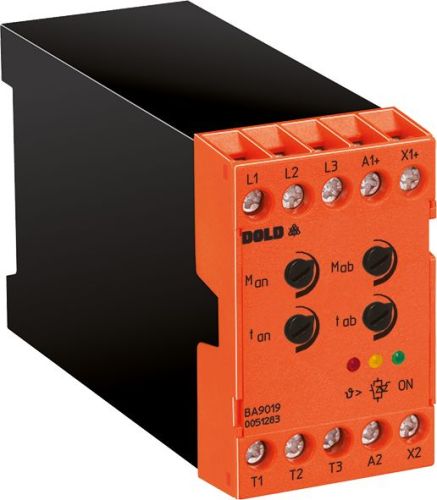
Dold 0051284 BA9019 3AC50/60Hz 200-480V 3kW soft start device
| Lieske Part No. | 1151875 |
|---|---|
| Mfg Part No | 0051284 |
| EAN-Code | 4030641512842 |
| Manufacturer | Dold |
| Here only | 380,66 EUR
452,99 EUR incl. VAT
|
Further information for Dold 0051284 BA9019 3AC50/60Hz 200-480V 3kW soft start device
| Technical data | |
| Extra functions | Temperature monitoring |
| For three-phase motors, 400 V up to | 5,5 kW |
| Load voltage up to | 3AC 460 V |
| Width | 45 mm |
| Type | BA 9019 |
| Auxiliary voltage required | |
| Variant | |
| Mains / motor voltage | 3AC 200 - 480 V |
| Nominal motor power | 3 kW |
Applications
This device is intended for drives in various industrial applications, including machines with gearbox, belt or chain drives, conveyor belts, fans, pumps, compressors, woodworking machines, centrifuges, packaging machines and door drives. The gentle acceleration and deceleration protect mechanical components and prevent damage caused by sudden torque demands. Additionally, it supports inrush current limitation for three-phase transformers, reducing network load.
Functions and Equipment in Detail
The BA9019 operates with a 2-phase motor control, where two motor phases are controlled via thyristors using phase-angle control. This allows currents and motor torque to increase gradually, ensuring a jerk-free start. After startup, the power semiconductors are bypassed via an internal relay to minimize power losses in the device. The soft stop function extends the natural coast-down time to avoid abrupt drive stops. The start voltage is 50 to 80 %, and the stop voltage is 30 to 80 % of the rated voltage.
Technology Explained Simply
Control is via a galvanically isolated DC control input (X1/X2), which starts the start sequence when voltage exceeds 13 V DC and initiates the stop sequence when voltage drops below 5 V DC. The auxiliary voltage (A1/A2) is DC 24 V ± 20 % and is required for operation. The integrated temperature monitoring protects the device from overheating. LED indicators show the operating status: green LED lights when auxiliary voltage is applied, yellow LED blinks during ramp operation and remains lit when power semiconductors are bypassed, red LED lights when temperature monitoring is activated. The power consumption is 3 W, and the residual ripple is up to 5 %.
Compatibility and Accessories
The device is compliant with IEC/EN 60947-4-2 and designed for use in industrial control systems. It is designed for an operating temperature of 0 to +55 °C, with storage up to +75 °C. The operating altitude is limited to ≤ 2000 m. The switching frequency is 20/h (at 3 kW) or 10/h (at 5.5 kW) at 3 times rated current and 5 seconds switching time. The minimum motor rated power is approximately 0.1 times the rated power. Two types of short-circuit protection are provided: Assignment 1 (gG 32 A) requires device replacement after a short circuit, while Assignment 2 (semiconductor fuse max. 610 A/2 s) allows continued operation after a short circuit.
Mounting and Installation
Mounting is in standard enclosures with a width of 45 mm. Connections are clearly labeled: L1/L2/L3 for supply voltage, T1/T2/T3 for motor, A1/A2 for auxiliary voltage, and X1/X2 for control input. Terminal markings correspond to the technical standard at the time of publication. The re-start readiness time is 200 ms, enabling rapid repetition of start and stop cycles.
Advantages in Operation
The gentle start and stop extend the service life of mechanical drive components. Reducing inrush current protects the network and reduces transformer load. The integrated temperature monitoring increases operational safety. Galvanic isolation between control input and auxiliary voltage improves immunity to interference. Adjustable ramp and torque parameters allow application-specific optimization of operating behavior.

This is an offer of:
79279 Vörstetten
https://industry-electronics.com
Tel. 07666/88499-0
Fax. 07666/88499-111
Diesen Artikel finden Sie unter:
industry-electronics.com/artikel/1151875

Lieske Elektronik e.K.
Reutener Str. 1079279 Vörstetten
https://industry-electronics.com
Tel. 07666/88499-0
Fax. 07666/88499-111
Diesen Artikel finden Sie unter:
industry-electronics.com/artikel/1151875