
Dold 0050808 delay module BG7926.60 AC/DC24V
Industrial Material > Industrial relays and contactors > Industrial Relays
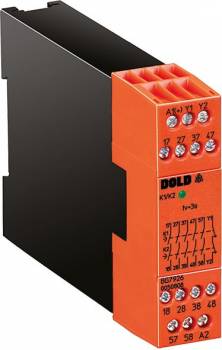
Dold 0050808 delay module BG7926.60 AC/DC24V
| Lieske Part No. | 1313015 |
|---|---|
| Mfg Part No | 0050808 |
| EAN-Code | 4030641508081 |
| Manufacturer | Dold |
| Here only | 201,36 EUR
239,62 EUR incl. VAT
|
Further information for Dold 0050808 delay module BG7926.60 AC/DC24V
| Technical data | |
| 1- / 2-channel | 1 |
| Approvals | UL-Recognized |
| Cat. / PL acc. to EN ISO 13849-1 | 2/d |
| Connection | Pluggable screw terminals |
| Output contacts max. | 1 NC contact, 5 NO contacts |
| SIL CL acc. to IEC/EN 62061 | 2 |
| SIL acc. to IEC/EN 62061 | 2 |
| Thermal current Ith max. | 5 A |
| Time delay max. | 3 s |
| Width | 22,5 mm |
| Type | BG 7926 |
| Variant | |
| Contact equipping | 5 NO contacts, 1 NC contact for feedback circuit |
| Nominal voltage | AC/DC 24 V |
| Time range | 3 s |
| Approvals and Markings | TÜV |
Applications
This device is intended for use in safety-critical control systems, for example in automation technology, manufacturing industry, or in plants with moving parts, where controlled function deactivation is required. It is used in conjunction with suitable switching devices or controls to implement safety-critical time delays without requiring additional auxiliary voltages. Typical applications include plants where immediate shutdown would be hazardous, such as conveyor belts, presses, or machine tools.
Functions and Equipment in Detail
The module features contact configuration with 5 normally open contacts (NO) and one normally closed contact (NC) for feedback circuit. These forced-guided contacts ensure safe signal transmission, even in the event of a fault. The operational status indicator enables visual monitoring of the module. Connections are made via removable screw terminals, designed for wires with 2 x 1.5 mm² (with ferrule and plastic sleeve DIN 46 228-1/-2/-3/-4) or 2 x 2.5 mm² (with ferrule DIN 46 228-1/-2/-3). The maximum time delay is 3 seconds, which is fixed and not adjustable.
Technology Explained Simply
The module functions based on a delayed release circuit, where the output does not switch off immediately after the input power is disconnected, but after a fixed delay of 3 seconds. This enables controlled sequences, for example, the complete shutdown of a drive. The rated voltage is AC/DC 24 V, allowing the module to be operated on both alternating and direct current supplies. The maximum thermal current (Ith) is 5 A, defining the contact load capacity. The TÜV and UL-Recognized approvals confirm compliance with international safety standards.
Compatibility and Accessories
The module is designed for use in safety systems meeting the requirements of standards EN ISO 13849-1 (Category 2, PL d) and IEC/EN 62061 (SIL 2). It can be used in combination with suitable switching devices or controls to implement safety-relevant time delays. The use of additional safety components, such as emergency stop switches or safety relays, is possible, provided the overall system requirements are met. The removable terminals allow flexible integration into existing circuits.
Mounting and Installation
Mounting is done in standard control panels with a width of 22.5 mm. The removable screw terminals facilitate wiring and maintenance. The wire connections are designed for the specified cross-sections, with the use of ferrules and plastic sleeves according to DIN 46 228 recommended. Installation must comply with general safety instructions and the requirements of the specific application. The operational status indicator serves as visual control during operation.
Advantages in Operation
The module provides a compact and reliable solution for safety-relevant time delays. The forced-guided contacts increase safety in case of failure, and the fixed time delay of 3 seconds enables precise sequence control. The operational status indicator supports maintenance and diagnostics. The operation without auxiliary voltage reduces system complexity. The TÜV and UL-Recognized approvals ensure compliance with international safety standards, facilitating integration into certified systems.

This is an offer of:
79279 Vörstetten
https://industry-electronics.com
Tel. 07666/88499-0
Fax. 07666/88499-111
Diesen Artikel finden Sie unter:
industry-electronics.com/artikel/1313015

Lieske Elektronik e.K.
Reutener Str. 1079279 Vörstetten
https://industry-electronics.com
Tel. 07666/88499-0
Fax. 07666/88499-111
Diesen Artikel finden Sie unter:
industry-electronics.com/artikel/1313015