
Dold 0050519 semiconductor contactor 2xAC 15A
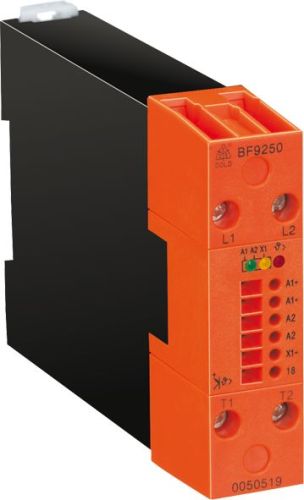
Dold 0050519 semiconductor contactor 2xAC 15A
| Lieske Part No. | 1001435 |
|---|---|
| Mfg Part No | 0050519 |
| EAN-Code | 4030641505196 |
| Manufacturer | Dold |
| Here only | 269,56 EUR
320,78 EUR incl. VAT
|
Further information for Dold 0050519 semiconductor contactor 2xAC 15A
| Technical data | |
| Approvals | UL |
| Load current up to | 50 A |
| Load voltage up to | AC 480 V |
| Number of poles | 1-pole, 2-pole, 3-pole |
| On/Off Input Control | AC/DC, DC |
| Width | 22,5 mm, 45 mm, 90 mm |
| Type | BF 9250 |
| Signalling output | |
| Temperature monitoring | |
| Variant | |
| Auxiliary voltage | DC 24 V |
| Contact equipping | with signal contact |
| Load current | 2 x AC 15 A |
| Load voltage | AC 24 - 480 V |
| Semiconductor output | 2-pole |
| Approvals and Markings | UL-listed C/US |
| Variant | Switching at zero crossing. Control input X1 with low current consumption. Monitoring output for the temperature protection |
Applications
This semiconductor contactor is suitable for use in installations with AC loads up to 480 V. It is commonly used in automation technology, manufacturing industry, and building technology, where reliable, disturbance-free, and noiseless switching of electrical consumers is required. The zero-voltage switching ensures that the switching operation occurs at the moment of zero crossing of the alternating voltage, minimizing the generation of switching sparks and electromagnetic interference.
Functions and Equipment in Detail
The device features a control input X1, which operates with low current consumption and is therefore suitable for actuation by programmable logic controllers (PLCs). Temperature monitoring of the power semiconductors is implemented via an integrated alarm output, which activates in case of overheating. This enables early response to thermal stress and protects the device from damage. The operational status is indicated by LEDs: a green LED indicates the supply voltage, a yellow LED signals actuation via X1, and a red LED lights up when the temperature monitoring is activated.
Technology Explained Simply
Switching is performed via semiconductors, which, unlike mechanical relays, have no moving parts. This makes the device wear-free and suitable for high switching frequencies. Zero-voltage switching reduces electrical interference and extends the service life of connected loads. Protection against transient voltage surges, which may arise from network disturbances or switching operations, is provided by varistors. The width of the device is 45 mm, allowing mounting on a DIN rail.
Compatibility and Accessories
The semiconductor contactor is available in various versions, including 1-pole, 2-pole, and 3-pole variants. The width varies depending on the model between 22.5 mm, 45 mm, and 90 mm. The load current capacity reaches up to 50 A, with the specific model BF9250.02/001 supporting a load current of 2 x AC 15 A. The UL-listed C/US certification confirms suitability for use in the USA and Canada.
Mounting and Installation
The device can be snapped onto a DIN rail, enabling simple and standardized installation in enclosures. The connection terminals are clearly labeled: A1/A2 serve as control or operating voltage, X1 as additional control input, 18 as alarm output, 11/12 as normally open contact, L1/L2/L3 as mains connections, and T1/T2/T3 as load outputs. Installation must follow the manufacturer’s technical instructions, ensuring correct polarity and compliance with electrical safety regulations.
Advantages in Operation
The semiconductor contactor offers high operational reliability due to integrated temperature monitoring and alarm output. Zero-voltage switching reduces electromagnetic interference and extends the service life of connected devices. The low current consumption at control input X1 allows direct actuation by PLC systems. The robust construction and certification according to IEC/EN 60947-4-2/-4-3 guarantee reliable performance in industrial environments.

This is an offer of:
79279 Vörstetten
https://industry-electronics.com
Tel. 07666/88499-0
Fax. 07666/88499-111
Diesen Artikel finden Sie unter:
industry-electronics.com/artikel/1001435

Lieske Elektronik e.K.
Reutener Str. 1079279 Vörstetten
https://industry-electronics.com
Tel. 07666/88499-0
Fax. 07666/88499-111
Diesen Artikel finden Sie unter:
industry-electronics.com/artikel/1001435