
Dold 0049382 Undervoltage Relay 3/NAC400/230V
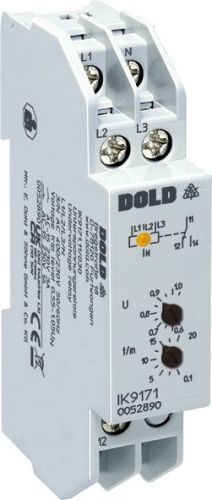
Dold 0049382 Undervoltage Relay 3/NAC400/230V
| Lieske Part No. | 1153824 |
|---|---|
| Mfg Part No | 0049382 |
| EAN-Code | 4030641493820 |
| Manufacturer | Dold |
| Here only | 52,90 EUR
62,95 EUR incl. VAT
|
Further information for Dold 0049382 Undervoltage Relay 3/NAC400/230V
| Technical data | |
| 1- / 3-phase | 1, 3 |
| Auxiliary voltage | Without |
| Enclosure design | Distribution board |
| Nominal voltage max. | 3/N AC 500 / 290 V |
| Output contacts | 1 C/O contact |
| Width | 17,5 mm |
| Type | IK 9171 |
| Operate delay | |
| Variant | |
| Contact equipping | 1 changeover contact |
| Nominal voltage | 3/N AC 400 / 230 V |
| Response value | 0,55 - 1,05 Un |
| Time delay | 0,5 - 20 s |
| Approvals and Markings | UKCA |
| Variant | With N. NC circuit operation. Settable time delay t2. Settable response value |
Applications
This relay is used to trigger a response in the event of voltage drops in 3-phase networks with or without a neutral conductor. It is also suitable for single-phase connections, where terminals L1, L2, and L3 must be bridged. Applications include ensuring power supply for critical loads, such as safety lighting, during network disturbances. In unstable networks, for example with local power generation or in networks of the 2nd and 3rd world, the variant with time delay t2 is used to switch consumer groups back in stages. It is also suitable for consumers that must not be switched on immediately after a short network failure — such as compressors or certain processing machines.
Functions and Equipment in Detail
The device features an adjustable pickup value in the range of 0.55 to 1.05 times nominal voltage (Un). The nominal voltage is 3/N AC 400/230 V, with a maximum nominal voltage of 3/N AC 500/290 V. The time delay t2 for returning to the normal state is adjustable between 0.5 and 20 seconds. The contact configuration includes one changeover contact (1 C/O contact). A yellow LED indicates the contact position: it lights up when the output relay contact 11-14 is closed. Phase sequence is irrelevant, as the device operates independently of phase order.
Technology Explained Simply
The relay measures the arithmetic mean of each phase against the neutral conductor (N). In variants without a neutral conductor connection, L1 and L3 are measured against L2 (IK/SK 9171) or L1 and L2 against L3 (IL/SL 9171). When the voltage drops below the set pickup value, the output relay contact opens. The time delay t2 ensures that the device only returns to the normal state after the set time has elapsed, preventing unwanted rapid switching during brief voltage dips. The hysteresis is approximately 4%, ensuring stable switching behavior. The device is certified to IEC/EN 60255-1 and carries the UKCA mark.
Compatibility and Accessories
The relay is suitable for 1- or 3-phase connections. It can be configured in various variants, for example with or without neutral conductor connection, with fixed or adjustable pickup value, and with or without time delays t1 and t2. Type I (IK 9171) is designed for installation distributors with terminals at the bottom, while type S (SK 9171) is intended for enclosures with terminals at the top. The width is 17.5 mm, enabling compact mounting in standard distributors.
Mounting and Installation
Mounting is in installation or industrial distributors in accordance with DIN 43 880. Type I has a depth of 59 mm, type S has a depth of 98 mm. The connection terminals are located at the bottom (I) or top (S) depending on the type. For single-phase connections, terminals L1, L2, and L3 must be connected. The frequency range is between 45 and 65 Hz. The device is designed for continuous overload capacity of 1.15 times nominal voltage.
Operational Advantages
The relay provides reliable network monitoring without auxiliary voltage. The adjustable time delay t2 enables controlled restart of consumers after a network fault. The LED indicator facilitates visual monitoring of the operating state. The rest current principle ensures that the output relay is not activated in the event of a fault, increasing safety. Compatibility with 1- and 3-phase networks, along with flexible configuration of pickup values and time delays, makes the device suitable for a wide range of applications.

This is an offer of:
79279 Vörstetten
https://industry-electronics.com
Tel. 07666/88499-0
Fax. 07666/88499-111
Diesen Artikel finden Sie unter:
industry-electronics.com/artikel/1153824

Lieske Elektronik e.K.
Reutener Str. 1079279 Vörstetten
https://industry-electronics.com
Tel. 07666/88499-0
Fax. 07666/88499-111
Diesen Artikel finden Sie unter:
industry-electronics.com/artikel/1153824