
Dold 0045378 BD9080.12/001 phase monitor 3AC400V UH AC230V
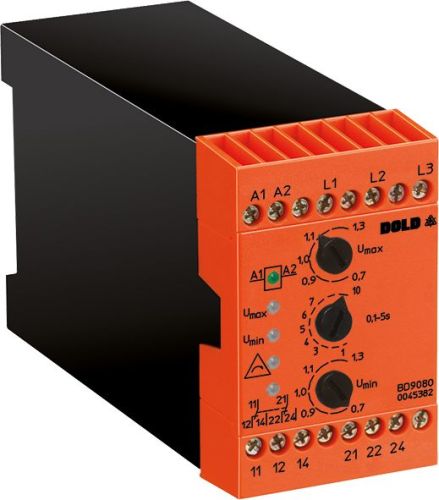
Dold 0045378 BD9080.12/001 phase monitor 3AC400V UH AC230V
| Lieske Part No. | 1002090 |
|---|---|
| Mfg Part No | 0045378 |
| EAN-Code | 4030641453787 |
| Manufacturer | Dold |
| Here only | 387,92 EUR
461,62 EUR incl. VAT
|
Further information for Dold 0045378 BD9080.12/001 phase monitor 3AC400V UH AC230V
| Technical data | |
| 1- / 3-phase | 3 |
| Enclosure design | Switch cabinet |
| Measuring range max. | 750 V |
| Output contacts | 2 C/O contacts |
| Standard measuring range | 3 AC 400 V |
| Width | 45 mm |
| Type | BD 9080 |
| Operate delay | |
| Variant | |
| Auxiliary voltage | AC 230 V |
| Contact equipping | 2 changeover contacts |
| Nominal voltage | 3AC 400 V |
| Release delay | 0,1 - 5 s |
| Approvals and Markings | CCC |
| Variant | Energized on trip |
Applications
The phase monitor is intended for use in industrial enclosures and is suitable for protecting systems that require stable and symmetrical three-phase power supply. Typical application areas include production plants, pump stations, air conditioning systems, or machines with electric drives, where unexpected power failure or voltage fluctuations can cause damage or downtime. Early detection of irregularities enables preventive maintenance and increases operational safety.
Functions and equipment in detail
The device monitors voltage in phases L1, L2, and L3 and detects deviations within the adjustable range of 0.7 to 1.3 times nominal voltage. When the auxiliary voltage is taken from the monitored network, the range is limited to 0.8 to 1.1 times nominal voltage. The pickup delay is adjustable between 0.1 and 5 seconds, allowing adaptation to the specific requirements of the system. The reset delay is also 0.1 to 5 seconds. Monitoring is performed by arithmetic averaging of multiple half-waves of rectified phase voltages L1/L2 and L2/L3, with L3 serving as the reference phase.
Technology explained simply
The phase monitor detects not only under- and over-voltages, but also incorrect phase sequence, asymmetry between phases, and complete power failure. Asymmetry detection occurs at deviations of ±8 to ±20 % of the pickup voltage, with a fault angle of approximately 120° ±15°. The repeat accuracy is ≤ ±0.5 % of nominal voltage, and the hysteresis is ≤5 % of the pickup value. The current consumption per phase is approximately 0.5 mA (L1, L2) and 0.8 mA (L3) at nominal voltage. The operating temperature range is -20 °C to +60 °C, and the storage temperature range is also within this range.
Compatibility and accessories
The device is designed for network voltages of 3AC 230, 400, 690, and 750 V, with other voltages available upon request. The auxiliary voltage can be taken from the network or a separate source and includes AC 110, 230, 400 V, as well as AC/DC 24–80 V and AC/DC 80–230 V. The contact configuration consists of two changeover contacts (C/O), rated according to IEC/EN 60947-5-1 for switching operations with AC 15 (2 A/AC 230 V) and DC 13 (1 A/DC 24 V). The electrical life is 250,000 switching operations at 1 A/AC 230 V, and the mechanical life is at least 50 million switching operations.
Mounting and installation
The phase monitor is designed for installation in enclosures and has a mounting width of 45 mm. Connections are made via terminals: L1, L2, L3 for phase voltage, A1/A2 for auxiliary voltage, and contacts 11–14 and 21–24 for the output relays. LED indicators signal the operating status: A1/A2 (auxiliary voltage), U max. (overvoltage), U min. (undervoltage), ∆ (asymmetry, incorrect phase sequence, power failure), and contact position. The operating altitude is limited to ≤2000 m.
Advantages in operation
Precise and reliable monitoring of voltage, phase sequence, and symmetry increases system availability. The adjustable pickup delay prevents false alarms during short-term voltage fluctuations. LED indicators enable quick fault localization. The device complies with the standard IEC/EN 60255-1 and carries the CCC approval mark. The nominal frequency is 50/60 Hz, with a frequency range of 45–65 Hz for the network and 45–500 Hz for the auxiliary voltage. The rated impulse withstand voltage is 6 kV, and the pollution degree is 2, according to IEC 60664-1.

This is an offer of:
79279 Vörstetten
https://industry-electronics.com
Tel. 07666/88499-0
Fax. 07666/88499-111
Diesen Artikel finden Sie unter:
industry-electronics.com/artikel/1002090

Lieske Elektronik e.K.
Reutener Str. 1079279 Vörstetten
https://industry-electronics.com
Tel. 07666/88499-0
Fax. 07666/88499-111
Diesen Artikel finden Sie unter:
industry-electronics.com/artikel/1002090