
Dold 0044942 time relay MK9962 delayed release
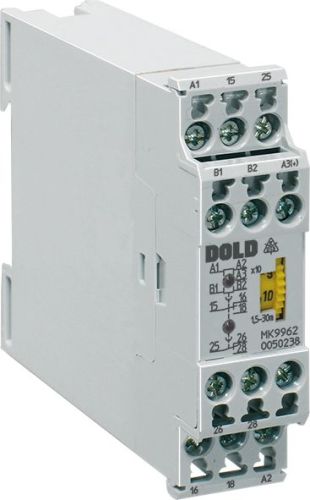
Dold 0044942 time relay MK9962 delayed release
| Lieske Part No. | 1154019 |
|---|---|
| Mfg Part No | 0044942 |
| EAN-Code | 4030641449421 |
| Manufacturer | Dold |
| Here only | 123,75 EUR
147,26 EUR incl. VAT
|
Further information for Dold 0044942 time relay MK9962 delayed release
| Technical data | |
| Enclosure design | Switch cabinet |
| Output contacts | 2 C/O contacts |
| Time function(s) | Off-delay, with control signal |
| Width | 22,5 mm |
| Type | MK 9962 |
| Variant | |
| Contact equipping | 2 changeover contacts delayed |
| Nominal voltage | AC/DC 24 V + AC 220 - 240 V |
| Time range | 0,5 - 10 h |
| Variant | Release delay, with control signal |
Applications
This time relay is suitable for time-dependent controls in industrial plants, such as in manufacturing automation, building automation, or machine control, where a delayed reset after signal termination is required. Its use in enclosures is supported by its design as an enclosure relay. The operating temperature range of -20 to +60 °C and operating altitude up to 2000 m above sea level allow flexible integration into various environments.
Functions and Equipment in Detail
The device features two changeover contacts as output contacts, rated for controlling loads up to 5 A thermal current (Ith) at AC 250 V. The contact materials consist of AgSnO₂, ensuring high switching durability and low wear. The electrical life expectancy is at least 500,000 switching operations at 5 A and AC 230 V, while the mechanical life expectancy is 30 million switching operations. The repeatability accuracy of the timing function is ≤ ±1 %, ensuring high precision during repeated operations. The minimum switching-on time is 20 ms, and the re-readiness time is approximately 5 ms.
Technology Explained Simply
The timing function is delayed-release, meaning that after deactivation of the control signal, the relay does not return to its resting position immediately, but only after the set time has elapsed. Control is potential-free via terminals B1/B2, with no galvanic isolation from the operating voltage terminals A1–A3. Therefore, control must be performed using potential-free contacts, which must provide appropriate galvanic isolation depending on the operating voltage. The operating voltage is connected to terminals A1–A2 (AC 220–240 V) and A3–A2 (AC/DC 24 V). Voltage influence values are ≤ ±0.5 %, and temperature influence is < ±0.1 %/K, ensuring stable operation under varying conditions.
Compatibility and Accessories
The relay is designed for use in enclosures and has a width of 22.5 mm, enabling compact mounting in standard control panels. The connection terminals are clearly labeled: A1–A3 for operating voltage, B1–B2 for control input, and 15–18 as well as 25–26–28 for the two changeover contacts. The certifications comply with the standard EN 61812-1, and EMC requirements are met according to IEC/EN 61000-4-2 to -4-5. The overvoltage category is III, and the rated impulse voltage is 4 kV at pollution degree 2.
Mounting and Installation
Mounting is performed in an enclosure using screw terminals. Terminal designations are detailed in the datasheet. Control is via potential-free contacts at B1/B2, with no galvanic isolation from the operating voltage terminals. The operating voltage is connected to A1–A2 (AC 220–240 V) and A3–A2 (AC/DC 24 V). The LED indicators (upper for control signal, lower for contact position) facilitate fault diagnosis and monitoring of the operating status.
Advantages in Operation
The simple operation via the continuously variable rotary switch and the clear indication via two LEDs for control signal and contact position enable quick commissioning and maintenance. The high repeatability accuracy and long contact life ensure reliable operation. The dual-voltage configuration expands application possibilities, as the device can be operated both on low-voltage networks (24 V) and on AC networks (220–240 V). The maximum delay time is 100 hours, although the variant specified here is limited to 0.5 to 10 hours.

This is an offer of:
79279 Vörstetten
https://industry-electronics.com
Tel. 07666/88499-0
Fax. 07666/88499-111
Diesen Artikel finden Sie unter:
industry-electronics.com/artikel/1154019

Lieske Elektronik e.K.
Reutener Str. 1079279 Vörstetten
https://industry-electronics.com
Tel. 07666/88499-0
Fax. 07666/88499-111
Diesen Artikel finden Sie unter:
industry-electronics.com/artikel/1154019