
Dold 0044937 time relay delayed return
Industrial Material > Industrial relays and contactors > Industrial Timers
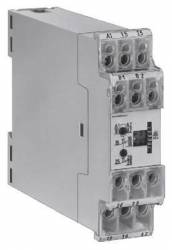
Dold 0044937 time relay delayed return
| Lieske Part No. | 832880 |
|---|---|
| Mfg Part No | 0044937 |
| EAN-Code | 4030641449377 |
| Manufacturer | Dold |
| Here only | 126,23 EUR
150,21 EUR incl. VAT
|
Further information for Dold 0044937 time relay delayed return
| Technical data | |
| Enclosure design | Switch cabinet |
| Output contacts | 2 C/O contacts |
| Time function(s) | Off-delay, with control signal |
| Width | 22,5 mm |
| Type | MK 9962 |
| Variant | |
| Contact equipping | 2 changeover contacts delayed |
| Nominal voltage | AC/DC 24 V + AC 220 - 240 V |
| Time range | 15 - 300 s |
| Variant | Release delay, with control signal |
Delayed-release time function
The relay operates on the principle of delayed release with control signal. Upon activation of the control signal at terminals B1–B2, the relay energizes and closes the output contacts. Once the control signal is removed, the timing sequence begins. After the set delay time has elapsed, the relay returns to its resting position. Control is potential-free, with control inputs B1–B2 not galvanically isolated from the operating voltage terminals A1–A2–A3. Therefore, contacts must be operated with potential-free signals, which must provide appropriate galvanic isolation depending on the operating voltage.
Functions and equipment in detail
The device features two changeover contacts as output contacts, rated for controlling loads up to 5 A (thermal current) at AC 250 V. The contact materials consist of AgSnO₂, ensuring high switching capacity and long service life. The electrical life is at least 500,000 switching operations at 5 A and AC 230 V, while the mechanical life is 30 million switching operations. The maximum permissible switching frequency is 6,000 switching operations per hour. The minimum switching-on time is 20 ms, and the re-arming time is approximately 5 ms.
Technology explained clearly
The time delay is set via a continuously adjustable rotary switch on an absolute scale, ensuring precise and reproducible adjustment. Voltage influence values are ≤ ±0.5 %, and temperature influence is < ±0.1 % per Kelvin. The operating temperature range is between -20 °C and +60 °C, with identical storage temperature. The operating altitude is limited to a maximum of 2000 m above sea level. The insulation test voltage is 2.5 kV for a duration of 1 minute. The overvoltage category is III, and the rated impulse voltage is 4 kV at pollution degree 2.
Compatibility and accessories
The time relay is designed for use in industrial control systems, particularly for time-dependent actuation and device indication. Connection terminals are clearly marked: A1–A3 for operating voltage, B1–B2 for control input, and 15–18 as well as 25–26–28 for the two changeover contacts. Integrated LEDs serve for fault diagnosis: the upper LED lights up when the control contact is connected, and the lower LED indicates activation of the output relay. The standard EN 61812-1 applies to the time relay function.
Mounting and installation
The device is designed for mounting in enclosures and conforms to the enclosure form for enclosure mounting. The width of 22.5 mm allows for compact placement in standard control panels. Connection terminals are designed for secure connections, with control inputs B1–B2 to be operated potential-free. Power supply is provided via terminals A1–A2 (for 220–240 V) and A3–A2 (for 24 V). The maximum permissible fuse rating is 6 A gG/gL.
Advantages in operation
The simple operation and visual fault diagnosis via the two LEDs facilitate commissioning and maintenance. High repeat accuracy and long service life ensure reliable operation. The continuously adjustable time delay over a wide range allows flexible adaptation to different applications. Compliance with standard EN 61812-1 ensures conformity with industrial requirements for time relays. The dual-voltage operating circuit (24 V and 220–240 V) increases installation flexibility.

This is an offer of:
79279 Vörstetten
https://industry-electronics.com
Tel. 07666/88499-0
Fax. 07666/88499-111
Diesen Artikel finden Sie unter:
industry-electronics.com/artikel/832880

Lieske Elektronik e.K.
Reutener Str. 1079279 Vörstetten
https://industry-electronics.com
Tel. 07666/88499-0
Fax. 07666/88499-111
Diesen Artikel finden Sie unter:
industry-electronics.com/artikel/832880