
Dold 0043302 undervoltage relay BA9043/003 3AC50/60HZ 690V 0,5-10S
Industrial Material > Industrial relays and contactors > Switching units / measuring, control relay
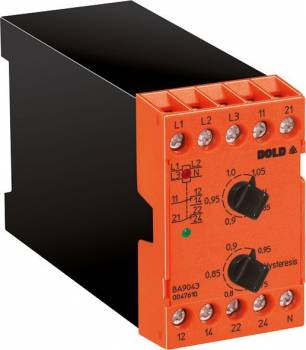
Dold 0043302 undervoltage relay BA9043/003 3AC50/60HZ 690V 0,5-10S
| Lieske Part No. | 452440 |
|---|---|
| Mfg Part No | 0043302 |
| EAN-Code | 4030641433024 |
| Manufacturer | Dold |
| Here only | 302,01 EUR
359,39 EUR incl. VAT
|
Further information for Dold 0043302 undervoltage relay BA9043/003 3AC50/60HZ 690V 0,5-10S
| Technical data | |
| 1- / 3-phase | 3 |
| Auxiliary voltage | Without |
| Enclosure design | Switch cabinet |
| Nominal voltage max. | 3/N AC 690 / 400 V |
| Output contacts | 2 C/O contacts |
| Width | 45 mm |
| Type | BA 9043 |
| Operate delay | |
| Variant | |
| Contact equipping | 2 changeover contacts |
| Nominal voltage | 3AC 690 V |
| Time delay | 0,5 - 10 s |
| Approvals and Markings | UKCA |
| Variant | For 3p3w systems. With adjustable time delay |
Applications
This relay is designed for industrial applications as well as railway applications, where reliable voltage monitoring is required. It is particularly suitable for systems operating without auxiliary voltage, as the device operates without external auxiliary voltage. The application is in three-phase networks with 3 conductors (3p3w), where voltage values between 100 V and 690 V (depending on variant) can be monitored.
Functions and Equipment in Detail
The device features two changeover contacts as output contacts, used for load protection. The pickup and drop-out values are continuously adjustable and range from 0.85 to 1.05 of the rated voltage, with hysteresis between 0.75 and 0.95 of the pickup value. The time delay is adjustable and ranges from 0.5 to 10 seconds. However, this delay is only active when the voltage is at least 60 % of the rated voltage; below 40 % of the rated voltage, the drop-out occurs immediately. Adjustment is done via rotary potentiometers on the front of the device, enabling user-friendly operation.
Technology Explained Simply
The relay operates on the residual current principle, where the output relay is not activated in the event of a fault, but is active in the normal state. LED indicators signal operational readiness (red LED) and contact position (green LED). Measurement is performed without auxiliary voltage, simplifying installation and reducing the number of required connections. Immunity to harmonics ensures reliable operation even in networks with harmonic distortions.
Compatibility and Accessories
The device is designed for networks with frequencies from 50 to 400 Hz and complies with standard IEC/EN 60255-1. It is designed for three-phase networks without a neutral conductor (3p3w). Variants BA9043/001 and BA9043/003 are without neutral conductor, with the BA9043/003 variant offering an adjustable time delay. The switching delay is inactive at voltages below 0.6 of the rated voltage. The electrical life expectancy is at least 200,000 switching operations at 3 A and AC 230 V, and the mechanical life expectancy exceeds 30 million switching operations.
Mounting and Installation
Mounting is done on a DIN rail in accordance with IEC/EN 60715. The terminals are designed for 2 x 2.5 mm² rigid or 2 x 1.5 mm² flexible conductors with heat-shrink tubing. Dimensions are 45 mm (width) x 73 mm (height) x 132 mm (depth). Fixing is done using plus-minus terminal screws M3.5 with self-lifting clip. The required tightening torque is 0.8 Nm. The operating temperature range is from -20 °C to +60 °C, and the storage temperature range is from -25 °C to +60 °C.
Advantages in Operation
The adjustable pickup and drop-out values allow application-specific adaptation. LED indicators facilitate fault localization. Immunity to harmonics and high life expectancy ensure reliable long-term use. The ability to operate without auxiliary voltage reduces installation complexity. The time delay prevents unwanted tripping during short-term voltage dips. The devices are suitable for use in industrial and railway applications, where high operational reliability is required.

This is an offer of:
79279 Vörstetten
https://industry-electronics.com
Tel. 07666/88499-0
Fax. 07666/88499-111
Diesen Artikel finden Sie unter:
industry-electronics.com/artikel/452440

Lieske Elektronik e.K.
Reutener Str. 1079279 Vörstetten
https://industry-electronics.com
Tel. 07666/88499-0
Fax. 07666/88499-111
Diesen Artikel finden Sie unter:
industry-electronics.com/artikel/452440