
Dold 0040843 coupling relay CA3056.01 220-240V
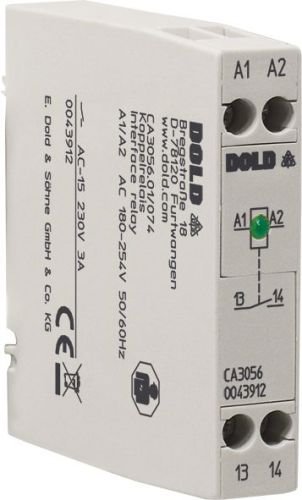
Dold 0040843 coupling relay CA3056.01 220-240V
| Lieske Part No. | 1001770 |
|---|---|
| Mfg Part No | 0040843 |
| EAN-Code | 4030641408435 |
| Manufacturer | Dold |
| Here only | 70,13 EUR
83,45 EUR incl. VAT
|
Further information for Dold 0040843 coupling relay CA3056.01 220-240V
| Technical data | |
| Enclosure design | Switch cabinet |
| Output contacts max. | 1 NC contact, 1 NO contact |
| Thermal current Ith max. | 5 A |
| Width | 11,5 mm |
| Type | CA 3056 |
| Initiator triggering | |
| Suppressor circuit on the coil input | |
| Variant | |
| Contact equipping | 1 NO contact |
| Nominal voltage | AC 220 - 240 V |
Applications
This relay is designed for use in industrial plants where galvanic isolation between control and load circuits is required. It is particularly suitable as an interface relay in automation systems, where signals from control devices are transmitted to power components. The secure isolation in accordance with IEC/EN 61140 and IEC/EN 60947-1, with a rated impulse voltage of 6 kV and pollution degree 2, ensures high electrical safety. The operating temperature ranges from -25 °C to +60 °C, making the device suitable for use in demanding climatic environments.
Functions and Features in Detail
The relay features an LED indicator that lights up when energized, visually signaling the operating status. The coil is equipped with protective circuitry at the input, providing enhanced surge voltage resistance. The pickup time is less than 10 ms, and the drop-out time is less than 20 ms, enabling fast switching response. The contacts are designed for switching operations according to AC 15, with the normally closed contact capable of switching up to 3 A at AC 230 V and the normally open contact up to 1 A at AC 230 V. For direct current switching (DC 13), the switching current is 1 A at DC 24 V.
Technical Explanation
The designation CA3056.01 refers to the variant with one normally closed contact. The nominal voltage of AC 220–240 V is suitable for use in Europe and other regions with corresponding mains voltage. The width of 11.5 mm corresponds to the standard for DIN rail mounting. The protective circuitry at the coil input protects the relay from transient voltage spikes caused by network disturbances or switching operations. The LED indicator enables visual monitoring of the operating status and facilitates troubleshooting.
Compatibility and Accessories
The relay is part of the CA 3056, CB 3056, and CC 3056 product family, which offers various contact configurations and options such as MOV at the input or gold-plated contacts (5 μm Au) for switching low-power loads. The variants are designed for mounting in enclosures and comply with standards IEC/EN 60947-5-1. The electrical life expectancy exceeds 800,000 switching operations at 3 A and AC 230 V, while the mechanical life expectancy exceeds 30 million switching operations.
Mounting and Installation
The relay is mounted in enclosures using either a DIN rail or an appropriate mounting plate. The connection terminals are designed for wiring connections. The operating altitude is limited to a maximum of 2000 m above sea level. The ambient temperature during operation must be within the range of -25 °C to +60 °C. Mounting requires no additional tools, as the terminals can be connected directly.
Operational Advantages
The relay offers high switching capacity with low power consumption (0.8 VA at AC 230 V). The LED indicator enables quick status monitoring. The secure isolation ensures electrical safety in the system. The high mechanical life expectancy and robust construction ensure reliable operation over a long period. Compatibility with various control and power devices makes it a universally applicable component in industrial electrotechnics.

This is an offer of:
79279 Vörstetten
https://industry-electronics.com
Tel. 07666/88499-0
Fax. 07666/88499-111
Diesen Artikel finden Sie unter:
industry-electronics.com/artikel/1001770

Lieske Elektronik e.K.
Reutener Str. 1079279 Vörstetten
https://industry-electronics.com
Tel. 07666/88499-0
Fax. 07666/88499-111
Diesen Artikel finden Sie unter:
industry-electronics.com/artikel/1001770