
Dold 0035138 IK3076.12 AC50/60HZ 110-130V coupling relay
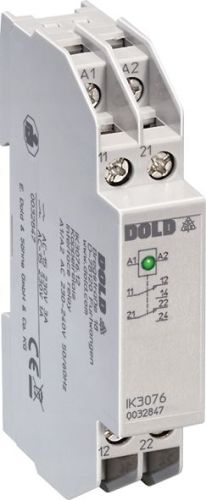
Dold 0035138 IK3076.12 AC50/60HZ 110-130V coupling relay
| Lieske Part No. | 1001816 |
|---|---|
| Mfg Part No | 0035138 |
| EAN-Code | 4030641351380 |
| Manufacturer | Dold |
| Here only | 71,16 EUR
84,68 EUR incl. VAT
|
Further information for Dold 0035138 IK3076.12 AC50/60HZ 110-130V coupling relay
| Technical data | |
| Enclosure design | Distribution board |
| Output contacts max. | 2 C/O contacts |
| Thermal current Ith max. | 10 A |
| Width | 17,5 mm |
| Type | IK 3076 |
| Initiator triggering | |
| Suppressor circuit on the coil input | |
| Variant | |
| Contact equipping | 2 changeover contacts |
| Nominal voltage | AC 110 - 130 V |
Applications
The IK3076.12 coupling relay is suitable for applications where signals from the control circuit need to be transmitted to multiple loads or control devices. It is commonly used in automation systems, machine controls, and enclosures, where galvanic isolation between control and power circuits is necessary. Use in railway installations is also intended, where high reliability and EMC resistance are required.
Functions and Equipment in Detail
The device is equipped with two changeover contacts, enabling flexible signal distribution. The green LED indicator lights up when the relay is energized and serves as a visual status indicator. The initiator actuation allows integration into control systems that operate with special actuation signals. The protective circuit at the coil input protects the device against voltage surges and transient overvoltages, increasing its lifespan and reliability.
Technology Explained Simply
The coupling relay operates at a rated voltage of AC 110–130 V at a frequency of 50/60 Hz. The voltage range is 0.8 to 1.1 times the rated voltage, providing high tolerance to voltage fluctuations. The thermal current Ith is 5 A, indicating the maximum continuous load capacity of the contacts. The pickup time is less than 10 ms, and the drop-out time is less than 20 ms, ensuring fast switching operations. The electrical life is 1 x 10⁵ switching cycles at 3 A and AC 230 V, while the mechanical life exceeds 30 x 10⁶ switching cycles. The permissible switching frequency is 6000 switching cycles per hour.
Compatibility and Accessories
The relay complies with IEC/EN 60947-5-1 and IEC/EN 61810-1 standards. The switching capacities are defined for AC 15 (make: 3 A / AC 230 V, break: 1 A / AC 230 V) and DC 13 (make: 1 A / DC 24 V, break: 1 A / DC 24 V). The short-circuit withstand requires a maximum fuse rating of 4 A gG / gL. The enclosure rating corresponds to IP 40, and the terminals to IP 20. The rated impulse voltage is 4 kV for input and output, and 2.5 kV for contacts. The creepage and clearance distances comply with pollution degree 2 according to IEC 60664-1.
Mounting and Installation
Mounting is done via DIN rail or screw fastening. The connection terminals are designed for conductor cross-sections of 2 x 2.5 mm² (solid) or 2 x 1.5 mm² (stranded wire with ferrule DIN 46228-1/-2/-3/-4). The stripping length is 10 mm. Conductor attachment is via flat terminals with self-lifting connection washers, and the tightening torque is 0.8 Nm. The operating temperature range is -25 °C to +60 °C, and the storage temperature range is -40 °C to +80 °C. The operating altitude is limited to ≤ 2000 m.
Advantages in Operation
The IK3076.12 coupling relay offers high operational safety due to the integrated input protective circuit and galvanic isolation. The LED indicator enables quick fault diagnosis. The high mechanical life and robust construction ensure long-term performance in demanding environments. Compliance with IEC/EN 60947-5-1 and IEC/EN 61810-1 standards guarantees adherence to international standards. EMC resistance against static discharges, HF radiation, and fast transients increases reliability in electromagnetically noisy environments.

This is an offer of:
79279 Vörstetten
https://industry-electronics.com
Tel. 07666/88499-0
Fax. 07666/88499-111
Diesen Artikel finden Sie unter:
industry-electronics.com/artikel/1001816

Lieske Elektronik e.K.
Reutener Str. 1079279 Vörstetten
https://industry-electronics.com
Tel. 07666/88499-0
Fax. 07666/88499-111
Diesen Artikel finden Sie unter:
industry-electronics.com/artikel/1001816