
Dold 0034985 time relay delayed release 127V
Industrial Material > Industrial relays and contactors > Industrial Timers
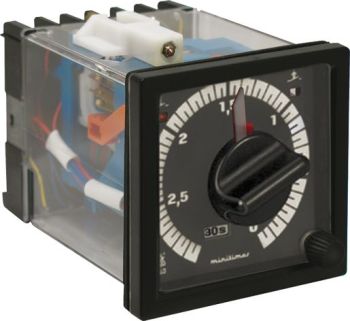
Dold 0034985 time relay delayed release 127V
| Lieske Part No. | 1583536 |
|---|---|
| Mfg Part No | 0034985 |
| EAN-Code | 4030641349851 |
| Manufacturer | Dold |
| Here only | 321,19 EUR
382,22 EUR incl. VAT
|
Further information for Dold 0034985 time relay delayed release 127V
| Technical data | |
| Enclosure design | Front panel mounting |
| Output contacts | 1 C/O contact |
| Time function(s) | Off-delay, with control signal |
| Width | 72 mm |
| Type | EF 7666 |
| Variant | |
| Contact equipping | 1 changeover contact delayed, 1 changeover undelayed |
| Nominal voltage | AC 127 V |
| Time range | 0,15 s - 30 h |
Applications
This relay is used in industrial control systems where controlled shutdown or delayed switching is required. Typical applications include controlling fans, pumps, motors, or lighting systems, where immediate shutdown is not desired. The delayed-release function allows, for example, a motor to coast down before power is interrupted, thereby increasing the lifespan of the system.
Functions and Features in Detail
The device features two output contacts: one delayed changeover contact and one instantaneous changeover contact. The delayed contact switches only after the set time has elapsed, while the instantaneous contact responds immediately when the control signal is activated. The time delay can be adjusted continuously via a rotary switch on the front panel. The adjustment range covers 0.15 seconds to 30 hours, with six selectable time ranges available. The repeatability is ≤ ± 0.5 % of the scale end value, and for times of 3 and 6 seconds, ≤ ± 1 %. A time progress indicator visually displays the progress of the delay time.
Technology Explained Simply
The time function is based on a purely mechanical timing mechanism, implemented via a spring and gear system. Adjustment is made via a continuously variable rotary switch positioned on an absolute scale. The delay time is determined by the rotational speed of the mechanism, which varies according to the switch setting. The contacts are made of AgNi with a gold plating of 0.2 μm, ensuring high switching capacity and long service life. The operating time of the contacts is less than 35 ms, and the release time is less than 60 ms. The device is voltage-free safe, meaning it returns to its default position when the supply voltage is interrupted.
Compatibility and Accessories
The time relay is designed for use in control panels with a front panel cutout of 72 x 72 mm. It is compatible with a rated voltage of AC 127 V and can be operated in systems with a frequency of 50/60 Hz. The contact configuration allows use in circuits requiring both delayed and immediate switching operations. The switching capacity according to AC 15 is 3 A at AC 230 V. The maximum switching frequency is 3000 operations per hour. The short-circuit withstand requires a maximum fuse rating of 10 A gG/gL.
Mounting and Installation
The device is installed into a front panel with dimensions 72 x 72 mm. Mounting is done by inserting it into the appropriate cutout, with the connection terminals connected to the designated points (A1/A2, B1/B2, 15/16, 27/28). The delay time is adjusted via the rotary switch on the front panel. The switching position indicator allows visual verification of the contact position.
Operational Advantages
The continuous adjustment of the delay time over a wide range from 0.15 s to 30 h offers flexibility for adapting to various applications. The high repeatability and voltage-free safety increase operational reliability. The front panel is protected against spray water (IP 65), enabling use in humid or dusty environments. The mechanical service life exceeds 30 million switching operations or 15,000 operating hours, ensuring a long service life. The time progress indicator supports maintenance and diagnostics during operation.

This is an offer of:
79279 Vörstetten
https://industry-electronics.com
Tel. 07666/88499-0
Fax. 07666/88499-111
Diesen Artikel finden Sie unter:
industry-electronics.com/artikel/1583536

Lieske Elektronik e.K.
Reutener Str. 1079279 Vörstetten
https://industry-electronics.com
Tel. 07666/88499-0
Fax. 07666/88499-111
Diesen Artikel finden Sie unter:
industry-electronics.com/artikel/1583536