
Dold 0033388 BA9043 undervoltage relay 3AC50-400Hz
Industrial Material > Industrial relays and contactors > Switching units / measuring, control relay
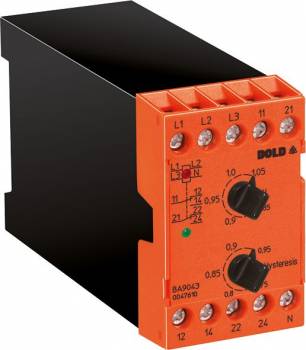
Dold 0033388 BA9043 undervoltage relay 3AC50-400Hz
| Lieske Part No. | 780585 |
|---|---|
| Mfg Part No | 0033388 |
| EAN-Code | 4030641333881 |
| Manufacturer | Dold |
| Here only | 270,07 EUR
321,38 EUR incl. VAT
|
Further information for Dold 0033388 BA9043 undervoltage relay 3AC50-400Hz
| Technical data | |
| 1- / 3-phase | 3 |
| Auxiliary voltage | Without |
| Enclosure design | Switch cabinet |
| Nominal voltage max. | 3/N AC 690 / 400 V |
| Output contacts | 2 C/O contacts |
| Width | 45 mm |
| Type | BA 9043 |
| Operate delay | |
| Variant | |
| Contact equipping | 2 changeover contacts |
| Nominal voltage | 3/N 290/500 V |
| Time delay | without |
| Approvals and Markings | UKCA |
| Variant | For 3p4w systems |
Applications
This relay is designed for networks with a nominal frequency of 50 to 400 Hz and is suitable for applications in industry and railway operations. It monitors voltages in the range of 3/N AC 100/57 V to 690/400 V, with the variant described here rated for 3/N AC 290/500 V. The devices are designed for continuous operation and function within a temperature range of -20 °C to +60 °C. The operating altitude is limited to a maximum of 2000 m above sea level.
Functions and Equipment in Detail
The device features two changeover contacts as output contacts, used for switching operations in control and protection circuits. The contact configuration allows actuation of auxiliary relays, indicator lights, or switching devices. LED indicators signal operational readiness (red LED) and active contact position (green LED). The adjustment ranges include a pickup value of 0.85 to 1.05 times the nominal voltage and a dropout ratio (hysteresis) of 0.75 to 0.95 of the pickup value. Switching delay is not present in this variant, although other versions offer an adjustable time delay of 0.5 to 10 seconds.
Technology Explained Simply
Measurement is based on arithmetic mean calculation of the three phases against the neutral conductor. In the event of voltage drops below 0.4 times the nominal voltage, the output relay de-energizes immediately. Harmonic insensitivity ensures stable operation even with distorted voltage waveforms. The electrical life expectancy is at least 200,000 switching operations at 3 A and AC 230 V, with a mechanical life expectancy exceeding 30 million switching operations.
Compatibility and Accessories
The relay is available for networks with or without neutral conductor, with the variant described here designed for systems with neutral conductor. It is intended for mounting on DIN rail (IEC/EN 60715). The connection terminals are rated for 2 x 2.5 mm² single- or multi-strand conductors, with a tightening torque of 0.8 Nm. The devices comply with the standard IEC/EN 60255-1 and are certified with UKCA approval.
Mounting and Installation
Mounting is performed on DIN rail within an enclosure. The terminals are equipped with plus-minus screws M3.5 with self-tightening mechanism. Dimensions are 45 mm width, 73 mm height, and 132 mm depth. Wiring is carried out according to the specifications in the data sheet, with terminals L1, L2, L3, and N designated for network connection and contacts 11-14 and 21-24 for output wiring.
Operational Advantages
Preventive maintenance is supported by early detection of voltage anomalies. Rapid fault localization enables efficient troubleshooting. High reliability and long service life reduce maintenance costs and increase productivity. Harmonic insensitivity and adjustable pickup values allow flexible adaptation to different network conditions.

This is an offer of:
79279 Vörstetten
https://industry-electronics.com
Tel. 07666/88499-0
Fax. 07666/88499-111
Diesen Artikel finden Sie unter:
industry-electronics.com/artikel/780585

Lieske Elektronik e.K.
Reutener Str. 1079279 Vörstetten
https://industry-electronics.com
Tel. 07666/88499-0
Fax. 07666/88499-111
Diesen Artikel finden Sie unter:
industry-electronics.com/artikel/780585