
Dold 0032820 MK9052.11 DC24V thermistor motor protection relay
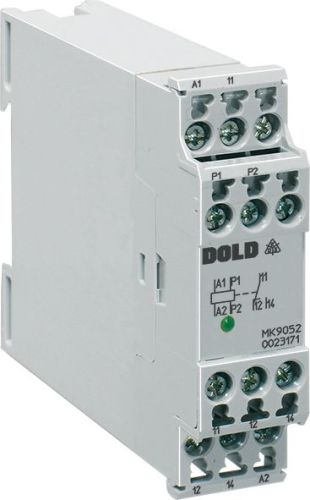
Dold 0032820 MK9052.11 DC24V thermistor motor protection relay
| Lieske Part No. | 1002253 |
|---|---|
| Mfg Part No | 0032820 |
| EAN-Code | 4030641328207 |
| Manufacturer | Dold |
| Here only | 131,37 EUR
156,33 EUR incl. VAT
|
Further information for Dold 0032820 MK9052.11 DC24V thermistor motor protection relay
| Technical data | |
| Classification | Thermistor-Motorschutz |
| Enclosure design | Switch cabinet |
| Measuring range max. | > 3 kΩ |
| Output contacts | 2 C/O contacts |
| Width | 22,5 mm |
| Type | MK 9052 |
| Variant | |
| Auxiliary voltage | DC 24 V |
| Contact equipping | 1 changeover contact |
Applications
This motor protection relay is used in plants where motors may be thermally overloaded due to high switching frequency, heavy start-up, single-phase operation, impaired cooling, or high ambient temperature. It is particularly suitable for drives in manufacturing industry, process engineering, or pump and fan installations, where reliable temperature monitoring is required. The use of up to 6 thermistors in series allows flexible adaptation to different motor sizes and requirements.
Functions and Equipment in Detail
The device features an input for thermistors or bimetal contacts, with a pickup value of ≥ 3 kΩ and a drop-out value of ≤ 1.8 kΩ. The measurement circuit load is approximately 1 mW at a resistance of 1.5 kΩ, and the measurement voltage is approximately 1.2 V. The LED indicates the relay’s switching state, facilitating visual monitoring during operation. The re-energizing lockout can be optionally activated to prevent automatic restart after a fault. The reset function allows manual reset after a shutdown.
Technology Explained Simply
The relay operates on the standby current principle, where the output relay is activated during normal operation and drops out when the pickup value is reached. This ensures the motor is only switched off when a genuine overload condition exists. The wire break detection monitors the sensor circuit and responds to interruptions to avoid false alarms. The pickup delay is less than 20 ms, and the drop-out delay is less than 15 ms, enabling fast and precise response to temperature changes. The contact configuration with 1 changeover contact (variant .11) and 2 changeover contacts (output contacts) offers flexibility when integrating into existing circuits.
Compatibility and Accessories
The device is designed for use with thermistors (PTC resistors) specifically designed for motor protection. The number of usable sensors can range from 1 to 6, with sensors connected in series. The terminal connections are rated for 2 x 2.5 mm² solid or 2 x 1.5 mm² stranded wire with ferrule according to DIN 46228. Mounting is via DIN rail according to IEC/EN 60715, enabling easy installation in standard enclosures.
Mounting and Installation
Mounting is on a DIN rail inside the enclosure. The terminals are equipped with a self-lifting connection washer, ensuring a secure and easy connection of the wires. The tightening torque is 0.4 Nm. The operating temperature range is -20 °C to +60 °C, and the storage temperature range matches this. The operating altitude is limited to below 2000 m. The enclosure protection rating is IP 40, and the terminals are rated IP 20, providing protection against touch and dust, but not against water.
Operational Advantages
The relay provides reliable and precise temperature monitoring, supported by wire break detection and the standby current principle. The electrical life is over 800,000 switching cycles at 3 A and AC 230 V, and the mechanical life exceeds 20 million switching cycles. The short-circuit withstand capability is ensured with a maximum fuse rating of 4 A gG/gL. The EMC coverage includes immunity to electrostatic discharge (8 kV), high-frequency radiation, and fast transients, ensuring safe operation in industrial environments. The radio frequency interference suppression complies with emission limit class B according to EN 55011.

This is an offer of:
79279 Vörstetten
https://industry-electronics.com
Tel. 07666/88499-0
Fax. 07666/88499-111
Diesen Artikel finden Sie unter:
industry-electronics.com/artikel/1002253

Lieske Elektronik e.K.
Reutener Str. 1079279 Vörstetten
https://industry-electronics.com
Tel. 07666/88499-0
Fax. 07666/88499-111
Diesen Artikel finden Sie unter:
industry-electronics.com/artikel/1002253