
Dold 0031783 time relay delayed release 230V
Industrial Material > Industrial relays and contactors > Industrial Timers
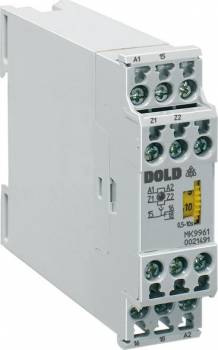
Dold 0031783 time relay delayed release 230V
| Lieske Part No. | 1583500 |
|---|---|
| Mfg Part No | 0031783 |
| EAN-Code | 4030641317836 |
| Manufacturer | Dold |
| Here only | 269,94 EUR
321,23 EUR incl. VAT
|
Further information for Dold 0031783 time relay delayed release 230V
| Technical data | |
| Approvals | UL |
| Enclosure design | Switch cabinet |
| Output contacts | 1 C/O contact |
| Time function(s) | Off-delay, without control signal |
| Width | 22,5 mm |
| Type | MK 9961 |
| Variant | |
| Contact equipping | 1 NO contact undelayed, 1 changeover contact delayed |
| Nominal voltage | AC 230 V |
| Time range | 5 - 100 s |
| Variant | Release delay, without control signal |
Applications
This time relay is suitable for applications requiring delayed de-energization after switching off the control. Typical applications include control of fans, pumps, or lighting systems, where immediate shutdown is not desired. The zero-voltage safety ensures that the relay maintains its function even during brief power interruptions. The repeat accuracy of < ±1 % ensures high precision during repeated switching operations.
Functions and Features in Detail
The device features an LED indicator that lights up when operating voltage is applied, visually signaling the operational status. Time adjustment is performed continuously on an absolute scale, with remote adjustment possible via an external potentiometer. For the time range of 5–100 s, external potentiometers with a resistance value of 10 MΩ (part number 0004084) are provided. The contact materials consist of AgSnO₂ for the changeover contact and AgNi for the closer, ensuring high switching durability and corrosion resistance. The rated operating voltage is AC 250 V, and the relay is designed for continuous operation.
Technology Explained Simply
The delayed-release function means that the contact does not switch immediately after the control is switched off, but only after a set delay time. This is achieved by an internal timing mechanism powered by the operating voltage. The minimum energizing time is 80 ms, ensuring correct response even to short pulses. Temperature dependence is < 0.1 %/K, enabling stable operation over a wide temperature range from -20 °C to +60 °C. The mechanical life is 50 million switching cycles, ensuring high reliability throughout the entire service life.
Compatibility and Accessories
The relay can be actuated with two-wire initiators, enabling easy integration into existing control systems. The connection terminals are designed for two conductors with a cross-section of 1.5 mm², with connections made via flat terminals with self-lifting clamping elements. Mounting is on a DIN rail in accordance with IEC/EN 60715. As accessories, external potentiometers are available for various time ranges; for the described time range of 5–100 s, the 10 MΩ potentiometer (part number 0004084) is used.
Mounting and Installation
Mounting is on a DIN rail inside an enclosure. Terminals A1/A2 are used for supplying operating voltage, while contacts 15/16/18 (changeover) and 23/24 (closer) are used for load switching. The terminals must be tightened with a torque of 0.4 Nm. The ambient temperature must be within the range of -20 °C to +60 °C, and the operating altitude is limited to a maximum of 2000 m above sea level. The enclosure design is intended for use in enclosures, with the front side having a protection rating of IP 40.
Operational Advantages
The relay offers high operational safety due to zero-voltage safety and precise time control with a repeat accuracy of < ±1 %. Remote adjustment allows flexible adaptation of the delay time without physical access to the device. The LED indicator simplifies diagnostics and maintenance, as the operational status is visually recognizable. The high mechanical life and robust construction ensure long service life in industrial applications. UL certification ensures suitability for use in relevant markets.

This is an offer of:
79279 Vörstetten
https://industry-electronics.com
Tel. 07666/88499-0
Fax. 07666/88499-111
Diesen Artikel finden Sie unter:
industry-electronics.com/artikel/1583500

Lieske Elektronik e.K.
Reutener Str. 1079279 Vörstetten
https://industry-electronics.com
Tel. 07666/88499-0
Fax. 07666/88499-111
Diesen Artikel finden Sie unter:
industry-electronics.com/artikel/1583500