
Dold 0029599 Undervoltage Relay BA9043 3/N
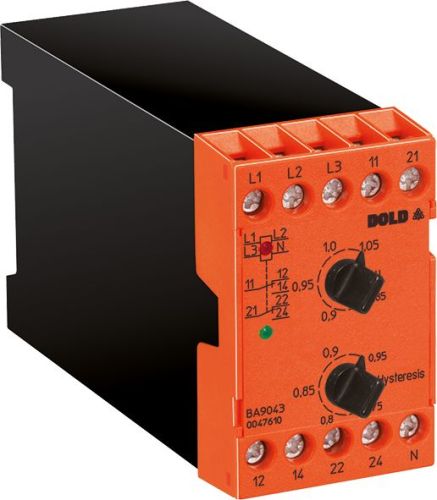
Dold 0029599 Undervoltage Relay BA9043 3/N
| Lieske Part No. | 1002284 |
|---|---|
| Mfg Part No | 0029599 |
| EAN-Code | 4030641295998 |
| Manufacturer | Dold |
| Here only | 33,35 EUR
39,69 EUR incl. VAT
|
Further information for Dold 0029599 Undervoltage Relay BA9043 3/N
| Technical data | |
| 1- / 3-phase | 3 |
| Auxiliary voltage | Without |
| Enclosure design | Switch cabinet |
| Nominal voltage max. | 3/N AC 690 / 400 V |
| Output contacts | 2 C/O contacts |
| Width | 45 mm |
| Type | BA 9043 |
| Operate delay | |
| Variant | |
| Contact equipping | 2 changeover contacts |
| Nominal voltage | 3/N 254/440 V |
| Time delay | without |
| Approvals and Markings | UKCA |
| Variant | For 3p4w systems |
Applications
The BA9043 is intended for industrial applications as well as railway installations where reliable voltage monitoring is required. It is particularly suitable for systems where voltage interruption could lead to production downtime or damage to machinery. The robust construction and high EMC immunity also make it suitable for environments with electromagnetic interference.
Functions and Equipment in Detail
The device features two changeover contacts as output contacts, designed for switching operations in the AC 15 and DC 13 categories. The maximum switching capacity is 2 A at AC 230 V for make contacts and 1 A at AC 230 V for break contacts. The electrical life is 2 x 10⁵ switching operations at 3 A and AC 230 V. The mechanical life exceeds 30 x 10⁶ switching operations. The contact configuration allows flexible integration into existing control systems. LED indicators signal operational readiness (red LED) and activation of the output relay (green LED), enabling visual monitoring of the operating status.
Technology Explained Simply
Voltage measurement is performed by arithmetic mean calculation of the three phases against the neutral conductor. For variants without a neutral conductor (e.g. BA9043/001), L1 and L2 are measured against L3. This model does not feature pickup delay, meaning the relay reacts immediately to undervoltage. The maximum overload capacity is 1.2 times nominal voltage continuously. The nominal power consumption is 4 VA. The temperature dependence of measurement is < 0.05 %/K, ensuring high measurement accuracy even with temperature fluctuations.
Compatibility and Accessories
The relay is available for networks with or without neutral conductor, with the variant described here designed for systems with neutral conductor. It is suitable for frequencies from 50 to 400 Hz and can be mounted in enclosures. Mounting is done on a DIN rail according to IEC/EN 60715. The connection terminals are designed for 2 x 2.5 mm² solid or 2 x 1.5 mm² stranded zinc-coated cable, with a tightening torque of 0.8 Nm. The width is 45 mm, enabling compact installation in standard control panels.
Mounting and Installation
Mounting is on a DIN rail, with cable connections made via plus-minus terminals with self-loosening clamp rings. Cables must be trimmed to a length of 10 mm. The front of the device features adjustment knobs for pickup and dropout values, which are user-friendly and adjusted via rotary potentiometers. The LED indicators allow for quick visual monitoring of the operating status.
Advantages in Operation
The continuous adjustability of pickup and dropout values, along with clear signaling via LED indicators, enables preventive maintenance. Rapid fault localization and the high reliability of the relay contribute to increased productivity. The immunity to harmonics ensures stable operation even in networks with harmonic distortions. EMC immunity according to IEC/EN 61000-4-2 to -4-5 ensures safe operation in electromagnetically stressed environments. The operating temperature range is between -20 °C and +60 °C, and the storage temperature range is between -25 °C and +60 °C. The operating altitude is limited to ≤ 2000 m.
Approvals and Markings
The device bears the UKCA mark, confirming compliance with applicable European safety and functional requirements. The overvoltage category is III, with a rated impulse withstand voltage of 6 kV at pollution degree 2 according to IEC 60664-1. Short-circuit withstand capability is ensured with a maximum fuse rating of 4 A gG/gL according to IEC/EN 60947-5-1.
Enclosure Design and Mounting
The relay is designed as an enclosure device and is mounted on a DIN rail. Dimensions are 45 mm (width) x 73 mm (height) x 132 mm (depth). The weight is 310 g. The front features adjustment knobs and LED indicators, while the rear has connection terminals for network and relay connections.
Operational Safety and Environmental Conditions
The device is designed for continuous operation and features high mechanical and electrical life. The operating temperature range is between -20 °C and +60 °C, and the storage temperature range is between -25 °C and +60 °C. The operating altitude is limited to ≤ 2000 m. Creepage and clearance distances correspond to the rated impulse withstand voltage of 6 kV at pollution degree 2. EMC immunity has been tested according to IEC/EN 61000-4-2 to -4-5, ensuring safe operation in electromagnetically stressed environments.

This is an offer of:
79279 Vörstetten
https://industry-electronics.com
Tel. 07666/88499-0
Fax. 07666/88499-111
Diesen Artikel finden Sie unter:
industry-electronics.com/artikel/1002284

Lieske Elektronik e.K.
Reutener Str. 1079279 Vörstetten
https://industry-electronics.com
Tel. 07666/88499-0
Fax. 07666/88499-111
Diesen Artikel finden Sie unter:
industry-electronics.com/artikel/1002284