
Dold 0029285 voltage relay BA9036/013 230V AC50Hz 0.5-10s
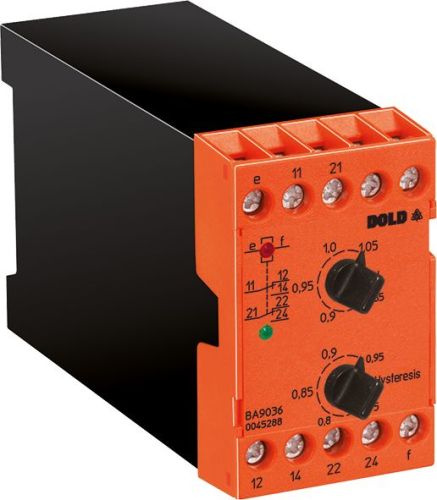
Dold 0029285 voltage relay BA9036/013 230V AC50Hz 0.5-10s
| Lieske Part No. | 1152407 |
|---|---|
| Mfg Part No | 0029285 |
| EAN-Code | 4030641292850 |
| Manufacturer | Dold |
| Here only | 266,52 EUR
317,16 EUR incl. VAT
|
Further information for Dold 0029285 voltage relay BA9036/013 230V AC50Hz 0.5-10s
| Technical data | |
| 1- / 3-phase | 1 |
| Auxiliary voltage | Without |
| Enclosure design | Switch cabinet |
| Nominal voltage max. | AC 400 V |
| Output contacts | 2 C/O contacts |
| Width | 45 mm |
| Type | BA 9036 |
| Operate delay | |
| Variant | |
| Contact equipping | 2 changeover contacts |
| Nominal voltage | AC 230 V 50 Hz |
| Time delay | 0,5 - 10 s |
| Approvals and Markings | CCC |
| Variant | Undervoltage relay. Open circuit operation. With time delay |
Applications
This relay is intended for monitoring electrical networks in industrial and technical installations where stable voltage supply is critical. It is used in enclosures and serves to protect machines, drives, pumps, or lighting systems. The early detection of voltage irregularities enables preventive maintenance and contributes to higher operational and system safety. Preventive maintenance is supported by continuous monitoring, minimizing downtime and failures.
Functions and Equipment in Detail
The device features 2 changeover contacts as output contacts for switching operations. The contacts are rated for a thermal current of 6 A and comply with switching capacity requirements according to IEC/EN 60947-5-1 for AC 15 (make: 2 A / AC 230 V, break: 1 A / AC 230 V) and DC 13 (make: 1 A / DC 24 V, break: 1 A / DC 24 V). The electrical life expectancy is 150,000 switching operations at 6 A and AC 230 V, while the mechanical life expectancy is 30 million switching operations. The LED indicators signal operational readiness (upper LED) and activation of the output relay (lower LED), enabling visual monitoring of the operating status.
Technology Explained Simply
The relay monitors the applied voltage and compares it with the set pickup value. In case of undervoltage below the set threshold (e.g., below 0.6 times nominal voltage), the output is activated, with the time delay delaying the response to ignore short-term fluctuations. The pickup delay is active and ensures stable response. The adjustment ranges are between 0.85 and 1.05 times nominal voltage, with the /1_ _ variant covering a range of 0.9 to 1.25 times nominal voltage. The dropout ratio (hysteresis) is 0.75 to 0.95 of the set value, ensuring secure return to normal operation. The repeatability accuracy is ± 0.5 % under constant parameters.
Compatibility and Accessories
The device is rated for a maximum nominal voltage of AC 400 V and can be used in networks with frequencies of 50 or 60 Hz. The input power is 6 VA / 10 W. For DC voltages above 60 V, an external series resistor is required, connected to terminals e and z. The measured voltage is connected to terminals e and f. Required series resistors are available as accessories, e.g. ZWS 20 SL 1.5 kΩ 20 W for DC 110 V. The device operates without auxiliary voltage, simplifying installation.
Mounting and Installation
The relay is designed for mounting in enclosures and has a width of 45 mm, making it suitable for standard control panels. Connections are made via terminals designed for wire connections. The operating and storage temperature ranges are between -20 °C and +60 °C. The devices are manufactured according to IEC/EN 60255-1 and carry the CCC certification.
Operational Advantages
Thanks to the adjustable pickup and dropout values as well as the time delay, the relay can be adapted to specific requirements. The LED indicators allow for quick fault localization. The operation without auxiliary voltage reduces installation complexity. Preventive maintenance is supported by continuous monitoring, increasing productivity and minimizing downtime. The high mechanical life expectancy and robust design ensure reliable long-term use in industrial environments.

This is an offer of:
79279 Vörstetten
https://industry-electronics.com
Tel. 07666/88499-0
Fax. 07666/88499-111
Diesen Artikel finden Sie unter:
industry-electronics.com/artikel/1152407

Lieske Elektronik e.K.
Reutener Str. 1079279 Vörstetten
https://industry-electronics.com
Tel. 07666/88499-0
Fax. 07666/88499-111
Diesen Artikel finden Sie unter:
industry-electronics.com/artikel/1152407