
Dold 0028610 BA9043/001 3AC50-400Hz 440V undervoltage relay
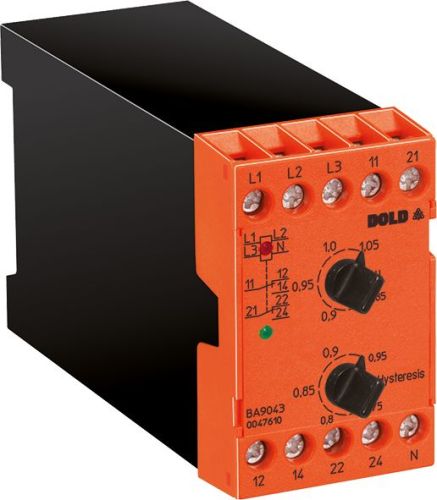
Dold 0028610 BA9043/001 3AC50-400Hz 440V undervoltage relay
| Lieske Part No. | 1002295 |
|---|---|
| Mfg Part No | 0028610 |
| EAN-Code | 4030641286101 |
| Manufacturer | Dold |
| Here only | 262,20 EUR
312,02 EUR incl. VAT
|
Further information for Dold 0028610 BA9043/001 3AC50-400Hz 440V undervoltage relay
| Technical data | |
| 1- / 3-phase | 3 |
| Auxiliary voltage | Without |
| Enclosure design | Switch cabinet |
| Nominal voltage max. | 3/N AC 690 / 400 V |
| Output contacts | 2 C/O contacts |
| Width | 45 mm |
| Type | BA 9043 |
| Operate delay | |
| Variant | |
| Contact equipping | 2 changeover contacts |
| Nominal voltage | 3AC 440 V |
| Time delay | without |
| Approvals and Markings | UKCA |
| Variant | For 3p3w systems |
Applications
This relay is suitable for industrial applications as well as railway applications. The simple wiring and direct connection capability to the network being monitored reduce installation effort. The operating temperature range is from -20 °C to +60 °C, allowing use even in industrial environments with variable temperatures.
Functions and Equipment in Detail
The device features two changeover contacts as output contacts, designed for switching operations with a thermal current of up to 6 A per contact. Switching capacities are 2 A/AC 230 V for closing contacts and 1 A/AC 230 V for opening contacts according to AC 15 (IEC/EN 60947-5-1). The electrical life expectancy is at least 200,000 switching cycles at 3 A/AC 230 V and cos ϕ = 1. The mechanical life expectancy is stated to be over 30 million switching cycles. The output relays operate on the zero-current principle, meaning they are not activated in the event of a fault, ensuring safe disconnection. Two LEDs serve as indicators: a red LED indicates that supply voltage is present, while a green LED signals the activated state of the output relay.
Technology Explained Simply
The arithmetic mean measurement enables precise voltage monitoring by capturing and averaging the voltage values of individual phases. In the variant without a neutral conductor (BA9043/001), measurement is performed by comparing phases L1 and L2 against L3. There is no pickup delay, meaning the relay reacts immediately to undervoltage. The maximum overload capacity is 1.2 times the nominal voltage continuously. The nominal frequency is 50 to 400 Hz, with a frequency tolerance of ±5 %. The temperature dependence of measurement is < 0.05 %/K, ensuring stable performance even with temperature fluctuations.
Compatibility and Accessories
The relay is designed for networks without a neutral conductor and complies with the standard IEC/EN 60255-1. It is suitable for operating altitudes up to 2000 m. EMC requirements are met: the devices are protected against static discharge (8 kV), high-frequency radiation (20 V/m), fast transients (2 kV), and surge voltages (1 kV between supply lines, 2 kV between lines and earth). The rated impulse voltage is 6 kV at pollution degree 2. The overvoltage category is III. The devices are designed for use in enclosures and mount on DIN rail according to IEC/EN 60715.
Mounting and Installation
Mounting is on DIN rail, with connection terminals designed for 2 x 2.5 mm² rigid or 2 x 1.5 mm² flexible conductors with shrink tubing. The terminals are equipped with M3.5 plus-minus screws with self-lifting clips. Dimensions are 45 mm (width) x 73 mm (height) x 132 mm (depth). The tightening torque is specified as 0.8 Nm. Terminal markings are L1, L2, L3 for network connections and 11, 12, 14 as well as 21, 22, 24 for the two changeover contacts.
Advantages in Operation
The simple operation via rotary potentiometers and direct network connection without auxiliary voltage simplify installation and maintenance. The LED indicators enable quick fault localization. The high mechanical and electrical life expectancy, as well as robustness against environmental influences, ensure reliable performance over a long period. Use in railway installations and industrial environments demonstrates the device’s reliability under demanding conditions. UKCA certification is provided, enabling use in the United Kingdom.

This is an offer of:
79279 Vörstetten
https://industry-electronics.com
Tel. 07666/88499-0
Fax. 07666/88499-111
Diesen Artikel finden Sie unter:
industry-electronics.com/artikel/1002295

Lieske Elektronik e.K.
Reutener Str. 1079279 Vörstetten
https://industry-electronics.com
Tel. 07666/88499-0
Fax. 07666/88499-111
Diesen Artikel finden Sie unter:
industry-electronics.com/artikel/1002295