
Dold 0028206 BA7632.31 AC50/60Hz 230V forward relay
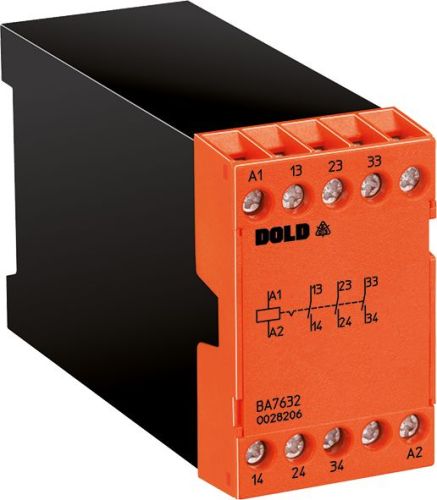
Dold 0028206 BA7632.31 AC50/60Hz 230V forward relay
| Lieske Part No. | 1001313 |
|---|---|
| Mfg Part No | 0028206 |
| EAN-Code | 4030641282066 |
| Manufacturer | Dold |
| Here only | 274,69 EUR
326,88 EUR incl. VAT
|
Further information for Dold 0028206 BA7632.31 AC50/60Hz 230V forward relay
| Technical data | |
| Enclosure design | Switch cabinet |
| Output contacts max. | 3 NO contacts |
| Thermal current Ith max. | 10 A |
| Width | 45 mm |
| Type | BA 7632 |
| Suppressor circuit on the coil input | |
| Variant | |
| Contact equipping | 3 NO contacts |
| Nominal voltage | AC 230 V |
| Variant | 3 NO contacts. Contact 1: E-A-A etc., Contact 2: A-E-A etc., Contact 3: A-A-E etc. |
Applications
This relay is designed for applications requiring sequential control of electrical loads, such as in automation technology, manufacturing industry, or plants with multi-stage operating procedures. It is particularly suitable for processes requiring a defined, repeatable switching sequence, without the need for continuous power supply to maintain the holding state.
Functions and Equipment in Detail
The device operates with impulse excitation via terminals A1-A2. It is not necessary for the coil to be continuously energized during the switching state, enabling energy-efficient operation and reducing self-heating. In the event of power failure, the relay remains in the last reached switching position, which is important for safety and reliability in critical installations. The protective circuit at the coil input protects the device against transient voltage spikes.
Technology Explained Simply
The switching function is performed by a mechanical rotating armature system activated by the magnetic impulse. The cam discs ensure that the contacts are actuated in a predefined sequence. The maximum thermal current rating is 10 A, describing the contact load capacity under continuous operation. The operating time of the contacts is less than 90 ms, and the release time is less than 180 ms, ensuring fast and precise switching. The electrical life is 1 million switching cycles at 50 % switching load and 0.5 million switching cycles at 100 % switching load. The mechanical life exceeds 5 million switching cycles.
Compatibility and Accessories
The relay complies with IEC/EN 61810-1 and can be mounted in enclosures with standard widths of 45 mm. It is designed for operating temperatures from -20 °C to +70 °C at 40 % ED (cycle duration 250 s). The operating altitude is limited to a maximum of 2000 m above sea level. The permissible switching frequency is 3000 switching cycles per hour. The rated frequency is 50/60 Hz. The maximum fuse rating is 10 A gG/gL. The contacts are designed for various load types: at AC 230 V and cos ϕ 1 to 0.7, the rated switching capacity is 4 A; at cos ϕ 0.4, it is 3 A. At DC 24 V, the switching capacity is 1.5 A for resistive loads and 0.8 A for inductive loads.
Mounting and Installation
The relay is mounted in enclosures, with a standardized width of 45 mm. The connection terminals are clearly labeled: A1 and A2 for the coil, and contact terminals 11, 12, 14, 21, 22, 24, 33, 34 for the three closers. Mounting is done in standard enclosure mounting rails or on mounting plates. The terminal designation conforms to standards and allows for unambiguous assignment.
Advantages in Operation
The operation without holding power reduces energy consumption and heat generation. The defined switching position during power failure enhances safety. High switching reliability and long service life ensure dependable performance in industrial applications. Compatibility with various voltages (AC 24, 110, 230 V and DC 24 V) expands the range of applications. EMC testing according to IEC/EN 61000-4-2 to -4-6 ensures robust operation in electromagnetically noisy environments.

This is an offer of:
79279 Vörstetten
https://industry-electronics.com
Tel. 07666/88499-0
Fax. 07666/88499-111
Diesen Artikel finden Sie unter:
industry-electronics.com/artikel/1001313

Lieske Elektronik e.K.
Reutener Str. 1079279 Vörstetten
https://industry-electronics.com
Tel. 07666/88499-0
Fax. 07666/88499-111
Diesen Artikel finden Sie unter:
industry-electronics.com/artikel/1001313