
Dold 0027863 BA9043/003 undervoltage relay 3AC50-400Hz
Industrial Material > Industrial relays and contactors > Switching units / measuring, control relay
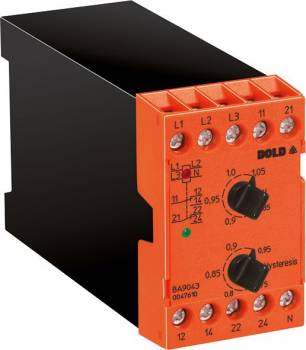
Dold 0027863 BA9043/003 undervoltage relay 3AC50-400Hz
| Lieske Part No. | 1312997 |
|---|---|
| Mfg Part No | 0027863 |
| EAN-Code | 4030641278632 |
| Manufacturer | Dold |
| Here only | 302,01 EUR
359,39 EUR incl. VAT
|
Further information for Dold 0027863 BA9043/003 undervoltage relay 3AC50-400Hz
| Technical data | |
| 1- / 3-phase | 3 |
| Auxiliary voltage | Without |
| Enclosure design | Switch cabinet |
| Nominal voltage max. | 3/N AC 690 / 400 V |
| Output contacts | 2 C/O contacts |
| Width | 45 mm |
| Type | BA 9043 |
| Operate delay | |
| Variant | |
| Contact equipping | 2 changeover contacts |
| Nominal voltage | 3AC 100 V |
| Time delay | 0,5 - 10 s |
| Approvals and Markings | UKCA, CCC |
| Variant | For 3p3w systems. With adjustable time delay |
Applications
This relay is suitable for industrial applications as well as railway applications. It monitors 3-phase AC networks and is particularly useful in environments with high operational load and critical processes, where reliable voltage monitoring is required. The device is installed in enclosures, with a width of 45 mm enabling compact mounting on DIN rail. The operating temperature range is from -20 °C to +60 °C, and the storage temperature range is from -25 °C to +60 °C.
Functions and Equipment in Detail
The device features two changeover contacts as output contacts, used for switching operations in control technology. The contacts are rated for a thermal current of up to 6 A per contact and meet switching capacities according to AC 15 (make: 2 A / AC 230 V) and DC 13 (break: 1 A / DC 24 V). The electrical life expectancy is at least 200,000 switching operations at 3 A and AC 230 V, while the mechanical life expectancy exceeds 30 million switching operations. LED indicators signal operational readiness (red LED) and contact position (green LED), enabling visual verification of the operating status.
Technology Explained Simply
The device operates on the rest current principle, where the output relay is not activated in the event of a fault, but only reactivates upon voltage restoration. The time delay is adjustable and ranges from 0.5 to 10 seconds. This delay is only effective if the voltage is at least 60 % of the nominal voltage. Below 40 % of the nominal voltage, the relay drops out immediately. Harmonic insensitivity ensures reliable operation even with distorted voltage waveforms.
Compatibility and Accessories
The relay is designed for networks without a neutral conductor and complies with the standard IEC/EN 60255-1. It is available for nominal voltages from 3AC 100 V to 3/N AC 690/400 V. The frequency range coverage of 50 to 400 Hz makes it suitable for various industrial and railway applications. Certifications UKCA and CCC are available, enabling use in respective markets. Mounting is on DIN rail, with terminals designed for 2 x 2.5 mm² solid or 2 x 1.5 mm² stranded zinc-coated cable.
Mounting and Installation
Mounting is on DIN rail in accordance with IEC/EN 60715. The terminals are equipped with plus-minus screws M3.5 with self-lifting clips, with a recommended tightening torque of 0.8 Nm. Cable dimensions are 2 x 2.5 mm² for solid or 2 x 1.5 mm² for stranded zinc-coated cable. The device dimensions are 45 mm (width) x 73 mm (height) x 132 mm (depth). Mounting is via DIN rail, ensuring secure and standardized installation.
Advantages in Operation
Thanks to adjustable pickup and dropout values as well as time delay, the device can be adapted to the specific requirements of the respective network. LED indicators enable quick fault localization. Harmonic insensitivity and high EMC immunity (e.g. 8 kV static discharge, 2 kV fast transients) ensure reliable operation even in electrically demanding environments. Preventive maintenance is supported by the clear indication of the operating status, increasing productivity and minimizing downtime.

This is an offer of:
79279 Vörstetten
https://industry-electronics.com
Tel. 07666/88499-0
Fax. 07666/88499-111
Diesen Artikel finden Sie unter:
industry-electronics.com/artikel/1312997

Lieske Elektronik e.K.
Reutener Str. 1079279 Vörstetten
https://industry-electronics.com
Tel. 07666/88499-0
Fax. 07666/88499-111
Diesen Artikel finden Sie unter:
industry-electronics.com/artikel/1312997