
Dold 0025127 time relay delayed release 230V
Industrial Material > Industrial relays and contactors > Industrial Timers
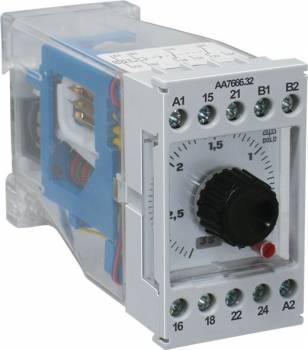
Dold 0025127 time relay delayed release 230V
| Lieske Part No. | 276894 |
|---|---|
| Mfg Part No | 0025127 |
| EAN-Code | 4030641251277 |
| Manufacturer | Dold |
| Here only | 323,26 EUR
384,68 EUR incl. VAT
|
Further information for Dold 0025127 time relay delayed release 230V
| Technical data | |
| Enclosure design | Switch cabinet |
| Time function(s) | Off-delay, with control signal |
| Width | 45 mm |
| Type | AA 7666 |
| Variant | |
| Contact equipping | 1 changeover contact delayed, 1 changeover undelayed |
| Nominal voltage | AC 230 V |
| Time range | 0,15 s - 30 h |
Applications
This device is designed for applications requiring a delay-on-dropout, i.e., when a switching operation should occur with delay after the control signal is switched off. Typical applications include motor coast-down behavior, switching off fans after a machine stops, or delaying switching operations in automation systems. The voltage failure safety ensures that the relay immediately returns to its default position in case of power failure, which is important for safety in industrial processes.
Functions and equipment in detail
The time relay features two changeover contacts: one delayed and one instantaneous contact. The delayed contact switches only after the set delay time has elapsed, while the instantaneous contact reacts immediately when the control signal is applied. The time delay indicator on the device visually displays the progress of the delay time, facilitating monitoring of the operating status. The repeatability is ≤ ± 0.5 % of the scale end value, with a permissible deviation of ≤ ± 1 % in the 3 and 6 second ranges. The reset time is < 150 ms, meaning the device is quickly ready for the next switching operation.
Technology explained simply
The time control operates mechanically via a clockwork principle, driven by the energy of the control signal. The delay time is set via a continuous rotary switch positioned on an absolute scale. Adjustment is possible from the front, simplifying maintenance and adaptation during operation. The contact materials consist of AgNi + 0.2 μm Au, ensuring high switching capacity and long service life. The rated operating voltage is AC 250 V, and the contacts switch with an operating time < 35 ms and a release time < 60 ms.
Compatibility and accessories
The device is designed for use in enclosures and complies with the standard EN 61812-1 for time relays. It is compatible with a rated frequency of 50/60 Hz, with a frequency range of ± 5 % around the rated frequency allowed. The voltage range is between 0.8 and 1.1 times the rated voltage. Short-circuit resistance is ensured by a maximum fuse rating of 10 A gG/gL. The electrical service life is at least 100,000 switching operations at 3 A and AC 230 V, and 500,000 switching operations at 1 A. The mechanical service life exceeds 30 million switching operations or 15,000 operating hours.
Mounting and installation
The device is mounted in standard enclosures, with the width of 45 mm enabling easy integration into existing control systems. The terminal connections are designed for connecting control and load lines. The delay time is adjusted via the rotary switches on the front, with the scale allowing precise time indication. Mounting requires no special tools, and the terminal markings (A1/A2, B1/B2, 15/16, 27/28) are detailed in the data sheet.
Advantages in operation
The wide adjustment range from 0.15 s to 30 h allows flexible adaptation to different requirements. The simple adjustment via continuous rotary switches reduces maintenance time. The purely mechanical time delay is robust and independent of electronic components, increasing reliability. The voltage failure safety and the switch position indicator (except for EH 7666) support operational safety. The repeatability and short reset time ensure precise and fast responses in industrial operation.

This is an offer of:
79279 Vörstetten
https://industry-electronics.com
Tel. 07666/88499-0
Fax. 07666/88499-111
Diesen Artikel finden Sie unter:
industry-electronics.com/artikel/276894

Lieske Elektronik e.K.
Reutener Str. 1079279 Vörstetten
https://industry-electronics.com
Tel. 07666/88499-0
Fax. 07666/88499-111
Diesen Artikel finden Sie unter:
industry-electronics.com/artikel/276894