
Dold 0024457 time relay EF7616.24 delayed-activation
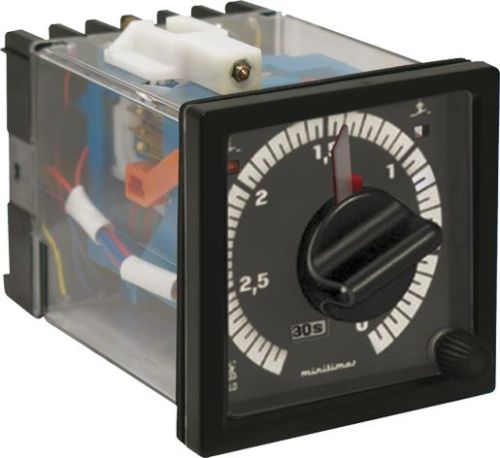
Dold 0024457 time relay EF7616.24 delayed-activation
| Lieske Part No. | 1153861 |
|---|---|
| Mfg Part No | 0024457 |
| EAN-Code | 4030641244576 |
| Manufacturer | Dold |
| Here only | 314,24 EUR
373,95 EUR incl. VAT
|
Further information for Dold 0024457 time relay EF7616.24 delayed-activation
| Technical data | |
| Enclosure design | Front panel mounting |
| Output contacts | 1 C/O contact |
| Time function(s) | On-delay |
| Width | 72 mm |
| Type | EF 7616 |
| Variant | |
| Contact equipping | 1 NC contact delayed, 1 NC contact undelayed, 1 NO contact delayed, 1 NO contact undelayed |
| Nominal voltage | AC 230 V |
| Time range | 0,2 s - 60 h |
Applications
This time relay is designed for applications in industrial environments where precise, time-controlled switching sequences are required. Typical applications include controlling pumps, fans, lighting systems, or protecting electrical installations from too rapid start-up. The front of the device is protected against spray water and complies with protection class IP 65, enabling use in outdoor or damp environments. The width is 72 mm, and the device is designed for front panel mounting, allowing integration into standard switchboards with 72 mm module width.
Functions and Equipment in Detail
The relay features contact configuration with one delayed normally open contact, one instantaneous normally open contact, one delayed normally closed contact, and one instantaneous normally closed contact. This configuration enables simultaneous control of multiple loads with different time delays. The delayed contacts switch only after the set delay time has elapsed, while the instantaneous contacts switch immediately upon relay activation. A time progress indicator with a red pointer on the device scale visually displays the progress of the set time. Additionally, a switching position indicator is integrated, which is visible when the normally closed contacts are closed (not available on the EH 7616 variant). The connection terminals are clearly labeled: A1-A2 for control and operating voltage, B1-B2 for control voltage (in versions with voltage loss protection), and contact terminals 15-16 (delayed normally open), 27-28 (delayed normally closed), 31-32 (instantaneous normally open), and 43-44 (instantaneous normally closed).
Technology Explained Simply
The time control is based on a purely mechanical principle: a synchronous motor drives a clockwork mechanism, which displays the elapsed time via a pointer. The delay time is adjusted using a rotary switch, which affects the motor speed and thus the rate of time progression. The frequency switching between 50 Hz and 60 Hz is performed at the rear of the device by shifting a latch using a screwdriver. The voltage loss protection (optional) ensures that the elapsed time is retained in case of power failure, and the delayed contacts maintain their position until the end of the set time. The contacts are designed for industrial environments and comply with standard EN 61812-1.
Compatibility and Accessories
The device is part of the MINITIMER series and can be combined with other models in the series, such as AA 7616, EC 7616, or EH 7616, in common control systems. The front panel mounting design allows installation in standard switchboards. Terminal labeling and functions are consistent across the series, facilitating integration into existing installations. Frequency switching is manual, making the device suitable for power supplies with 50 Hz or 60 Hz.
Mounting and Installation
The time relay is installed in a front panel with a width of 72 mm. Mounting is done by securing it to the panel, with connection terminals connected to the corresponding wires. The control and operating voltage is connected to A1-A2, with additional B1-B2 required for control voltage in versions with voltage loss protection. The delay time is adjusted using the rotary switches on the front, with the desired time range selected manually. Frequency switching is performed at the rear of the device.
Operational Advantages
The mechanical time control offers high reliability and repeatability, especially for longer delay times. The wide adjustment range from 0.2 seconds to 60 hours allows flexible adaptation to different requirements. Front-side adjustment and the visual time progress indicator simplify commissioning and maintenance. The IP 65 protection class ensures robust functionality in damp or dusty environments. The switching position indicator supports diagnosis of operating states, especially in complex control sequences.

This is an offer of:
79279 Vörstetten
https://industry-electronics.com
Tel. 07666/88499-0
Fax. 07666/88499-111
Diesen Artikel finden Sie unter:
industry-electronics.com/artikel/1153861

Lieske Elektronik e.K.
Reutener Str. 1079279 Vörstetten
https://industry-electronics.com
Tel. 07666/88499-0
Fax. 07666/88499-111
Diesen Artikel finden Sie unter:
industry-electronics.com/artikel/1153861