
Dold 0022767 control cable BA7905.81 DC220V 1.5-30S
Cables > Control line > Flexible Control lines
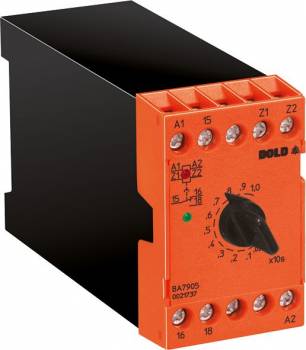
Dold 0022767 control cable BA7905.81 DC220V 1.5-30S
| Lieske Part No. | 467056 |
|---|---|
| Mfg Part No | 0022767 |
| EAN-Code | 4030641227678 |
| Manufacturer | Dold |
| Here only | 126,33 EUR
150,33 EUR incl. VAT
|
Further information for Dold 0022767 control cable BA7905.81 DC220V 1.5-30S
| Technical data | |
| Enclosure design | Switch cabinet |
| Output contacts | 2 C/O contacts |
| Time function(s) | On-delay |
| Width | 45 mm |
| Type | BA 7905 |
| Variant | |
| Contact equipping | 1 changeover contact delayed |
| Nominal voltage | DC 220 V |
| Time range | 1,5 - 30 s |
Applications
The relay is used in industrial control systems where controlled, time-delayed activation of output relays is required. Typical applications include gradual motor start-up, delaying switching operations in automation systems, or ensuring an orderly sequence during machine commissioning. The high repeatability of ≤ ± 1 % of the scale end value ensures consistent operating procedures.
Functions and Equipment in Detail
The device features a continuously adjustable rotary switch for setting the delay time. The contact configuration includes 1 delayed changeover contact, with a total of 2 changeover contacts available as output contacts. Operational readiness and contact position are indicated by LED displays: the upper LED lights up when operating voltage is applied, and the lower LED indicates activation of the output relay. This visual feedback simplifies diagnosis and maintenance.
Technology Explained Simply
The time relay operates on the principle of delayed activation: as soon as operating voltage is applied, the delay time begins, and the output contact only switches after the set time has elapsed. The rated voltage is DC 220 V, and the device can be operated without a series resistor. The reset time is 100 ms at 50 V and 50 ms at 100 V, enabling rapid reset after de-energisation. The temperature dependence of the timing function is 0.2 % per Kelvin, ensuring stable performance over a wide temperature range.
Compatibility and Accessories
The relay is designed for use in enclosures and has a width of 45 mm, making it suitable for integration into standard control panels. Remote potentiometer connection is possible via terminals Z1 and Z2, allowing the time delay to be adjusted externally, for example, via an external potentiometer. Terminal markings include the supply voltage (A1/A2), remote potentiometer connections (Z1/Z2), and changeover contacts (15/16/18 and 25/26/28).
Mounting and Installation
Mounting is carried out in an enclosure, with the width of 45 mm determining the mounting height. The connection terminals are designed for connection to control wiring. The operating voltage is connected to A1 (+) and A2 (–). The output relay contacts (15/16/18 and 25/26/28) are connected to the loads to be controlled. The LED indicators are integrated directly into the device and require no additional wiring.
Advantages in Operation
The high repeatability and wide adjustment range allow flexible adaptation to different requirements. The LED indicators provide direct visual feedback on the operating status. The use of a remote potentiometer allows external adjustment of the delay time, which is advantageous in complex control systems. The device is designed for continuous operation and can be used at operating temperatures from –20 °C to +60 °C. The enclosure protection rating is IP 40, and the terminals are IP 20, providing protection against contact and dust. The electrical life is 250,000 switching operations at 3 A/AC 230 V, and the mechanical life is 50 million switching operations. The maximum switching frequency is 6,000 switching operations per hour. Short-circuit resistance is ensured by a maximum fuse rating of 4 A gG/gL.
Standards and Approvals
The device complies with standard EN 61812-1 for delayed-action time relays. EMC requirements are met according to IEC/EN 61000-4-2 to -4-6. Radio frequency interference suppression complies with emission limit class B according to EN 55011. The rated impulse voltage is 4 kV, and the pollution degree is 2. Creepage and clearance distances are designed in accordance with IEC 60664-1. The enclosure is made of thermoplastic with V0 flammability rating according to UL Subj. 94, ensuring good flame resistance. Vibration resistance is specified at an amplitude of 0.35 mm at a frequency of 10 to 55 Hz.

This is an offer of:
79279 Vörstetten
https://industry-electronics.com
Tel. 07666/88499-0
Fax. 07666/88499-111
Diesen Artikel finden Sie unter:
industry-electronics.com/artikel/467056

Lieske Elektronik e.K.
Reutener Str. 1079279 Vörstetten
https://industry-electronics.com
Tel. 07666/88499-0
Fax. 07666/88499-111
Diesen Artikel finden Sie unter:
industry-electronics.com/artikel/467056