
Dold 0021526 toggle relay AD8851.17 230V
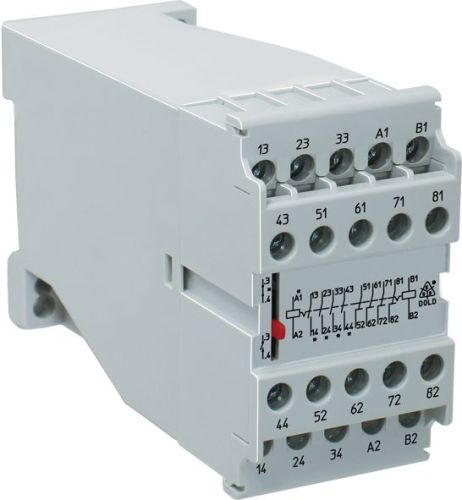
Dold 0021526 toggle relay AD8851.17 230V
| Lieske Part No. | 1001728 |
|---|---|
| Mfg Part No | 0021526 |
| EAN-Code | 4030641215262 |
| Manufacturer | Dold |
| Here only | 198,39 EUR
236,08 EUR incl. VAT
|
Further information for Dold 0021526 toggle relay AD8851.17 230V
| Technical data | |
| Enclosure design | Switch cabinet |
| Output contacts max. | 4 NC contacts, 4 NO contacts |
| Thermal current Ith max. | 8 A |
| Width | 45 mm |
| Type | AD 8851 |
| Variant | |
| Contact equipping | 2 NO contacts, 2 NC contacts |
| Nominal voltage | AC 230 V |
Applications
This relay is designed for use in industrial control and protection circuits, particularly in systems where secure latching of switching states is required. Typical application areas include machine controls, drive technology, safety functions, and process automation. The latching function ensures that the switching state is maintained even during brief interruptions in control voltage, which is advantageous in critical systems.
Functions and Equipment in Detail
The AD8851.17 features a contact configuration with 2 NO contacts and 2 NC contacts, with a maximum contact count per relay of up to 4 NO and 4 NC contacts. The contacts are arranged on a common magnetic system connected to coil A1-A2. This ensures that no undefined contact states occur when both magnetic systems are energized simultaneously. Operation is performed via impulse or continuous energization of coils A1-A2 or B1-B2. A toggle lever on the front plate allows manual adjustment of the magnetic system and simultaneously indicates the current magnetic or contact position.
Technology Explained Simply
The bistable operation means the relay can assume two stable states (on or off), which are maintained without continuous power supply. Latching is achieved through the mutual mechanical latching of the two flip-arm magnetic systems. The response and release time of the contacts is less than 40 ms each, enabling fast switching response. The thermal current Ith is a maximum of 8 A, applicable when using two contacts. When using three or four contacts, the value reduces accordingly to 5 A or 4 A.
Compatibility and Accessories
The relay is compliant with IEC/EN 61810-1 and designed for use in enclosures. It is suitable for operating temperatures from -20 °C to +45 °C and can be operated up to an altitude of 2000 m above sea level. Switching capacities are 3 A for NO contacts and 1 A for NC contacts at AC 230 V according to IEC/EN 60947-5-1. The electrical life is at least 100,000 switching cycles at 1 A and AC 230 V, with an allowable switching frequency of 3000 switching cycles per hour. Short-circuit resistance is ensured by a maximum fuse rating of 10 A gG/gL.
Mounting and Installation
The relay is mounted in enclosures and requires a width of 45 mm. Mounting is done on a standard enclosure base, with connection terminals clearly marked for control coils (A1-A2, B1-B2) and load contacts (11-14, 21-24, 31-34, 41-44). The circuit diagrams in the datasheet show possible contact arrangements, with the coil marked with an asterisk closing the corresponding contacts also marked with an asterisk.
Operational Advantages
The bistable function enables energy-efficient control, as no continuous power supply is required to maintain the switching state. The mechanical stability provided by the torsion-resistant mounting frame ensures reliability under harsh operating conditions. The contact position indication via the toggle lever simplifies maintenance and diagnostics, as the current state is visually identifiable. The high electrical life and robust construction make the relay suitable for long-term use in industrial environments.

This is an offer of:
79279 Vörstetten
https://industry-electronics.com
Tel. 07666/88499-0
Fax. 07666/88499-111
Diesen Artikel finden Sie unter:
industry-electronics.com/artikel/1001728

Lieske Elektronik e.K.
Reutener Str. 1079279 Vörstetten
https://industry-electronics.com
Tel. 07666/88499-0
Fax. 07666/88499-111
Diesen Artikel finden Sie unter:
industry-electronics.com/artikel/1001728