
Dold 0017935 AK9840.82 3AC50/60Hz 415V asymmetrical relay
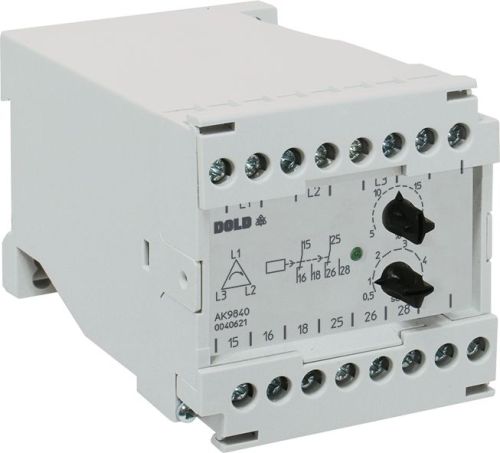
Dold 0017935 AK9840.82 3AC50/60Hz 415V asymmetrical relay
| Lieske Part No. | 100040 |
|---|---|
| Mfg Part No | 0017935 |
| EAN-Code | 4030641179359 |
| Manufacturer | Dold |
| Here only | 669,51 EUR
796,72 EUR incl. VAT
|
Further information for Dold 0017935 AK9840.82 3AC50/60Hz 415V asymmetrical relay
| Technical data | |
| 1- / 3-phase | 3 |
| Enclosure design | Switch cabinet |
| Measuring range max. | 3 AC 690 V |
| Output contacts | 2 C/O contacts |
| Standard measuring range | 3 AC 400 V |
| Width | 70 mm |
| Type | AK 9840 |
| Operate delay | |
| Variant | |
| Contact equipping | 2 changeover contacts |
| Nominal voltage | 3AC 415 V 50/60 Hz |
Applications
This relay is designed for rated voltages of 3 AC 110 to 690 V, with the variant specified here configured for 3 AC 415 V 50/60 Hz. It is particularly suitable for networks with high harmonic content, such as those found in installations with thyristors, automatic reactive power compensation systems, or emergency power supplies. Harmonic resistance is ensured by the selected measurement principle, preventing any distortion of the pickup values. Monitoring of networks with a neutral conductor is also possible, although the N terminal is not required — in this case, the rated voltage must be converted to line-to-line voltage.
Functions and Equipment in Detail
The device detects voltage asymmetry by measuring the difference between two voltages, thus not responding to symmetrical voltage drops as long as the undervoltage detection (fixed at 0.7 U_N) is not exceeded. If the set asymmetry threshold (5 to 20 % U_N) is exceeded or undervoltage occurs, the output relay is deactivated after the adjustable pickup delay (0.5 to 5 seconds, continuously adjustable). In the case of incorrect phase sequence, the relay trips immediately. Reverse voltage detection is also integrated; depending on network conditions, reverse power feed is recognized either as asymmetry (delayed) or as incorrect phase sequence (immediate).
Technology Explained Simply
The device measures voltage symmetry by arithmetic averaging of the three phases. In the event of a fault, the output relay is de-energized, causing contacts 15-16 and 25-26 to open, while 15-18 and 25-28 remain closed. The LED indicator lights up when the output relay is active and turns off in the event of a fault. The contact configuration includes 2 changeover contacts, which can be used to control auxiliary functions such as alarms or emergency power switching. The width is 70 mm, enabling compact installation in standard enclosures.
Compatibility and Accessories
The relay is designed for use in three-phase networks and complies with the standard IEC/EN 60255-1. It is suitable for applications requiring automatic switching to battery-powered emergency lighting when the mains voltage drops by 30 % (according to VDE 0108). The rated frequency is 50/60 Hz, with a frequency range of ±5 % or ±10 % up to 1.5 s. The rated consumption is limited to ≤ 7.1 VA.
Mounting and Installation
Mounting is carried out in an enclosure. The connection terminals L1, L2, L3 are used to connect to the three-phase network to be monitored. The output contacts (15-16, 15-18, 25-26, 25-28) are intended for connection to external control or alarm devices. The pickup delay is adjusted using a rotary control on the device. The LED indicator provides visual status monitoring.
Advantages in Operation
By detecting voltage asymmetry, undervoltage, or phase failure early, the relay enables preventive maintenance and prevents costly damage to connected machines and systems. The simple installation without auxiliary voltage and high robustness against harmonics make it a reliable solution for demanding industrial environments. The adjustable pickup delay allows adaptation to specific requirements, while the LED indicator clearly signals the operating status.

This is an offer of:
79279 Vörstetten
https://industry-electronics.com
Tel. 07666/88499-0
Fax. 07666/88499-111
Diesen Artikel finden Sie unter:
industry-electronics.com/artikel/100040

Lieske Elektronik e.K.
Reutener Str. 1079279 Vörstetten
https://industry-electronics.com
Tel. 07666/88499-0
Fax. 07666/88499-111
Diesen Artikel finden Sie unter:
industry-electronics.com/artikel/100040