
Dold 0009662 IK8800.11 DC24V remote switch
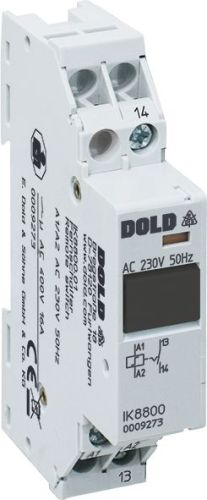
Dold 0009662 IK8800.11 DC24V remote switch
| Lieske Part No. | 1001301 |
|---|---|
| Mfg Part No | 0009662 |
| EAN-Code | 4030641096625 |
| Manufacturer | Dold |
| Here only | 52,43 EUR
62,39 EUR incl. VAT
|
Further information for Dold 0009662 IK8800.11 DC24V remote switch
| Technical data | |
| Output contacts max. | 4 C/O contacts |
| Thermal current Ith | 16 A |
| Width | 17,5 mm |
| Type | IK 8800 |
| For top hat rail mounting | |
| Variant | |
| Contact equipping | 1 changeover contact |
| Nominal voltage | DC 24 V |
Applications
The remote switch is suitable for applications requiring remote control of loads via pushbuttons or other control units. Typical use cases include controlling lighting systems, heating, ventilation systems, or other electrical consumers in buildings or production facilities. The impulse control reduces energy consumption, as the device only draws power during actuation. Mounting on a DIN rail enables flexible and space-saving installation in enclosures.
Functions and Equipment in Detail
The device features an integrated button for manual actuation of contacts, allowing the switching position to be changed manually without requiring an electrical impulse. The current switching position is indicated by a red indicator window, visible when the output contacts are activated. This facilitates visual inspection of the operating status. The contact configuration is fixed at 1 changeover contact, while the IK 8800 series overall supports up to 4 changeover contacts. The maximum thermal current rating is 16 A, enabling use with medium to high loads.
Technology Explained Simply
The impulse operation works such that a short current impulse (at least 50 ms) is sufficient to actuate the contacts. The contacts remain in the new position until another impulse is received. This reduces energy consumption compared to continuous current flow. The switching function is therefore particularly suitable for applications where the load only needs to be switched on temporarily. The mechanical life is 3 x 10⁶ switching operations, ensuring high operational reliability over a long period. The electrical life at resistive load and 500 switching operations per hour is 10 x 10⁴ switching operations at 16 A.
Compatibility and Accessories
The device is designed for use with control units, pushbuttons, or other signal sources providing a DC 24 V current impulse. The connection terminals are intended for connecting control signals (A1, A2) and loads (13/14, 11/12/14). Mounting is on a DIN rail, allowing close spacing in impulse mode. For continuous operation, a mounting clearance of 7 mm between relays is required to ensure heat dissipation and thermal stress management. The width of 17.5 mm enables compact placement in enclosures.
Mounting and Installation
Mounting is on a DIN rail using integrated retaining clips. The connection terminals are designed for connecting control signals (A1 = DC+, A2 = DC-) and loads (13/14, 11/12/14). Wiring should follow the circuit diagrams in the datasheet. During installation, sufficient cooling and the required mounting clearance for continuous operation must be ensured. The operating temperature range is -20 °C to +45 °C, and the storage temperature range is -25 °C to +55 °C.
Operational Advantages
The impulse operation results in low energy consumption, as the device only draws power during actuation. The integrated manual actuation and switching position indicator simplify maintenance and diagnostics. The compact design with 17.5 mm width allows dense mounting in enclosures. The high mechanical life of 3 x 10⁶ switching operations and thermal rating of 16 A ensure reliable performance in industrial environments. Compliance with IEC/EN 60669 ensures adherence to safety and functional requirements.

This is an offer of:
79279 Vörstetten
https://industry-electronics.com
Tel. 07666/88499-0
Fax. 07666/88499-111
Diesen Artikel finden Sie unter:
industry-electronics.com/artikel/1001301

Lieske Elektronik e.K.
Reutener Str. 1079279 Vörstetten
https://industry-electronics.com
Tel. 07666/88499-0
Fax. 07666/88499-111
Diesen Artikel finden Sie unter:
industry-electronics.com/artikel/1001301