
Dold 0001044 insulation monitor DC24V 230V
Industrial Material > Industrial relays and contactors > Switching units / measuring, control relay
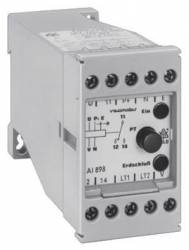
Dold 0001044 insulation monitor DC24V 230V
| Lieske Part No. | 768084 |
|---|---|
| Mfg Part No | 0001044 |
| EAN-Code | 4030641010447 |
| Manufacturer | Dold |
| Here only | 432,31 EUR
514,45 EUR incl. VAT
|
Further information for Dold 0001044 insulation monitor DC24V 230V
| General | |
| Manufacturer | Dold |
| Operating voltage | 230 V AC |
| Frequency range | 45-400 Hz |
| DC power supply | 24 V DC |
| Model | 6K UH |
| Function | insulation monitor |
Applications
The insulation monitor DOLAI898 is used in electrical installations where high insulation quality is required to prevent short circuits, fire hazards or electrical disturbances. Typical application areas include machine construction, plant engineering, process technology, and power supply technology. The device monitors the insulation resistance between the conductors and the protective earth conductor (PE) and responds with a signal when a preset threshold value is undershot, for example triggering a warning light or alarm. It is particularly suitable for installations operated at high voltages or in humid environments.
Functions and Equipment in Detail
The device monitors insulation resistance in alternating current circuits and detects deviations from the norm. When the preset threshold value is undershot, a signal is output, communicated via a relay or optical indicator. The 6K UH configuration allows specific adaptation to certain plant configurations. The operating voltage of 230 V AC in the frequency range 45–400 Hz ensures stable operation under various network conditions. The 24 V DC supply voltage is used for internal control and signal processing.
Technology Explained Simply
The insulation monitor operates on the principle of continuous measurement of insulation resistance. It monitors the resistance between the electrical conductors and the protective earth conductor (PE). A high insulation resistance indicates intact insulation; if this value falls below a certain threshold, an alarm is triggered. The technology is based on an electronic measuring circuit that analyses voltage and current in the installation. The 6K UH configuration refers to a specific setup optimised for certain industrial requirements. The operating voltage of 230 V AC in the frequency range 45–400 Hz enables use in various networks, including industrial and public supply networks.
Compatibility and Accessories
The device is designed for use in alternating current installations operated at 230 V AC with frequencies between 45 and 400 Hz. It is compatible with standard switchgear and can be integrated into existing electrical systems. The 24 V DC supply voltage requires a corresponding power supply in the plant environment.
Mounting and Installation
Mounting is carried out in the usual manner in enclosures or distribution boxes. The device is designed for mounting on a rail (e.g. DIN rail), enabling easy integration into existing switchgear. Connections are made via terminals designed for connection to electrical conductors. Installation requires compliance with applicable regulations for electrical installations, particularly VDE and DIN standards.
Advantages in Operation
The continuous operation of the insulation monitor enables early detection of insulation faults, increasing the safety of the installation and preventing potential damage. Clear signalling when the threshold value is exceeded facilitates maintenance and fault diagnosis. Use in industrial installations with high requirements for electrical safety makes the device a reliable component of electrical monitoring technology. The operating voltage of 230 V AC in the frequency range 45–400 Hz ensures universal applicability in various application areas.

This is an offer of:
79279 Vörstetten
https://industry-electronics.com
Tel. 07666/88499-0
Fax. 07666/88499-111
Diesen Artikel finden Sie unter:
industry-electronics.com/artikel/768084

Lieske Elektronik e.K.
Reutener Str. 1079279 Vörstetten
https://industry-electronics.com
Tel. 07666/88499-0
Fax. 07666/88499-111
Diesen Artikel finden Sie unter:
industry-electronics.com/artikel/768084