
Dold 0000850 AI837AC50/60HZ2,5-5A undercurrent relay
Industrial Material > Industrial relays and contactors > Switching units / measuring, control relay
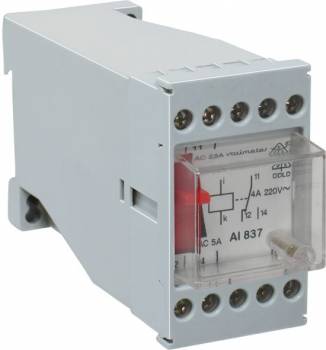
Dold 0000850 AI837AC50/60HZ2,5-5A undercurrent relay
| Lieske Part No. | 974954 |
|---|---|
| Mfg Part No | 0000850 |
| EAN-Code | 4030641008505 |
| Manufacturer | Dold |
| Here only | 298,43 EUR
355,13 EUR incl. VAT
|
Further information for Dold 0000850 AI837AC50/60HZ2,5-5A undercurrent relay
| Technical data | |
| 1- / 3-phase | 1 |
| Auxiliary voltage | Without |
| Enclosure design | Switch cabinet |
| Output contacts | 1 C/O contact |
| Width | 45 mm |
| Type | AI 837 |
| Variant | |
| Contact equipping | 1 changeover contact |
| Measuring range | AC 50/60 Hz 2,5 - 5 A |
Applications
This relay is used in industrial plants where continuous current monitoring is required, for example in pump control systems, motor monitoring, or protecting consumers against underload. It is particularly suitable for applications where switching off or signaling is necessary when current flow is too low, such as in the event of generator failure or interruptions in the power supply chain.
Functions and Equipment in Detail
The device features an adjustable setpoint screw, enabling stepless adjustment of the setpoint within the measuring range. The contact configuration includes one changeover contact (1 C/O contact), which can be used for controlling auxiliary functions or signal indication. The contact rating is defined for both alternating and direct voltage, with nominal values specified for 24 V to 380 V AC and 24 V to 220 V DC. The electrical life expectancy is up to 5 million switching operations at a load of 30 % of the switching capacity.
Technology Explained Simply
The relay measures current directly in the main circuit and responds to changes in current flow. The internal resistance of the device is 0.089 Ohm in the measuring range of 2.5–5 A, ensuring minimal load on the monitored circuit. The switching delay is approximately 100 ms, providing stable response to short-term fluctuations. The dropout ratio (hysteresis) is approximately 0.8 at the beginning of the scale and 0.9 at the end of the scale for alternating current, enabling clear distinction between pickup and dropout points. For direct current with a residual ripple of less than 5 %, the dropout ratio is approximately 0.6 at the beginning of the scale and 0.7 at the end.
Compatibility and Accessories
For measuring ranges above 16 A, the relay can be combined with a current transformer, for example, type KSW 73 from Ritz Instrument Transformers GmbH, which has a secondary rated current of 5 A with a setting range of 2.5–5 A. The rated power of the current transformer is 18 VA. For direct current, a parallel connection of a shunt resistor is required, with specifications applicable to the 8–16 A range. The measuring range shift caused by different lead lengths is graphically illustrated in the datasheet.
Mounting and Installation
The relay is designed for installation in enclosures and has a width of 45 mm, making it suitable for standard control panels with 35 mm mounting profiles. The terminal connections are designed for direct connection to wires, with input terminals (i, k) designated for the current measurement input and contacts (11, 12, 14) for the changeover contact. Mounting is achieved via screw fastening in the enclosure.
Advantages in Operation
The relay is characterized by high repeatability (≤ ±2 % for alternating current) and robust construction. The overload capacity is continuous up to 12 A at 1.2 times the scale end value (direct current) or 1.0 times (alternating current), and short-term (1 s) up to 2.0 times the scale end value. The thermal current rating (Ith) is 6 A. The nominal power consumption is below 18 VA for alternating voltage. Operational reliability is ensured by compliant design and high electrical life expectancy.

This is an offer of:
79279 Vörstetten
https://industry-electronics.com
Tel. 07666/88499-0
Fax. 07666/88499-111
Diesen Artikel finden Sie unter:
industry-electronics.com/artikel/974954

Lieske Elektronik e.K.
Reutener Str. 1079279 Vörstetten
https://industry-electronics.com
Tel. 07666/88499-0
Fax. 07666/88499-111
Diesen Artikel finden Sie unter:
industry-electronics.com/artikel/974954