
Dold 0000700 AA7616.32 time relay delayed-actuation
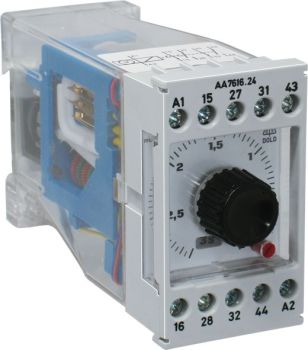
Dold 0000700 AA7616.32 time relay delayed-actuation
| Lieske Part No. | 1153859 |
|---|---|
| Mfg Part No | 0000700 |
| EAN-Code | 4030641007003 |
| Manufacturer | Dold |
| Here only | 250,19 EUR
297,73 EUR incl. VAT
|
Further information for Dold 0000700 AA7616.32 time relay delayed-actuation
| Technical data | |
| Enclosure design | Switch cabinet |
| Output contacts | 1 C/O contact |
| Time function(s) | On-delay |
| Width | 45 mm |
| Type | AA 7616 |
| Variant | |
| Contact equipping | 1 changeover contact delayed, 1 changeover undelayed |
| Nominal voltage | AC 240 V |
| Time range | 0,15 s - 30 h |
Applications
The time relay AA7616.32 is suitable for applications requiring a pre-programmed delay when switching on devices. Typical uses include controlling pumps, fans, lighting systems, or other electrical loads where immediate start-up is not desired. The delay function helps reduce mechanical stress and extend the service life of connected devices. Devices in the MINITIMER series are designed for use in industrial environments where reliable and low-maintenance control is required.
Functions and Equipment in Detail
The relay features two output contacts: one delayed changeover contact and one instantaneous changeover contact. The delayed contact switches only after the set delay time has elapsed, while the instantaneous contact responds immediately when control voltage is applied. The time progression is indicated by a red pointer on the device scale, visually showing the progress of the delay time. Repeatability is ≤ ± 0.5 %, with a permissible deviation of ≤ ± 1 % in the 3 and 6 second ranges. The switching position indicator is integrated, but not available on the EH 7616 variant.
Technology Explained Simply
The time control is based on a purely mechanical principle driven by a synchronous motor. The delay time is set via a rotary switch, which adjusts the motor speed and thus the duration of time. The time ranges are selectable via a switch on the front, allowing flexible adjustment of the setting range. Frequency switching between 50 Hz and 60 Hz is performed on the rear of the device by shifting a latch using a screwdriver.
Compatibility and Accessories
The device is designed for use in enclosures and complies with standard EN 61812-1. It is compatible with other devices in the MINITIMER series, such as EC 7616, EF 7616, and EH 7616, which feature different front panel sizes and widths. The AA 7616 variant is specifically designed for a width of 45 mm. The time relays can be used in combination with other control elements to manage complex sequences. The voltage-proof version is available as an option, retaining the elapsed time during power failure.
Mounting and Installation
Mounting is performed in an enclosure, with the 45 mm width enabling standard installation. The connection terminals are clearly labeled: A1-A2 for operating voltage, B1-B2 for control voltage (on versions with B1-B2), and contact terminals 15-16 (delayed normally open), 27-28 (delayed normally closed), 31-32 (instantaneous normally open), and 43-44 (instantaneous normally closed). The delay time is adjusted via the rotary switches on the front. Frequency switching is performed on the rear of the device.
Operational Advantages
The time relay AA7616.32 offers a wide adjustment range from 0.15 seconds to 30 hours, making it suitable for a variety of applications. The simple operation via continuous rotary switches allows for quick adaptation to different requirements. The mechanical time control is robust and low-maintenance, increasing operational reliability. The time progression indicator provides visual control of the switching process, and the high repeatability ensures reliable performance. The voltage-proof version (optional) ensures that the set time is not lost during power failure, which is advantageous in critical applications.

This is an offer of:
79279 Vörstetten
https://industry-electronics.com
Tel. 07666/88499-0
Fax. 07666/88499-111
Diesen Artikel finden Sie unter:
industry-electronics.com/artikel/1153859

Lieske Elektronik e.K.
Reutener Str. 1079279 Vörstetten
https://industry-electronics.com
Tel. 07666/88499-0
Fax. 07666/88499-111
Diesen Artikel finden Sie unter:
industry-electronics.com/artikel/1153859