
Dold 0000681 time relay delayed response 240V
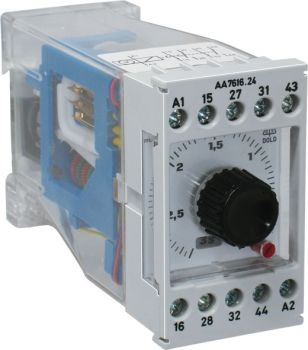
Dold 0000681 time relay delayed response 240V
| Lieske Part No. | 1153858 |
|---|---|
| Mfg Part No | 0000681 |
| EAN-Code | 4030641006815 |
| Manufacturer | Dold |
| Here only | 250,19 EUR
297,73 EUR incl. VAT
|
Further information for Dold 0000681 time relay delayed response 240V
| Technical data | |
| Enclosure design | Switch cabinet |
| Output contacts | 1 C/O contact |
| Time function(s) | On-delay |
| Width | 45 mm |
| Type | AA 7616 |
| Variant | |
| Contact equipping | 1 NC contact delayed, 1 NC contact undelayed, 1 NO contact delayed, 1 NO contact undelayed |
| Nominal voltage | AC 240 V |
| Time range | 0,15 s - 30 h |
Applications
The time relay AA7616.24 is suitable for applications requiring a defined delay when switching on loads. Typical uses include controlling pumps, fans, lighting systems, or protecting motors from too rapid start-up. The mechanical time function ensures a high repeatability of ≤ ± 0.5 %, with a deviation of ≤ ± 1 % allowed in the range of 3 and 6 seconds. The time progression is indicated by a red pointer on the scale, enabling visual monitoring of the timing process.
Functions and Equipment in Detail
The device features contact configuration with one delayed normally open contact, one instantaneous normally open contact, one delayed normally closed contact, and one instantaneous normally closed contact. This configuration allows control of multiple loads with different time delays. The output contacts are configured as 1 changeover, enabling flexible integration into existing circuits. The switching position indicator is integrated, but not available in the EH 7616 variant. The time function is on-delay, meaning the contacts switch only after the set delay time has elapsed.
Technology Explained Simply
The time control is purely mechanical, driven by a synchronous motor powered by the operating voltage connected to terminals A1-A2. The delay time is adjusted via a rotary switch on the front, with six switchable time ranges available. Frequency switching between 50 Hz and 60 Hz is performed on the rear of the device by moving a latch with a screwdriver. The time function complies with standard EN 61812-1, which applies to time relays. The repeatability is sufficient for most applications, with increased accuracy for short durations achievable with the AA 7616.32 version.
Compatibility and Accessories
The time relay AA7616.24 has a width of 45 mm and can be mounted in standard enclosures. It is part of the MINITIMER series, which also includes variants EC 7616, EF 7616, and EH 7616, the latter featuring larger front surfaces. Terminal markings follow the standard, with A1-A2 for control voltage and B1-B2 optionally available for a voltage-fail-safe version. The voltage-fail-safe version retains the elapsed time during power failure, allowing the timing function to resume after power is restored.
Mounting and Installation
Mounting is done in an enclosure using the provided mounting elements. The connection terminals are clearly labeled, with control voltage connected to A1-A2. In versions with B1-B2, an additional control voltage can be connected for the voltage-fail-safe function. The delay time is adjusted via the rotary switch on the front, with the scale indicating the set time. Frequency switching is performed on the rear of the device.
Operational Advantages
The mechanical time function provides high reliability and repeatability. The stepless adjustment of delay time over a wide range allows flexible adaptation to different requirements. The time progression indicator and switching position indicator facilitate maintenance and diagnostics. The width of 45 mm enables compact installation in existing enclosures. Compliance with EN 61812-1 ensures adherence to relevant safety and functional requirements.

This is an offer of:
79279 Vörstetten
https://industry-electronics.com
Tel. 07666/88499-0
Fax. 07666/88499-111
Diesen Artikel finden Sie unter:
industry-electronics.com/artikel/1153858

Lieske Elektronik e.K.
Reutener Str. 1079279 Vörstetten
https://industry-electronics.com
Tel. 07666/88499-0
Fax. 07666/88499-111
Diesen Artikel finden Sie unter:
industry-electronics.com/artikel/1153858