
DEHN 927944 BCO CL2 BD 24 combination surge arrester 1 pair cable
Energy > Surge Protection
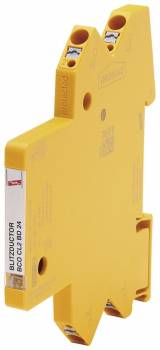
DEHN 927944 BCO CL2 BD 24 combination surge arrester 1 pair cable
| Lieske Part No. | 1780567 |
|---|---|
| Mfg Part No | 927944 |
| EAN-Code | 4013364411784 |
| Manufacturer | DEHN |
| Here only | 111,72 EUR
132,95 EUR incl. VAT
|
Further information for DEHN 927944 BCO CL2 BD 24 combination surge arrester 1 pair cable
| Extended technical data | |
| Max. discharge current (8/20 µs) [1/2 - PG], [1+2 - PG] (Imax) | 20 kA |
| Discharge current (8/20 µs) [1/2 - PG], [1+2 - PG] | 10 kA (10x) |
| Voltage protection level line-PG at 1 kV/μs C3 after being subjected to Imax (UP) | ≤ 600 V |
| Technical data | |
| SPD class | L |
| Impulse category | D1, C1, C2, C3, B2 |
| Nominal voltage (UN) | 24 V |
| Max. continuous operating voltage DC (UC) | 36 V |
| Max. continuous operating a.c. voltage (UC) | 25.4 V |
| Nominal current at 70 °C (IL) | 0.75 A |
| D1 Total lightning impulse current (10/350 µs) (Iimp) | 3 kA |
| D1 Lightning impulse current (10/350 µs) per line (Iimp) | 1.5 kA |
| C2 Total nominal discharge current (8/20 µs) (In) | 10 kA |
| C2 Nominal discharge current (8/20 µs) per line (In) | 5 kA |
| Voltage protection level line-line for In C2 (UP) | ≤ 57 V |
| Voltage protection level line-PG for In C2 (UP) | ≤ 600 V |
| Voltage protection level line-line for In C1 (UP) | ≤ 57 V |
| Voltage protection level line-PG for In C1 (UP) | ≤ 600 V |
| Voltage protection level line-line at 1 kV/µs C3 (UP) | ≤ 46 V |
| Voltage protection level line-PG at 1 kV/µs C3 (Up) | ≤ 600 V |
| Series resistance per line | 1 Ohm |
| Cut-off frequency line-line (fG) | 5.8 MHz |
| Capacitance line-line (C) | ≤ 1.5 nF |
| Capacitance line-PG (C) | ≤ 16 pF |
| Operating temperature range (TU) | -40 °C ... +80 °C |
| Operating state / fault indication | green / red |
| Degree of protection | IP 20 |
| For mounting on | 35 mm DIN rails acc. to EN 60715 |
| Connection (input / output) | push-in / push-in |
| Cross-sectional area, solid | 0.2-2.5 mm2 |
| Cross-sectional area, flexible | 0.2-2.5 mm2 |
| Earthing via | 35 mm DIN rails acc. to EN 60715 |
| Enclosure material | Polyamide PA 6.6 |
| Colour | yellow |
| Test standards | IEC 61643-21 / EN 61643-21 |
| Approvals | UL 497B, CSA, ATEX, IECEx, CCC, SIL |
| SIL classification | up to SIL3 *) |
| ATEX approvals | TÜV 20 ATEX 8527 X: II 3G Ex ec IIC T4 Gc |
| IECEx approvals | IECEx TUR 20.0063X: Ex ec IIC T4 Gc |
| China Compulsory Certification | CCC no. 2021312304001192 |
| Test values according to UL 497b | |
| Type (SPD classification) | BCO CL2 BD 24 |
| Strike voltage Line to Ground 100 V/s min. | 40 V |
| Strike voltage Line to Ground 100 V/s max. | 44.2 V |
| Strike voltage Line to Line 100 V/s min. | 72 V |
| Strike voltage Line to Line 100 V/s max. | 108 V |
Applications
The surge arrester is intended for use in industrial plants, automation systems, and in potentially explosive areas. It is certified according to ATEX approval TÜV 20 ATEX 8527 X: II 3G Ex ec IIC T4 Gc and IECEx approval IECEx TUR 20.0063X: Ex ec IIC T4 Gc, suitable for use in Zone 2 and higher. The SIL classification up to SIL3 makes it suitable for safety-critical applications in the field of functional safety. It is designed for use in the lightning protection zone concept at interfaces 0 A – 2 and higher.
Functions and Equipment in Detail
The BCO CL2 BD 24 features an integrated optical status indicator showing the operating state: green for functional, red for defective. This function allows for quick visual inspection of the arrester during operation. The integrated LifeCheck function monitors the condition of the arrester and supports system availability through failsafe behaviour. In case of failure, the protection circuit remains electrically closed to avoid interruption of the line.
Technology Explained Simply
The surge arrester protects against overvoltages by diverting surge currents. It is designed for a nominal voltage of 24 V, with the maximum continuous voltage at 36 V DC or 25.4 V AC. The maximum surge current rating is 20 kA (8/20 µs) per pole, with the nominal discharge current (C2) at 10 kA (total) or 5 kA per wire. The lightning surge current (D1) is 3 kA (total) or 1.5 kA per wire. The protection levels are ≤ 57 V between wires (wire-wire) and ≤ 600 V between wire and earthing (wire-PG) under C2 loading. The series impedance per wire is 1 Ohm, the cut-off frequency wire-wire is 5.8 MHz. The capacitance between wires is ≤ 1.5 nF, between wire and earthing ≤ 16 pF. These values ensure efficient protection without significant impairment of signal quality in data bus systems.
Compatibility and Accessories
The surge arrester is designed for use in systems with earth potential-free symmetrical interfaces, as found in industrial communication networks (e.g. Profibus, Modbus). It is compatible with other products in the BLITZDUCTORconnect family, particularly with accessories such as cross connectors, longitudinal connectors, parallel connectors, T-connectors, pipe clamps, and equipotential bonding rails. The use of these components enables flexible and modular installation in enclosures.
Mounting and Installation
Mounting is done on a 35 mm DIN rail according to EN 60715. The push-in connections allow for easy and quick cable connection. Earthing is via the DIN rail, ensuring a direct and reliable earth connection. The operating temperature range is between -40 °C and +80 °C, enabling use in a wide range of environments. The housing is made of polyamide PA 6.6 and is yellow in colour. The protection rating IP 20 protects against finger contact and solid foreign objects, but not against water or dust.
Operational Advantages
The BCO CL2 BD 24 offers a high level of protection in a compact design. The integrated status indicator and LifeCheck function increase operational safety and reduce maintenance requirements. The push-in technology speeds up installation and reduces error susceptibility. The approvals according to ATEX, IECEx, CCC, UL, CSA and SIL3 make it suitable for a wide range of applications, including potentially explosive environments and safety-critical systems. The test standards IEC 61643-21 and EN 61643-21 guarantee compliance with international standards for surge protection devices.

This is an offer of:
79279 Vörstetten
https://industry-electronics.com
Tel. 07666/88499-0
Fax. 07666/88499-111
Diesen Artikel finden Sie unter:
industry-electronics.com/artikel/1780567

Lieske Elektronik e.K.
Reutener Str. 1079279 Vörstetten
https://industry-electronics.com
Tel. 07666/88499-0
Fax. 07666/88499-111
Diesen Artikel finden Sie unter:
industry-electronics.com/artikel/1780567