
DEHN 927910 BCO CL2 B 180 surge arrester 2-wire
Installation > Grounding Systems > Lightning protection material
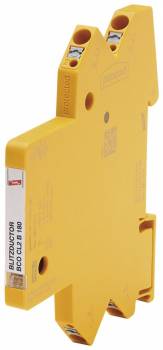
DEHN 927910 BCO CL2 B 180 surge arrester 2-wire
| Lieske Part No. | 1780570 |
|---|---|
| Mfg Part No | 927910 |
| EAN-Code | 4013364411739 |
| Manufacturer | DEHN |
| Here only | 60,04 EUR
71,45 EUR incl. VAT
|
Further information for DEHN 927910 BCO CL2 B 180 surge arrester 2-wire
| General | |
| Mounting width | 6 mm |
| Connection system | Push-in |
| Protection function | Surge current diverter for 2 individual conductors |
| Application range | Lightning protection potential equalization, indirect grounding of shielded lines |
| Status indicator | |
| Extended technical data | |
| Discharge current (8/20 µs) [1/2 - PG], [1+2 - PG] | 10 kA (10x) |
| Voltage protection level line-PG at 1 kV/μs C3 after being subjected to Imax (UP) | ≤ 700 V |
| Technical data | |
| SPD class | A |
| Impulse category | D1, C2, C3 |
| Nominal voltage (UN) | 180 V |
| Max. continuous operating voltage DC (UC) | 180 V |
| Max. continuous operating a.c. voltage (UC) | 127 V |
| Nominal current (IN) | 1.2 A |
| D1 Total lightning impulse current (10/350 µs) (Iimp) | 3 kA |
| D1 Lightning impulse current (10/350 µs) per line (Iimp) | 1.5 kA |
| C2 Total nominal discharge current (8/20 µs) (In) | 10 kA |
| C2 Nominal discharge current (8/20 µs) per line (In) | 5 kA |
| Voltage protection level line-line for In C2 (UP) | ≤ 1100 V |
| Voltage protection level line-PG for In C2 (UP) | ≤ 800 V |
| Voltage protection level line-line at 1 kV/µs C3 (UP) | ≤ 950 V |
| Voltage protection level line-PG at 1 kV/µs C3 (Up) | ≤ 700 V |
| Series resistance per line | 0 Ohm |
| Cut-off frequency line-line at 100 ohms (fG) | 150 MHz |
| Capacitance line-line (C) | ≤ 10 pF |
| Capacitance line-PG (C) | ≤ 13 pF |
| Operating temperature range (TU) | -40 °C ... +80 °C |
| Operating state / fault indication | green / red |
| Degree of protection | IP 20 |
| For mounting on | 35 mm DIN rails acc. to EN 60715 |
| Connection (input / output) | push-in / push-in |
| Cross-sectional area, solid | 0.2-2.5 mm2 |
| Cross-sectional area, flexible | 0.2-2.5 mm2 |
| Earthing via | 35 mm DIN rails acc. to EN 60715 |
| Enclosure material | polyamide PA 6.6 |
| Colour | yellow |
| Test standards | IEC 61643-21 / EN 61643-21 |
| Approvals | UL 497B, CSA, ATEX, IECEx, CCC, SIL |
| SIL classification | up to SIL3 *) |
| ATEX approvals | TÜV 20 ATEX 8527 X: II 3G Ex ec IIC T4 Gc |
| IECEx approvals | IECEx TUR 20.0063X: Ex ec IIC T4 Gc |
| China Compulsory Certification | CCC no. 2021312304001192 |
| Test values according to UL 497b | |
| Type (SPD classification) | BCO CL2 B 180 |
| Strike voltage Line to Ground 100 V/s min. | 260 V |
| Strike voltage Line to Ground 100 V/s max. | 552 V |
| Strike voltage Line to Line 100 V/s min. | 184 V |
| Strike voltage Line to Line 100 V/s max. | 285 V |
Lightning protection equipotential bonding is a central component of protective measures in electrical installations, designed to prevent voltage differences between different conductors or installation parts that may arise due to lightning strikes or other transient overvoltages. The BCO CL2 B 180 performs this function for two individual conductors, enabling efficient use in complex installations with multiple cables. The arrester’s function is to rapidly and safely divert overvoltages caused by lightning currents or inductive effects, thereby protecting connected devices and installations.
Push-in connection technology enables simple and reliable cable connections without the need for soldering or screwing. The cable is simply inserted into the terminal, creating a mechanically stable and electrically conductive connection. This technique reduces installation time and minimizes error sources during installation. The connection terminals are designed to ensure a secure connection even under vibration and temperature fluctuations.
Status indicator provides visual feedback on the operating condition of the arrester. It allows for quick identification during operation whether the arrester is still functional or if maintenance or replacement is required. This feature is particularly important in installations where continuous availability of the protective function is essential to prevent damage from overvoltages.
Indirect earthing of shielded cables is a method in which the cable shield is not directly connected to the earthing system, but instead connected via an arrester that diverts overvoltages. The BCO CL2 B 180 enables this type of earthing, thereby enhancing electrical safety without compromising the integrity of the shielding. This is particularly relevant in installations with sensitive electronic equipment, where direct earthing could cause interference.
Applications primarily include installation in buildings with lightning protection systems, especially in areas where multiple cables are run in parallel and a compact solution is required. The arrester is suitable for use in distribution boxes, enclosures, and other installation systems where space optimization and quick installation are prioritized. The combination of low width and push-in technology makes it an efficient solution for protecting two individual conductors.
Compatibility and accessories refer to use in existing lightning protection systems based on equipotential bonding and indirect earthing. The arrester is designed for use in systems that can be combined with similar DEHN products to ensure a consistent protection strategy.
Mounting and installation take place in standard distribution boxes or enclosures. The push-in technology allows for quick and tool-free cable connections. The width of 6 mm enables dense mounting of multiple arresters side by side, optimizing space utilization. The status indicator is directly visible on the device, allowing functional checks without additional measuring instruments.
Operational advantages lie in the combination of compact design, easy installation, and visual status indication. Quick installation reduces mounting time, while the status indicator enables continuous monitoring of the protective function. The ability to protect two individual conductors simultaneously increases installation efficiency and reduces the number of required components.

This is an offer of:
79279 Vörstetten
https://industry-electronics.com
Tel. 07666/88499-0
Fax. 07666/88499-111
Diesen Artikel finden Sie unter:
industry-electronics.com/artikel/1780570

Lieske Elektronik e.K.
Reutener Str. 1079279 Vörstetten
https://industry-electronics.com
Tel. 07666/88499-0
Fax. 07666/88499-111
Diesen Artikel finden Sie unter:
industry-electronics.com/artikel/1780570