
DEHN 103126 TBM 11M SCFU STTZN AL lightning protection mast ÜFL screw foundation
Installation > Grounding Systems > Lightning protection material
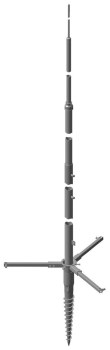
DEHN 103126 TBM 11M SCFU STTZN AL lightning protection mast ÜFL screw foundation
| Lieske Part No. | 1313822 |
|---|---|
| Mfg Part No | 103126 |
| EAN-Code | 4013364112841 |
| Manufacturer | DEHN |
| Here only | 2.867,10 EUR
3.411,85 EUR incl. VAT
|
Further information for DEHN 103126 TBM 11M SCFU STTZN AL lightning protection mast ÜFL screw foundation
| General | |
| Test | DIN EN 62561-(1+2) |
| Sizing | Eurocode 1 (DIN EN 1991-1-4 + DIN EN 1991-1-4/NA) |
| Maximum gust wind speed | 112 km/h |
| Foundation type | Screw foundation |
| Bracing | Deep grounding electrode |
| Material | St/tZn / Al |
| Height above ground level (l1) | 11000 mm |
| Max. gust wind speed | 112 km/h |
| Standard | EN 62561-(1+2) |
Applications
This lightning protection mast is designed for use in installations that, due to their construction or location, are exposed to an increased risk of lightning strikes. These include open-area installations such as photovoltaic open-field plants or biogas plants, where conventional lightning protection installation would be complex or impossible. The construction allows for quick and easy installation without extensive earthworks.
Functions and Equipment in Detail
The mast is anchored in the ground via a screw foundation. This foundation is screwed directly into the natural ground without prior ground preparation. The anchoring is achieved through the screw foundation, which is additionally secured with deep earth electrodes to ensure stable anchoring. This eliminates excavation work and conventional foundation measures. The construction is designed to remain stable even under wind load.
Technology Explained Simply
The lightning protection mast is dimensioned according to Eurocode 1 (DIN EN 1991-1-4 + DIN EN 1991-1-4/NA), meaning it is designed for a maximum gust wind speed of 112 km/h. This standardization ensures that the mast fulfills its function even under extreme weather conditions. The height of 11,000 mm above floor level ensures that the mast provides sufficient lightning diversion area and that the protected installation lies within the protection zone. The use of a screw foundation enables quick and resource-efficient installation, as no concreting or deep foundations are required.
Compatibility and Accessories
The lightning protection mast is designed as a standalone system and does not require additional components for functionality. Connection to the earthing system is achieved via the deep earth electrodes, which are connected to the screw foundation.
Installation and Mounting
Installation is carried out by screwing the screw foundation into the natural ground. This requires no special ground preparation. After inserting the foundation, the mast is placed on top and connected to the deep earth electrodes to ensure secure anchoring. Installation is therefore quick and does not require special construction measures.
Operational Advantages
The use of the lightning protection mast reduces installation time and costs for earthworks. The construction is robust and designed for outdoor use. Testing in accordance with DIN EN 62561-(1+2) ensures the reliability of the system. The maximum gust wind speed of 112 km/h demonstrates that the mast remains stable even under extreme weather conditions. The simple installation without excavation work makes it particularly suitable for temporary or rapidly installed installations.

This is an offer of:
79279 Vörstetten
https://industry-electronics.com
Tel. 07666/88499-0
Fax. 07666/88499-111
Diesen Artikel finden Sie unter:
industry-electronics.com/artikel/1313822

Lieske Elektronik e.K.
Reutener Str. 1079279 Vörstetten
https://industry-electronics.com
Tel. 07666/88499-0
Fax. 07666/88499-111
Diesen Artikel finden Sie unter:
industry-electronics.com/artikel/1313822