
Chauvin Arnoux P01102157 remote control probe No. 4
Measurement
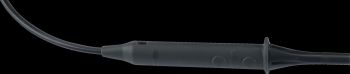
Chauvin Arnoux P01102157 remote control probe No. 4
| Lieske Part No. | 1927850 |
|---|---|
| Mfg Part No | P01102157 |
| EAN-Code | 3663653001076 |
| Manufacturer | Chauvin Arnoux |
| Here only | 65,66 EUR
78,14 EUR incl. VAT
|
Further information for Chauvin Arnoux P01102157 remote control probe No. 4
| Eigenschaften | |
| Test voltage | 250 V / 500 V |
| Range | - |
| Measurement frequency | - |
| Frequency: range / resolution / accuracy | - |
| Communication | - |
| Software | - |
Remote control functions
The probe controls the most important operating buttons of the installation tester remotely. The TEST button is activated via the probe to start a measurement. On devices of type C.A 6133, the MEM button is also remotely operable to store measurement results directly. The + (Ω/MΩ) connection can also be used via the probe, increasing flexibility in connection routing. These functions reduce the need to operate the main device directly and enable safe and efficient testing, especially in hard-to-reach areas.
Alarm function and user-friendliness
The probe works in conjunction with the integrated alarm function of the installation tester. During insulation and continuity tests, the measurement result is confirmed by an acoustic signal. This allows the tester to evaluate the measurement without directly reading the display, increasing work speed and focusing attention on the physical testing. The test probe is detachable, which simplifies maintenance and cleaning and supports adaptation to different operating conditions.
Compatibility and accessories
The probe is specifically designed for the installation testers C.A 6131 and C.A 6133. These devices are compliant with IEC 61557 for testing electrical installations and cover functions such as earth resistance measurement, loop impedance measurement, insulation testing, and FI/RCD testing. The probe is a supplementary tool that extends the functionality of these devices.
Application areas
The probe is primarily used in electrical installation, maintenance and testing services, as well as during commissioning of new installations. It supports the performance of safety tests, especially when testing residual current circuit breakers (RCDs) and checking continuity resistances. The combination of remote control and acoustic confirmation increases safety, as the tester does not need to remove hands from the test object to operate the device.
Scope of delivery
The scope of delivery includes the remote probe No. 4 and the operating instructions.
Compliance with standards
The installation testers C.A 6131 and C.A 6133, with which the probe is used, comply with standards IEC 61557-1, -2, -3, -4, -6, -7 and -10. Electrical safety is ensured in accordance with IEC 61010-1, IEC 61010-2-030, IEC 61010-2-034 and IEC 61326-1. The devices are approved for category 600 V CAT III and 300 V CAT II at the charging input.
Ergonomics and operation
The probe is ergonomically designed to enable comfortable handling. The detachable test probe and remote control functions reduce physical strain on the tester. Integration with existing installation testers allows seamless use without additional operating steps. The main device display features blue backlighting, improving readability in poor lighting conditions.
Operational advantages
The remote probe No. 4 increases efficiency when performing electrical tests. The ability to trigger the measurement with one hand while holding the test probe with the other reduces the risk of incorrect operation and enhances safety. The acoustic confirmation of the measurement allows for quick evaluation without directly reading the display, increasing work speed. Compatibility with installation testers C.A 6131 and C.A 6133, along with compliance with relevant standards, makes the probe a reliable tool for professional users in the field of electrical engineering.

This is an offer of:
79279 Vörstetten
https://industry-electronics.com
Tel. 07666/88499-0
Fax. 07666/88499-111
Diesen Artikel finden Sie unter:
industry-electronics.com/artikel/1927850

Lieske Elektronik e.K.
Reutener Str. 1079279 Vörstetten
https://industry-electronics.com
Tel. 07666/88499-0
Fax. 07666/88499-111
Diesen Artikel finden Sie unter:
industry-electronics.com/artikel/1927850