
Chauvin Arnoux BPT1-S7 Redox probe S7 connector
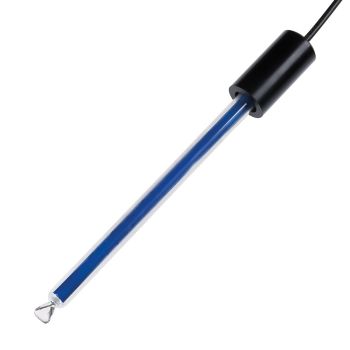
Chauvin Arnoux BPT1-S7 Redox probe S7 connector
| Lieske Part No. | 1142356 |
|---|---|
| Mfg Part No | BPT1-S7 |
| EAN-Code | 3663653005876 |
| Manufacturer | Chauvin Arnoux |
| Here only | 182,40 EUR
217,06 EUR incl. VAT
|
Further information for Chauvin Arnoux BPT1-S7 Redox probe S7 connector
| General | |
| Electrode type | Redox indicator electrode - |
| Material | Platinum - |
| Housing | Glass - |
| Connection | S7 - |
| Application range | Oxidizing solutions with chlorides, redox titrations - |
| Function | Measurement of redox potentials - |
Redox measurement is a method for determining electrochemical potentials in a solution, used particularly in analytical chemistry, environmental technology, and process monitoring. The BPT1-S7 serves as an indicator electrode, reacting to changes in the redox state of the sample. The platinum wire as a metal electrode offers high chemical resistance and is especially suitable for aggressive, oxidizing media, as platinum is resistant to corrosion and oxidation. The electrode is designed in the form of a glass rod, ensuring easy handling and cleaning.
Applications include monitoring wastewater treatment processes, analysis of drinking water, process control in the chemical industry, and laboratory investigations, especially in redox titrations. The electrode is designed for applications where the service life of the measuring electrode is significantly shorter than that of the reference electrode, making a separate design sensible. Using a separate measuring electrode extends the service life of the more expensive reference electrode and reduces maintenance effort.
Functions and equipment in detail include the integrated platinum wire, which serves as the active measuring surface, and the glass body, which ensures mechanical stability and ease of cleaning. The electrode is equipped with an S7 connector, enabling a compatible connection to corresponding measuring instruments. The S7 plug connection is a standard in laboratory and process measurement technology and ensures a secure and interference-free electrical coupling. The electrode is supplied as a single unit, without additional components such as reference electrodes or measuring devices.
Technology explained simply means that the BPT1-S7 measures the electrical voltage generated between the sample and the reference electrode. This voltage is a measure of the redox potential, i.e., the tendency of the substances in the solution to give up electrons (oxidation) or accept them (reduction). The platinum wire serves as an electrical contact indicating the voltage. The measurement takes place in a closed electrical circuit, with the reference electrode providing a constant reference point. The glass construction mechanically protects the platinum wire and ensures a clean surface for measurement.
The BPT1-S7 is designed for devices that support an S7 connector. There are two ordering variants for connectors, adapted to different device configurations. The exact selection depends on the measuring system used. The electrode is not suitable for use without a reference electrode, as a single measuring electrode does not provide an absolute potential scale.
Mounting and installation are carried out by simply inserting the electrode into the S7 connector of the measuring device. The electrode is immersed in the solution to be measured, ensuring that the tip of the platinum wire is fully submerged in the medium. Cleaning is done by rinsing with water or an appropriate cleaning agent, with the glass construction enabling easy maintenance. No special tools or additional mounting components are required.
Operational advantages lie in the high chemical resistance of platinum, easy handling, and long service life under aggressive conditions. Separating the measuring electrode from the reference electrode reduces the need to replace the more expensive reference electrode and lowers operating costs. The S7 plug connection ensures a reliable electrical connection and is widely used in the industry, increasing compatibility with various devices. The glass construction facilitates cleaning and prevents deposits that could impair measurement accuracy.
Note: Reference electrodes, measuring devices, and other accessories are not included in the delivery scope.

This is an offer of:
79279 Vörstetten
https://industry-electronics.com
Tel. 07666/88499-0
Fax. 07666/88499-111
Diesen Artikel finden Sie unter:
industry-electronics.com/artikel/1142356

Lieske Elektronik e.K.
Reutener Str. 1079279 Vörstetten
https://industry-electronics.com
Tel. 07666/88499-0
Fax. 07666/88499-111
Diesen Artikel finden Sie unter:
industry-electronics.com/artikel/1142356