
BTR 151P3EAJAA0E Patch Cable SC-LC OS2 10m
Networks > Fiber and Components
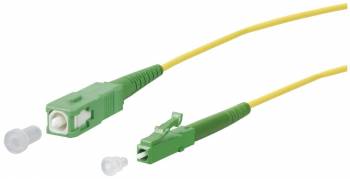
BTR 151P3EAJAA0E Patch Cable SC-LC OS2 10m
| Lieske Part No. | 2128094 |
|---|---|
| Mfg Part No | 151P3EAJAA0E |
| EAN-Code | 4251122199622 |
| Manufacturer | BTR |
| Here only | 19,39 EUR
23,07 EUR incl. VAT
|
Further information for BTR 151P3EAJAA0E Patch Cable SC-LC OS2 10m
| General | |
| Fibre type | Singlemode OS2 |
| Core diameter | 9 µm |
| Sheath diameter | 125 µm |
| Bend insensitivity | in accordance with IEC 60793-2-50 Type B6_a and B6_b, G.657.A2 and G.657.B2 |
| Compatibility | G.652.D |
| Material outer sheath | Halogen-free with low smoke emission LSHF-FR |
| Outer diameter | 2,0 mm |
| Test | 100 % on insertion and backflow attenuation |
| Flame retardancy | |
| Serial number | |
A0E is a high-quality network cable for use in modern fibre optic infrastructures. It connects optical components in singlemode operation and is specifically designed for applications requiring high signal quality and mechanical robustness. The cable features a singlemode fibre of type OS2 with a core diameter of 9 µm and a cladding of 125 µm (E9/125 µm), classified according to IEC 60793-2-50 as type B6_a and B6_b, as well as according to ITU-T G.657.A2 and G.657.B2. These specifications ensure high bend-insensitivity, making the cable particularly suitable for installations in tight radii or in structured cabling systems. The fibre is compatible with G.652.D, enabling broad usability in existing and new networks.
Applications
This patch cable is designed for use in data and communication networks, particularly in environments requiring high bandwidth and low signal loss. Typical application scenarios include connecting switches, routers, servers, optical network devices, as well as in telecommunications and industrial automation. The bend-insensitive fibre allows for flexible installation, even in confined spaces or with frequent movements, without impairing optical performance.
Functions and Equipment in Detail
The cable is equipped with a jacket made of halogen-free material with low smoke emission (LSHF-FR), which is flame-retardant. This jacket type is particularly suitable for indoor use, as it does not release toxic gases in case of fire and minimizes smoke development. The outer diameter is 2.0 mm, enabling compact and convenient handling. Each cable is 100 % tested for insertion loss and return loss to ensure consistent and reliable signal transmission. The serial number on each cable enables unique identification and traceability.
Technology Explained Simply
The singlemode fibre OS2 used is optimized for long-distance applications, as it transmits only one light mode and thus exhibits low attenuation and dispersion effects. The bend-insensitivity according to G.657.A2 and G.657.B2 means that the cable shows no significant signal loss even at small bend radii (e.g. under 10 mm). Compatibility with G.652.D ensures interoperability with existing network infrastructures. Testing for insertion loss and return loss ensures that the cable meets the required optical specifications for professional network use.
Compatibility and Accessories
The cable is designed for use with optical connectors that meet the requirements of the respective network topology. It is used in conjunction with compatible optical devices that also support singlemode technology. Cable variants can be individually created via a cable configurator, enabling adaptation to specific requirements.
Installation and Mounting
Installation is performed by connecting the connectors to the corresponding optical ports of the devices. Due to the bend-insensitive fibre, the cable can also be routed in tight radii without impairing optical performance. The flame-retardant and halogen-free jacket material requires no special precautions during installation, although routing should be done to avoid mechanical damage. The serial number facilitates documentation and maintenance of the cabling.
Operational Advantages
The high mechanical stability and low attenuation of the fibre ensure reliable and stable signal transmission over long distances. The flame-retardant and halogen-free jacket material increases safety in use, especially in enclosed spaces. The 100 % testing for insertion loss and return loss guarantees consistent quality, which is required for professional networks. The serial number supports maintenance and identification during operation.

This is an offer of:
79279 Vörstetten
https://industry-electronics.com
Tel. 07666/88499-0
Fax. 07666/88499-111
Diesen Artikel finden Sie unter:
industry-electronics.com/artikel/2128094

Lieske Elektronik e.K.
Reutener Str. 1079279 Vörstetten
https://industry-electronics.com
Tel. 07666/88499-0
Fax. 07666/88499-111
Diesen Artikel finden Sie unter:
industry-electronics.com/artikel/2128094