
BTR 151P1JOMAA0E patch cable LC-D/E2000-D APC OS2 10m
Networks > Fiber and Components
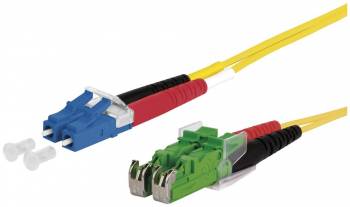
BTR 151P1JOMAA0E patch cable LC-D/E2000-D APC OS2 10m
| Lieske Part No. | 2095798 |
|---|---|
| Mfg Part No | 151P1JOMAA0E |
| EAN-Code | 4250184193791 |
| Manufacturer | BTR |
| Here only | 67,05 EUR
79,79 EUR incl. VAT
|
Further information for BTR 151P1JOMAA0E patch cable LC-D/E2000-D APC OS2 10m
| General | |
| Fibre type | Single mode |
| Fibre standard | OS2 |
| Core diameter | 9 µm |
| Sheath diameter | 125 µm |
| Bend insensitivity | in accordance with IEC 60793-2-50 Type B6_a and B6_b, G.657.A2 and B2 |
| Compatibility | G.652.D |
| Material outer sheath | Halogen-free with low smoke emission LSHF-FR |
| Cable type | Duplex cable |
| Cable construction | Zipcord (figure 8) |
| Tension relief | Aramid |
| Test | 100 % tested |
| Outer diameter | 2,0 x 4,2 mm |
| Connector | LC-D / E2000-D APC |
| Flame retardancy | |
Applications
This patch cable is intended for use in structured cabling systems for data communication, particularly in high-speed networks such as FTTH, data centers, or enterprise networks. Its bend-insensitivity makes it especially suitable for installations in tight radii, such as in patch panels, switches, or building cabling. The flame-retardant and halogen-free design meets fire safety requirements for indoor and public buildings.
Functions and Features in Detail
The cable is designed as a duplex connection, integrating two independent fibers within a single cable, each transmitting data in one direction. Connections are made via connectors, specifically LC-D and E2000-D APC in this case. The use of APC connectors (Angled Physical Contact) reduces reflections at the fiber end face and improves signal quality, especially at higher frequencies. The entire cable length is 100% tested to ensure consistent quality and performance. The outer diameters are 2.0 mm (for individual fibers) and 4.2 mm (for the overall cable), enabling a compact and easy-to-handle design.
Technology Explained Simply
The singlemode fiber OS2 used is designed for transmitting light signals over long distances with low attenuation. Bend-insensitivity according to G.657.A2 and B2 means the cable maintains signal integrity even under tight bends, such as a 5 mm bend radius. The LSHF-FR (Low Smoke Halogen Free Flame Retardant) jacket material ensures no toxic gases are released in case of fire and minimizes smoke production. The aramid fiber strength member protects the delicate glass fiber from mechanical stress during installation or pulling.
Compatibility and Accessories
The cable is compatible with devices supporting LC-D and E2000-D APC connectors. Using APC connectors requires that the opposing components also feature APC connectors to ensure optimal signal transmission. The fiber is compatible with the G.652.D standard fiber, enabling interoperability with existing infrastructures. The cable configurator function allows customization of length and connectors to meet specific requirements.
Installation and Mounting
The cable can be installed in standardized patch panels, switches, or other optical components. The Zipcord design facilitates routing and separation of the two fibers, enabling precise placement and connection. The flame-retardant and halogen-free construction requires no special installation measures but complies with fire safety standards for indoor environments.
Operational Advantages
The high mechanical stability and bend-insensitivity reduce the risk of breaks or signal loss during installation and operation. The 100% testing ensures consistent quality, and the use of APC connectors minimizes reflections, resulting in improved signal transmission. The LSHF-FR design contributes to safety in confined spaces, especially in buildings with high occupancy.

This is an offer of:
79279 Vörstetten
https://industry-electronics.com
Tel. 07666/88499-0
Fax. 07666/88499-111
Diesen Artikel finden Sie unter:
industry-electronics.com/artikel/2095798

Lieske Elektronik e.K.
Reutener Str. 1079279 Vörstetten
https://industry-electronics.com
Tel. 07666/88499-0
Fax. 07666/88499-111
Diesen Artikel finden Sie unter:
industry-electronics.com/artikel/2095798