
BTR 151P1JOJOB0E patch cable LC-D/LC-D OS2 20 m
Networks > Fiber and Components
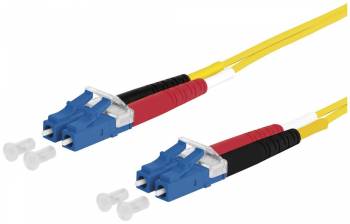
BTR 151P1JOJOB0E patch cable LC-D/LC-D OS2 20 m
| Lieske Part No. | 468255 |
|---|---|
| Mfg Part No | 151P1JOJOB0E |
| EAN-Code | 4250184157816 |
| Manufacturer | BTR |
| Here only | 37,80 EUR
44,98 EUR incl. VAT
|
Further information for BTR 151P1JOJOB0E patch cable LC-D/LC-D OS2 20 m
| General | |
| Fibre type | Single mode |
| Fibre standard | OS2 |
| Core diameter | 9 µm |
| Sheath diameter | 125 µm |
| Bend insensitivity | in accordance with IEC 60793-2-50 Type B6_a and B6_b, G.657.A2 and B2 |
| Compatibility | G.652.D |
| Material outer sheath | halogen-free, low smoke emission LSHF-FR |
| Cable type | Duplex cable |
| Cable construction | Zipcord (figure 8) |
| Tension relief | Aramid |
| Test | 100 % tested |
| Outer diameter | 2,0 x 4,2 mm |
| Flame retardancy | |
Singlemode fiber is designed for transmitting light signals over long distances with high bandwidth and low attenuation. Unlike multimode fibers, only one light mode is guided here, resulting in reduced signal distortion and greater reach. The cable is suitable for use in structured cabling systems in enterprises, data centers, and other IT infrastructures where high data rates and reliability are required.
Bend-insensitivity is a key advantage, especially in tight installation situations such as patch panels, server racks, or cabling in cable ducts. The fiber complies with standards IEC 60793-2-50 Type B6_a and B6_b as well as G.657.A2 and B2, ensuring high mechanical robustness and low optical attenuation during bending. Compatibility with G.652.D ensures interoperability with existing systems.
Jacket material of the cable is halogen-free and features low smoke emission (LSHF-FR), making it suitable for indoor use, particularly in buildings with high safety requirements. The material is also flame-retardant, reducing fire load in case of fire and minimizing smoke development. The outer diameter is 2.0 x 4.2 mm, enabling a compact design without compromising mechanical stability.
The cable is configured as a duplex cable, meaning it contains two fibers—one for transmit and one for receive. The zipcord design (figure 8) allows for easy handling and cabling, as the two conductors are run in parallel and can be easily separated. The aramid tensile strength protects the fibers from mechanical stress and prevents breakage under bending or pulling loads.
100 % tested means that each individual cable is checked for optical parameters such as attenuation and mode field diameter before shipment, ensuring quality and reliability. Manufacturing follows strict quality standards to guarantee consistent performance in operation.
All available variants of this cable can be created via a cable configurator, enabling individual adaptation to specific requirements. Configuration includes various lengths, connector types, and other parameters that can be selected based on application.
Use in structured cabling systems, particularly in data centers, server rooms, and enterprise networks, is typical. The cable is suitable for applications requiring high data rates and long transmission distances, such as Gigabit and 10-Gigabit Ethernet, Fibre Channel, or other high-speed networks.
Compatibility with standards G.657.A2, B2, and G.652.D ensures interoperability with a wide range of network devices and existing infrastructures. The bend-insensitive fiber allows flexible installation, even in confined spaces or with frequent cable movement. The flame-retardant and halogen-free construction meets fire safety requirements for indoor use.
Tensile strength provided by aramid ensures that fibers are not damaged by mechanical stress. This is especially important during installation and operation, when the cable is pulled, bent, or routed in cable ducts. The aramid fibers evenly distribute tensile force and protect the sensitive glass fiber.
Zipcord design (figure 8) provides clear separation of the two conductors, simplifying installation and maintenance. The parallel routing of conductors enables neat cabling, especially in patch panels or when connecting switches and servers. The compact design reduces space requirements in the rack.
100 % testing ensures that each cable is checked for optical parameters such as attenuation and mode field diameter before shipment. This guarantees consistent performance and minimizes network error sources. Testing is performed according to defined standards to document and trace quality.
Cable configuration allows individual adaptation to specific requirements, such as different lengths, connector types, or other parameters. This provides flexibility in planning and installing network infrastructures.

This is an offer of:
79279 Vörstetten
https://industry-electronics.com
Tel. 07666/88499-0
Fax. 07666/88499-111
Diesen Artikel finden Sie unter:
industry-electronics.com/artikel/468255

Lieske Elektronik e.K.
Reutener Str. 1079279 Vörstetten
https://industry-electronics.com
Tel. 07666/88499-0
Fax. 07666/88499-111
Diesen Artikel finden Sie unter:
industry-electronics.com/artikel/468255