
BTR 110834131970 Modbus RTU 4-digital inputs
Installation > Home Automation > EIB material
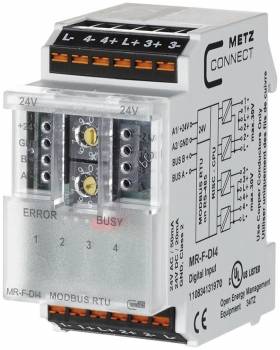
BTR 110834131970 Modbus RTU 4-digital inputs
| Lieske Part No. | 2092655 |
|---|---|
| Mfg Part No | 110834131970 |
| EAN-Code | 4251394620688 |
| Manufacturer | BTR |
| Here only | 133,11 EUR
158,40 EUR incl. VAT
|
Further information for BTR 110834131970 Modbus RTU 4-digital inputs
| General | |
| Number of digital inputs | 4 |
| Communications protocol | Modbus RTU |
| Mounting method | TH35 mounting rail |
| Mounting standard | IEC 60715 |
| Connection system | Spring-loaded terminals (Push-In) |
| Configuration | via address switch or software |
| Input type | potential-free or voltage input |
Applications
This module is intended for decentralised switching tasks in industrial and commercial installations, particularly in building technology and automation systems. It is suitable for monitoring the status of mechanical or electrical components that signal via contacts or voltages. Mounting is done on the TH35 support rail in accordance with IEC 60715 standard, ensuring standardisation in electrical distribution boards. The application is particularly useful in systems where decentralised state capture is required without additional control devices.
Functions and Equipment in Detail
The four digital inputs enable the capture of binary signals, with input signals connectable either via potential-free switches or voltage levels (e.g. 24 V DC). The Modbus address, baud rate, and parity settings are configured either via two address switches on the front of the module or through software configuration. This flexibility allows for easy integration into existing Modbus-RTU networks. Connections are made via spring-loaded terminals (Push-In), enabling quick and secure connections without tools.
Technology Explained Simply
The module operates according to the Modbus-RTU protocol, a widely used standard for serial communication in industrial control systems. Data transmission occurs via a serial interface, with communication parameters (address, baud rate, parity) configured via front switches or software. The inputs are designed to detect both mechanical contacts and electrical voltages, ensuring broad applicability. The use of spring-loaded terminals (Push-In) simplifies installation and reduces wiring errors.
Compatibility and Accessories
The module is designed for use in Modbus-RTU networks and can communicate with Modbus masters that support standard registers for digital inputs. It is designed for mounting on the TH35 support rail in accordance with IEC 60715, ensuring compatibility with standard electrical distribution boards. Connection is made via spring-loaded terminals, allowing direct connection to wires.
Mounting and Installation
Mounting is done on the TH35 support rail, which is standard in electrical distribution boards. The spring-loaded terminals (Push-In) allow for quick and tool-free wire connections. Installation requires no additional components, as the module is designed for direct use in existing systems.
Operational Advantages
The module provides a compact and reliable solution for decentralised state monitoring. The use of spring-loaded terminals (Push-In) reduces installation time and improves connection reliability. Configurability via front switches or software enables flexible adaptation to different networks. Compatibility with Modbus-RTU systems and mounting on TH35 support rail ensures easy integration into existing infrastructures. The ability to capture states via potential-free contacts or voltages expands application possibilities in various scenarios.
Protection Rating and Environmental Conditions
Mounting is in electrical distribution boards, indicating indoor installation, although no specific environmental requirements are stated. The operating voltage is not explicitly specified, although voltage inputs (e.g. 24 V DC) are supported, suggesting an operating voltage range around 24 V DC, though not explicitly confirmed.

This is an offer of:
79279 Vörstetten
https://industry-electronics.com
Tel. 07666/88499-0
Fax. 07666/88499-111
Diesen Artikel finden Sie unter:
industry-electronics.com/artikel/2092655

Lieske Elektronik e.K.
Reutener Str. 1079279 Vörstetten
https://industry-electronics.com
Tel. 07666/88499-0
Fax. 07666/88499-111
Diesen Artikel finden Sie unter:
industry-electronics.com/artikel/2092655