
Axis 01680-001 CPNT Video Encoder 4-Channel
Networks > Network Cameras > Accessories
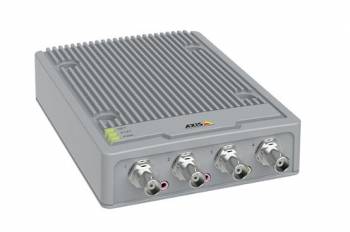
Axis 01680-001 CPNT Video Encoder 4-Channel
| Lieske Part No. | 1031390 |
|---|---|
| Mfg Part No | 01680-001 |
| EAN-Code | 7331021066403 |
| Manufacturer | Axis |
| Here only | 406,34 EUR
483,54 EUR incl. VAT
|
Further information for Axis 01680-001 CPNT Video Encoder 4-Channel
| General | |
| Frame rate | 25/30 Bilder pro Sekunde |
Applications
The AXIS P7304 is suitable for applications where analog cameras are already installed and a gradual migration to IP surveillance is planned. This includes, among others, security systems in commercial facilities, warehouses, industrial plants, or public areas where the existing camera equipment is to be retained. Support for PAL/NTSC enables use in various regions with different video standards. The integrated PoE function (Power over Ethernet) simplifies installation, as both power supply and data transmission occur over a single network cable.
Functions and Equipment in Detail
The encoder features four channels, each processing an analog video signal. Supported video formats include PAL and NTSC, ensuring broad compatibility with existing analog cameras. The frame rate is 25 or 30 frames per second, depending on the setting. The integrated video compression technology Zipstream supports the codecs H.264 and H.265, reducing the required bandwidth and storage space for recording. This is particularly advantageous for transmission over networks with limited capacity or when using memory cards in Edge Storage mode.
Technology Explained Simply
The signed firmware and secure boot functions ensure that only authorized and unmodified firmware files are executed on the device. This protects against unauthorized manipulation and enhances the security of the surveillance system. The two-way audio function enables bidirectional audio transmission, allowing voice messages to be transmitted from the camera to the encoder and vice versa. The integrated I/O ports (inputs/outputs) are configurable and can be used for various alarm or control functions. A memory card slot enables local recording of video and audio data onto a MicroSD card, enabling decentralized storage (Edge Storage).
Compatibility and Accessories
The AXIS P7304 is compatible with a wide range of analog cameras, including PTZ cameras, and supports control of these cameras via the encoder. Integration into existing networks is achieved via Ethernet, with the PoE function enabling power supply over the network cable. As accessories, various components can be used to extend the system, including PoE midspans, network switches, audio microphones, memory cards (e.g. 128 GB, 512 GB, 1 TB), cables, and connectors. These components support functional expansion, such as increasing PoE power, extending the network, or integrating audio and storage functions.
Installation and Mounting
Installation is performed via a network cable that transmits both data and power (via PoE). Mounting can be done at various locations depending on the network architecture. The use of PoE technology reduces the need for additional power supplies and simplifies installation. Configuration is done via a network connection, with settings such as video format, compression, audio, and I/O functions adjustable through a user interface or management software.
Operational Advantages
Using the AXIS P7304 enables a step-by-step modernization of existing surveillance systems without complete replacement. Bandwidth and storage requirements are reduced through Zipstream and support for H.264/H.265, lowering operating costs. Integrated security features such as signed firmware and secure boot enhance system integrity. The option for local storage on a MicroSD card provides a redundant recording option that can operate independently of the network. Support for two-way audio and configurable I/O ports extends functionality for specific application scenarios.

This is an offer of:
79279 Vörstetten
https://industry-electronics.com
Tel. 07666/88499-0
Fax. 07666/88499-111
Diesen Artikel finden Sie unter:
industry-electronics.com/artikel/1031390

Lieske Elektronik e.K.
Reutener Str. 1079279 Vörstetten
https://industry-electronics.com
Tel. 07666/88499-0
Fax. 07666/88499-111
Diesen Artikel finden Sie unter:
industry-electronics.com/artikel/1031390