
ARDUINO ABX00012 Board MKR Zero I2S SD
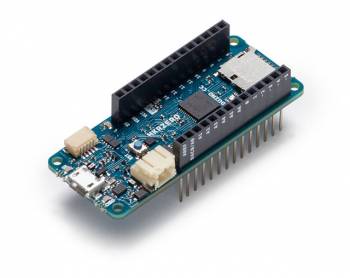
ARDUINO ABX00012 Board MKR Zero I2S SD
| Lieske Part No. | 1044757 |
|---|---|
| Mfg Part No | ABX00012 |
| EAN-Code | 7630049200470 |
| Manufacturer | ARDUINO |
| Here only | 26,30 EUR
31,30 EUR incl. VAT
|
Further information for ARDUINO ABX00012 Board MKR Zero I2S SD
| General | |
| Microcontroller | SAMD21 Cortex-M0+ 32bit low power ARM MCU |
| Operating voltage | 3,3 V |
| Current supply | 5 V |
| Digital I/O Pins | 22 |
| PWM pins | 12 |
| UART | 1 |
| SPI | 1 |
| I2C | 1 |
| Analog Input Pins | 7 |
| Analog Output Pins | 1 |
| External Interrupts | 8 |
| DC Current per I/O Pin | 7 mA |
| Flash Memory | 256 KB |
| Flash Memory for Bootloader | 8 KB |
| SRAM | 32 KB |
| Clock speed | 32.768 kHz (RTC), 48 MHz |
| LED_BUILTIN | 32 |
| USB mode | Full-Speed USB Device and embedded Host |
| Supported Battery | Li-Po single cell, 3.7V, 700mAh minimum |
| DC Current for 3.3V Pin | 600 mA |
| DC current for 5V pin | 600 mA |
| Analog input resolution | 8/10/12 bit |
| Analog output resolution | 10 bit |
| EEPROM | |
Applications
The MKR Zero is suitable for projects that process digital audio data, such as music playback, audio component control, or acoustic sensor data analysis. Due to the integrated SD interface and I2S support, it is particularly suitable for applications in the field of audio electronics and the development of 32-bit applications. It also serves as an educational tool for developing complex microcontroller systems.
Functions and Features in Detail
The board features 22 digital input/output pins, of which 12 can be configured as PWM pins. It provides a UART, an SPI, and an I2C interface. The analog inputs include 7 pins with a resolution of 8, 10, or 12 bits, as well as one analog output (DAC) with 10-bit resolution. The external interrupt function is available on 8 pins. Power supply is via USB or VIN at 5 V. The operating voltage of the circuit is 3.3 V. The maximum current draw is 600 mA at the 3.3-V and 5-V connections. Up to 7 mA is available per I/O pin.
Technology Explained Simply
The SAMD21 microcontroller is a powerful, energy-efficient 32-bit processor developed for embedded systems. It operates at a clock frequency of 48 MHz and features 256 KB of flash memory, of which 8 KB is reserved for the bootloader. The SRAM memory is 32 KB. The integrated RTC (Real-Time Clock) operates at 32.768 kHz. The board supports Full-Speed USB Device mode as well as an integrated USB Host mode, enabling connection to external USB devices. The integrated LED at pin 32 serves as a status indicator.
Compatibility and Accessories
The MKR Zero is compatible with the Arduino development environment and can be used with the provided libraries for audio functions. It supports the use of Li-Po batteries with a voltage of 3.7 V and a capacity of at least 700 mAh. The use of SD cards is possible directly via the integrated SD interface.
Mounting and Installation
Installation is done via the Arduino IDE, connecting the board to a computer via USB. Programming is performed through the integrated development environment. Power supply can be via USB or through the VIN connection. Mounting of external components is done via the digital and analog pins as well as the serial interfaces.
Advantages in Operation
The MKR Zero offers a compact form factor with high performance. The integrated functions for audio processing, including SD card reader and I2S bus, reduce the need for additional hardware. Support for 32-bit applications and the energy efficiency of the SAMD21 microcontroller make it a versatile solution for demanding projects. The integrated USB Host function expands application possibilities through direct connection to USB peripheral devices.

This is an offer of:
79279 Vörstetten
https://industry-electronics.com
Tel. 07666/88499-0
Fax. 07666/88499-111
Diesen Artikel finden Sie unter:
industry-electronics.com/artikel/1044757

Lieske Elektronik e.K.
Reutener Str. 1079279 Vörstetten
https://industry-electronics.com
Tel. 07666/88499-0
Fax. 07666/88499-111
Diesen Artikel finden Sie unter:
industry-electronics.com/artikel/1044757