
ARDUINO A000135 Board PRIMO
Maker > Cases, Cooling and Accessories
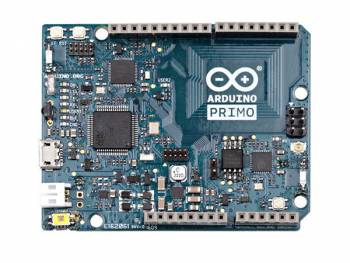
ARDUINO A000135 Board PRIMO
| Lieske Part No. | 650743 |
|---|---|
| Mfg Part No | A000135 |
| EAN-Code | 4038816097989 |
| Manufacturer | ARDUINO |
| Here only | 35,26 EUR
41,96 EUR incl. VAT
|
Further information for ARDUINO A000135 Board PRIMO
| General | |
| Microcontroller | Nordic nRF52832 |
| Architecture | ARM Cortex-M4F |
| Clock frequency | 64 MHz |
| Flash memory | 512 KB |
| SRAM | 64 KB |
| Operating voltage | 3,3 V |
| WiFi module | Espressif ESP8266 |
| WiFi standard | 802.11 b/g/n |
| Frequency band | 2,4 GHz |
| Bluetooth | Bluetooth Smart |
| Analog pins | 8 |
| Digital pins | 20 |
| PWM outputs | 10 |
| Current supply | 5 V |
| Power consumption | 87 mA |
| Battery holder | Button cells |
| Sensors | Accelerometer, gyroscope, temperature and humidity sensor, infrared receiver and transmitter |
| Connection | SWD, NFC connector, Reset button, Power switch |
| NFC | |
Applications
The Arduino Primo is designed for applications in the field of connected devices (IoT), particularly for mobile and wearable systems such as wearables. The combination of Bluetooth Smart, NFC, and WiFi enables flexible communication with other devices, smartphones, or networks. The integrated sensors allow for the collection of motion data, environmental conditions, and infrared signals, making it suitable for applications in health monitoring, smart home technology, or industrial automation. The low power consumption and support for coin cell batteries also make the board suitable for battery-powered, long-term operating devices.
Functions and Equipment in Detail
The board features 20 digital input/output pins, all of which can be used as PWM outputs. There are 8 analog pins (D0 to D7), 6 of which function as analog inputs and 1 as a DAC (Digital-to-Analog Converter). Power supply is provided via an input voltage of 5 V. The integrated power management enables the use of a coin cell battery, with a battery charging circuit integrated into the board. Communication occurs via BLE (Bluetooth Low Energy) with a maximum output power of +4 dBm and sensitivity of -96 dBm. An SWD interface allows programming of the board via an external programmer. The RGB LED serves as visual feedback, while the on-board button and reset switch are used to control the microcontroller.
Technology Explained Simply
The core of the board is the Nordic nRF52832 microcontroller, based on an ARM Cortex-M4F architecture and reaching a clock frequency of 64 MHz. It features 512 KB flash memory and 64 KB SRAM. The integrated Bluetooth interface enables wireless communication with low energy consumption, which is crucial for battery-powered devices. The ESP8266 module provides WiFi connections in the 2.4 GHz band according to the 802.11 b/g/n standard. The sensors enable the detection of motion (accelerometer, gyroscope), ambient temperature and humidity, as well as infrared signals. The integrated power management and battery holder allow for flexible operating voltage and easy integration into wearable devices.
Compatibility and Accessories
The Arduino Primo is compatible with the Arduino ecosystem and can be programmed using the Arduino IDE. The use of an external programmer via the SWD interface is required to flash the board. The integrated USB/UART connection and CMSIS-DAP module support communication with a host computer. The NFC functionality requires an external NFC antenna, which can be connected via the NFC interface. The infrared functions are suitable for communication with IR remote controls or receivers. Power supply is via 5 V, with the integrated power management also supporting coin cell batteries.
Mounting and Installation
The board is mounted using the integrated connectors and pins. Power supply is via a 5 V input, with the integrated power management enabling the use of a coin cell battery. Programming is done via an external programmer connected to the SWD interface. Communication with a host computer occurs via the integrated USB/UART connection. The sensors and connectors are directly available on the board, so no additional adapters or modules are required. The physical dimensions are 53 mm × 68.5 mm, and the weight is 34 g.
Advantages in Operation
The Arduino Primo offers high integration density with multiple sensors and communication modules on a single board. The combination of Bluetooth Smart, WiFi, and NFC enables flexible communication. The low power consumption and support for coin cell batteries make the board suitable for battery-powered applications. The integrated power management and battery holder simplify integration into wearable devices. The use of standard technologies such as ARM Cortex-M4F and ESP8266 ensures broad compatibility and support from the Arduino community.

This is an offer of:
79279 Vörstetten
https://industry-electronics.com
Tel. 07666/88499-0
Fax. 07666/88499-111
Diesen Artikel finden Sie unter:
industry-electronics.com/artikel/650743

Lieske Elektronik e.K.
Reutener Str. 1079279 Vörstetten
https://industry-electronics.com
Tel. 07666/88499-0
Fax. 07666/88499-111
Diesen Artikel finden Sie unter:
industry-electronics.com/artikel/650743