
APC NBWS100H DTEC Wireless Temperature-Humidity Sensor
Storage > Accessories > Other Accessories
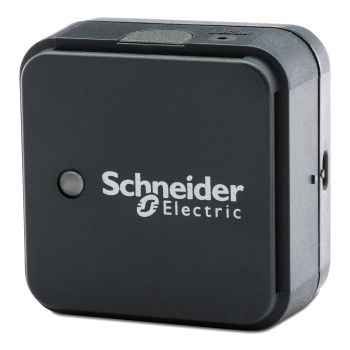
APC NBWS100H DTEC Wireless Temperature-Humidity Sensor
| Lieske Part No. | 1194068 |
|---|---|
| Mfg Part No | NBWS100H |
| EAN-Code | 0731304312703 |
| Manufacturer | APC |
| Here only | 151,99 EUR
180,87 EUR incl. VAT
|
Further information for APC NBWS100H DTEC Wireless Temperature-Humidity Sensor
| Features | |
| Purpose | Indoor |
| Type | Freestanding |
| Connectivity technology | Wireless |
| Humidity measuring range | 11 - 89% |
| Certification | REACH: Contains No SVHCs |
| Logistics data | |
| Harmonized System (HS) code | 90318080 |
| Operational conditions | |
| Storage temperature (T-T) | 0 - 45 °C |
| Sustainability | |
| Compliance certificates | RoHS |
| Weight & dimensions | |
| Width | 38 mm |
| Depth | 38 mm |
| Height | 19 mm |
| Weight | 20 g |
Applications
The sensor is specifically designed for use in IT infrastructures, where a stable environment is required for servers, network devices and other sensitive electronics. It is suitable for monitoring data centers, network enclosures, IT rooms and other enclosed spaces where temperature and humidity are critical for device functionality. The measured values can be transmitted wirelessly to a NetBotz monitoring system to trigger alarms when critical thresholds are exceeded.
Functions and Equipment in Detail
The sensor measures air humidity in the range of 11 to 89 % relative humidity (RH) with an accuracy of ±3 %. Temperature measurement is performed in the range of 15 to 50 °C (equivalent to 32 to 122 °F) with an accuracy of ±1 °C (±1.8 °F). These measurement ranges cover typical operating conditions in IT rooms. The sensor is wireless and communicates via a wireless network operated by a Wireless Coordinator or Router, which is integrated in selected NetBotz devices. Communication takes place via the ZigBee protocol, suitable for connecting sensors in a local network.
Technology Explained Simply
The sensor operates without a wired power supply and does not require a direct connection to the main unit. The wireless transmission of measurement values occurs via a local network controlled by a NetBotz Coordinator. This Coordinator ensures that data from up to 47 wireless sensors is forwarded to the central monitoring system. Data transmission occurs in real time, enabling immediate detection of deviations from predefined thresholds.
Compatibility and Accessories
The sensor is compatible with all devices from the current and older generations of NetBotz Series 200, 400, 500 and 700. It requires the use of a NetBotz Wireless Coordinator or Router, which is included in selected NetBotz appliances. The connection is made via the ZigBee protocol, optimized for wireless communication in a local network. An included 1-m USB extension cable can be used to improve signal transmission strength, especially when the Coordinator is installed in a closed enclosure.
Mounting and Installation
The sensor is designed as a freestanding device and can be placed on a flat surface or mounted on a wall, for example. Rack mounting is not intended. Installation does not require special tools, as the sensor is simply positioned and switched on. Communication with the Coordinator occurs automatically once the sensor is recognized in the network. Precise positioning should ensure that the sensor is not influenced by direct heat sources, fans or other interference sources to guarantee accurate measurements.
Operational Advantages
The sensor enables decentralized, flexible monitoring of environmental conditions without additional cabling. Wireless communication reduces installation effort and allows quick adjustment of sensor positions. Integration into existing NetBotz systems enables centralized visualization and alarm triggering, allowing operators to respond quickly to critical conditions. The small size (38 mm width, 38 mm depth, 19 mm height) and low weight (20 g) make the sensor a discreet yet effective monitoring component.
Certification and Sustainability
The sensor complies with the requirements of the RoHS directive and is REACH-compliant, as it does not contain any substances of very high concern (SVHC) above the threshold level. The operating temperature ranges from 0 to 45 °C, enabling use in typical indoor environments. The packaging is designed for single-unit sale (VPE 1), with packaging dimensions of 23.5 cm width, 16.5 cm length and 5.1 cm height. The warranty period is 24 months.
Note: Batteries are not included in the delivery scope.

This is an offer of:
79279 Vörstetten
https://industry-electronics.com
Tel. 07666/88499-0
Fax. 07666/88499-111
Diesen Artikel finden Sie unter:
industry-electronics.com/artikel/1194068

Lieske Elektronik e.K.
Reutener Str. 1079279 Vörstetten
https://industry-electronics.com
Tel. 07666/88499-0
Fax. 07666/88499-111
Diesen Artikel finden Sie unter:
industry-electronics.com/artikel/1194068