
APC KVM-USBVMCAC CPNT KVM USB server module with virtual media and CAC reader
Accessories > Cable / Adapter > KVM Kits
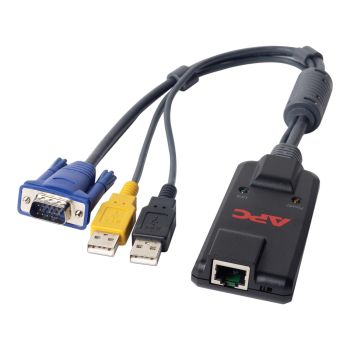
APC KVM-USBVMCAC CPNT KVM USB server module with virtual media and CAC reader
| Lieske Part No. | 857605 |
|---|---|
| Mfg Part No | KVM-USBVMCAC |
| EAN-Code | 0731304286707 |
| Manufacturer | APC |
| Here only | 180,49 EUR
214,78 EUR incl. VAT
|
Further information for APC KVM-USBVMCAC CPNT KVM USB server module with virtual media and CAC reader
| Certificates | |
| Compliance certificates | RoHS, WEEE |
| Waste Electrical and Electronic Equipment (WEEE) compliance | |
| Logistics data | |
| Country of origin | Taiwan |
| Harmonized System (HS) code | 84733080 |
| Customs product code (TARIC) | 8517620000 |
| Total carbon footprint (kg of CO2e) | 0.6317051722759613 |
| Other features | |
| Connector(s) | USB2.0 A, VGA, RJ45 |
| Depth | 125 mm |
| Height | 14 mm |
| Width | 125 mm |
| Dimensions (WxDxH) | 125 x 125 x 14 mm |
| Compatible operating systems | Windows, Sun, Unix, Linux |
| Packaging data | |
| Weight | 140 g |
| Performance | |
| Product colour | Black |
| Connector 1 | 2x USB2.0 A, VGA |
| Connector 2 | RJ45 |
| Connector gender | Male/Female |
| Technical details | |
| Preferred mounting position | no preference |
| Sustainable packaging | |
| Proposition 65 | |
| Take-back system | |
| Packaging without single use plastic | |
Applications
This module is intended for use in data centres, server rooms, and IT infrastructures where multiple servers need to be managed from a single control station. It allows remote control of servers even when they are physically inaccessible, such as in enclosed racks or remote locations. The support for Virtual Media enables the transmission of virtual drives, such as ISO files or USB images, over the network, which is useful for operating system installation, maintenance, or troubleshooting. The integrated CAC function (Common Access Card) allows authentication via smart cards, which is particularly relevant in security-critical environments such as military or government facilities.
Functions and Features in Detail
The module includes two USB 2.0 A ports, one VGA port, and one RJ45 port. The USB ports connect the keyboard and mouse, while the VGA port transmits the video signal to the monitor. The RJ45 port enables network connectivity, integrating the module into the KVM system. The connection is made via plug/socket, ensuring a secure and stable link. Dimensions are 125 mm width, 125 mm depth, and 14 mm height, making the module compact and space-saving. Weight is 140 g.
Technology Explained Simply
The module’s technology is based on transmitting input and video signals over a network. USB and VGA signals are digitized and transmitted via the RJ45 connector, eliminating the need for physical proximity between the control station and the server. The Virtual Media function simulates the presence of a physical drive at the server by transmitting data over the network. CAC support enables authentication via smart cards, enhancing access security. The firmware version of the module is v1.2.115, ensuring compatibility with current KVM systems in the APC product line.
Compatibility and Accessories
The module is compatible with various operating systems, including Windows, Sun, Unix, and Linux. It is part of the APC KVM 2G series and can be used in combination with other modules from this series, such as KVM2132P or KVM2116P. Integration is achieved via the network, with firmware updates available on the official APC website. Use requires a corresponding KVM system that supports Virtual Media and CAC functions.
Mounting and Installation
The module is not rack-mountable and is connected directly to server or KVM system components. Mounting is done via the provided connectors (USB, VGA, RJ45). There is no specific mounting preference, allowing flexible use in various environments. Installation involves physically connecting the connectors and configuring the module over the network.
Operational Advantages
Using this module enables central management of multiple servers, increasing IT management efficiency. Remote control over the network reduces the need for physical access, which is particularly beneficial in large data centres. The Virtual Media function simplifies software installation and maintenance, while CAC support enhances access security. Compliance with RoHS and WEEE demonstrates the product’s environmental compatibility. Operating temperature ranges from 0 to 50 °C, with relative humidity from 5 to 95 %, enabling broad application in various environments. The product is manufactured in Taiwan and complies with standards FCC Part 15 Class A, ICES-003, UL 60950-1, and VCCI Class A. Warranty is 24 months.

This is an offer of:
79279 Vörstetten
https://industry-electronics.com
Tel. 07666/88499-0
Fax. 07666/88499-111
Diesen Artikel finden Sie unter:
industry-electronics.com/artikel/857605

Lieske Elektronik e.K.
Reutener Str. 1079279 Vörstetten
https://industry-electronics.com
Tel. 07666/88499-0
Fax. 07666/88499-111
Diesen Artikel finden Sie unter:
industry-electronics.com/artikel/857605