
AMD 100-100001904WOF CPU Ryzen 5 7500X3D
Computer-Components > Processors > Socket AM5
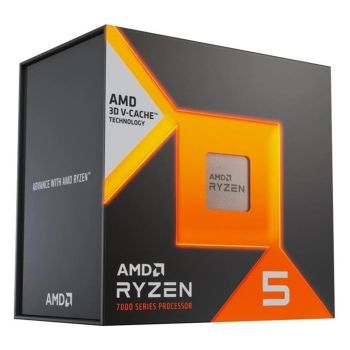
AMD 100-100001904WOF CPU Ryzen 5 7500X3D
| Lieske Part No. | 1653755 |
|---|---|
| Mfg Part No | 100-100001904WOF |
| EAN-Code | 0730143318167 |
| Manufacturer | AMD |
| Here only | 251,76 EUR
299,59 EUR incl. VAT
|
Further information for AMD 100-100001904WOF CPU Ryzen 5 7500X3D
| General | |
| Processor family | AMD Ryzen 5 |
| Socket | AM5 |
| Cores | 6 |
| Threads | 12 |
| Base frequency | 4.0 GHz |
| Turbo frequency | 4.5 GHz |
| L3 cache | 102 MB |
| L1 cache | 0.384 MB |
| L2 cache | 6144 KB |
| Lithography | 5 nm |
| TDP | 65 W |
| Memory type | DDR5-SDRAM |
| Max. memory | 128 GB |
| Memory channels | Dual-channel |
| Max. storage clock frequency | 5200 MHz |
| PCIe version | 5.0 |
| PCIe lanes | 28 |
| Integrated graphics | AMD Radeon |
| Market segment | Desktop |
Applications
This processor is intended for use in desktop computers, particularly in systems requiring balanced performance with moderate power consumption. It is suitable for office applications, multimedia processing, and light to moderate gaming scenarios, especially when the integrated graphics are sufficient. Support for DDR5-SDRAM with a maximum clock frequency of 5200 MHz enables fast data transfer rates, which is beneficial for modern applications and operating systems.
Functions and Features in Detail
The processor features a 102 MB L3 cache, which supports fast data processing, especially for applications accessing frequently used data. The L1 cache size is 0.384 MB, while the L2 cache comprises 6144 KB. This cache structure supports efficient data retrieval and reduces access times. The maximum internal memory capacity supported by the processor is 128 GB, with the memory type being DDR5-SDRAM. Support for two memory channels enables higher bandwidth and improves system performance.
Technology Explained Simply
5-nm lithography is an advanced manufacturing technology that allows for higher transistor density, resulting in better energy efficiency and lower heat generation. The TDP (Thermal Design Power) is 65 W, meaning the processor generates a maximum heat output of 65 watts under normal operating conditions. This is an important value for cooling and selecting appropriate fans or coolers. The integrated graphics unit from the AMD Radeon family enables display output without an additional graphics card, which is advantageous for entry-level or cost-efficient systems.
Compatibility and Accessories
The processor is compatible with motherboards featuring the AM5 socket. It supports PCIe 5.0 with 28 lanes, enabling high bandwidth for storage devices and expansion cards. The use of DDR5-SDRAM with a maximum clock frequency of 5200 MHz requires motherboards that support this specification.
Mounting and Installation
Installation is performed on motherboards with the AM5 socket. The installation requires correct alignment of the processor in the socket and secure locking. The installation is carried out in a desktop computer, with power supplied via the motherboard.
Advantages in Operation
The processor offers balanced performance with a high number of threads, which is beneficial for multitasking and parallel processes. The integrated graphics reduces the need for a separate graphics card, lowering system costs. Support for DDR5-SDRAM and PCIe 5.0 enables high system performance, especially with modern applications. The TDP of 65 W ensures moderate heat generation, simplifying cooling and increasing operational reliability.

This is an offer of:
79279 Vörstetten
https://industry-electronics.com
Tel. 07666/88499-0
Fax. 07666/88499-111
Diesen Artikel finden Sie unter:
industry-electronics.com/artikel/1653755

Lieske Elektronik e.K.
Reutener Str. 1079279 Vörstetten
https://industry-electronics.com
Tel. 07666/88499-0
Fax. 07666/88499-111
Diesen Artikel finden Sie unter:
industry-electronics.com/artikel/1653755