
AMD 100-100001405WOF CPU Ryzen 5 9600X AM5
Computer-Components > Processors > Socket AM5
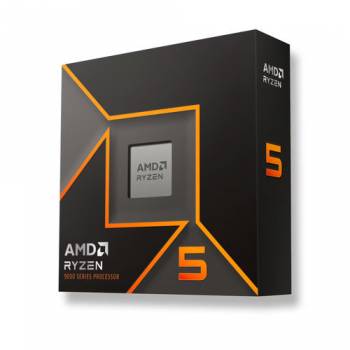
AMD 100-100001405WOF CPU Ryzen 5 9600X AM5
| Lieske Part No. | 1215621 |
|---|---|
| Mfg Part No | 100-100001405WOF |
| EAN-Code | 0730143315609 |
| Manufacturer | AMD |
| Here only | 154,19 EUR
183,49 EUR incl. VAT
|
Further information for AMD 100-100001405WOF CPU Ryzen 5 9600X AM5
| General | |
| Processor family | AMD Ryzen 5 |
| Socket | AM5 |
| Number of cores | 6 |
| Number of threads | 12 |
| Base frequency | 3,9 GHz |
| Turbo frequency | 5,4 GHz |
| L3 cache | 38 MB |
| TDP | 65 W |
| Memory type | DDR5-SDRAM |
| Maximum memory bandwidth | 5600 MHz |
| Maximum internal memory | 192 GB |
| Memory channels | Dual-channel |
| Integrated graphics | AMD Radeon |
| Graphics base frequency | 2200 MHz |
| Lithography | 4 nm |
| Supported command sets | AES, AVX, AVX 2.0, AVX-512, SSE, SSE2, SSE3, SSE4.1, SSE4.2, SSSE3 |
| USB version | 2.0/3.2 Gen 2 |
| PCIe version | 4.0 |
| PCIe lanes | 4 |
| Type of delivery | WOF |
Applications
The processor is designed for use in desktop computers, particularly in systems based on motherboards with the AM5 socket. It is suitable for office applications, multimedia processing, light to moderate graphic editing, and systems utilizing integrated graphics. Support for DDR5-SDRAM and PCIe 4.0 enables a modern system architecture. The integrated Radeon graphics allow operation without an additional graphics card, which is advantageous for entry-level or cost-efficient systems.
Features and Specifications in Detail
The processor has six physical cores and twelve logical threads, enabled by Hyper-Threading technology. The base frequency is 3.9 GHz, with the turbo frequency reaching up to 5.4 GHz depending on load and cooling conditions. The 38 MB L3 cache supports fast access to frequently used data and improves overall performance. The integrated graphics are based on AMD Radeon technology and operate at a base frequency of 2200 MHz, sufficient for basic graphics applications and screen output. Support for DDR5-SDRAM with up to 5600 MHz clock rate and up to 192 GB of memory across two channels ensures high bandwidth and capacity. Support for instruction sets such as AVX-512 and AES expands usability in areas like cryptography and scientific computing.
Technical Explanation
The 4 nm lithography refers to the chip manufacturing technology, enabling higher transistor density and thus more efficient performance. The TDP of 65 W describes the maximum thermal power consumption under full load. This value is crucial for selecting an appropriate heatsink, as the processor is delivered without an integrated cooler. The integrated graphics (Radeon) allow screen output without an additional graphics card, which is beneficial for budget-limited or entry-level systems. Support for DDR5-SDRAM with high clock rates ensures fast data transfer between CPU and RAM. PCIe support at level 4.0 x4 enables connection to fast storage or network devices.
Compatibility and Accessories
The processor is compatible with motherboards featuring the AM5 socket. Use requires a motherboard supporting this socket, as well as a suitable heatsink, since the processor is delivered without cooling. Support for DDR5-SDRAM up to 5600 MHz requires corresponding memory modules. The integrated graphics allow operation without an additional graphics card, although performance is limited. USB support includes versions 2.0 and 3.2 Gen 2, enabling connection to modern peripheral devices. PCIe support at level 4.0 x4 is sufficient for connecting to fast storage or network devices.
Installation and Mounting
Installation involves inserting the processor into the AM5 socket on the motherboard. Correct alignment (usually indicated by a notch or marking) must be ensured. After insertion, the socket is locked. Heatsink mounting follows the manufacturer’s instructions for the specific cooler. Power supply is via the motherboard, with the TDP of 65 W to be considered. Connection to memory modules is done through the motherboard’s DIMM slots, with DDR5-SDRAM support and up to 5600 MHz to be taken into account.
Operational Advantages
The processor offers balanced performance for desktop use with six cores and twelve threads. The high turbo frequency of 5.4 GHz enables fast processing during short load peaks. The integrated Radeon graphics allow operation without an additional graphics card, reducing system costs. Support for DDR5-SDRAM with high clock rates ensures fast data transfer. Support for modern instruction sets expands usability across various application areas.

This is an offer of:
79279 Vörstetten
https://industry-electronics.com
Tel. 07666/88499-0
Fax. 07666/88499-111
Diesen Artikel finden Sie unter:
industry-electronics.com/artikel/1215621

Lieske Elektronik e.K.
Reutener Str. 1079279 Vörstetten
https://industry-electronics.com
Tel. 07666/88499-0
Fax. 07666/88499-111
Diesen Artikel finden Sie unter:
industry-electronics.com/artikel/1215621